

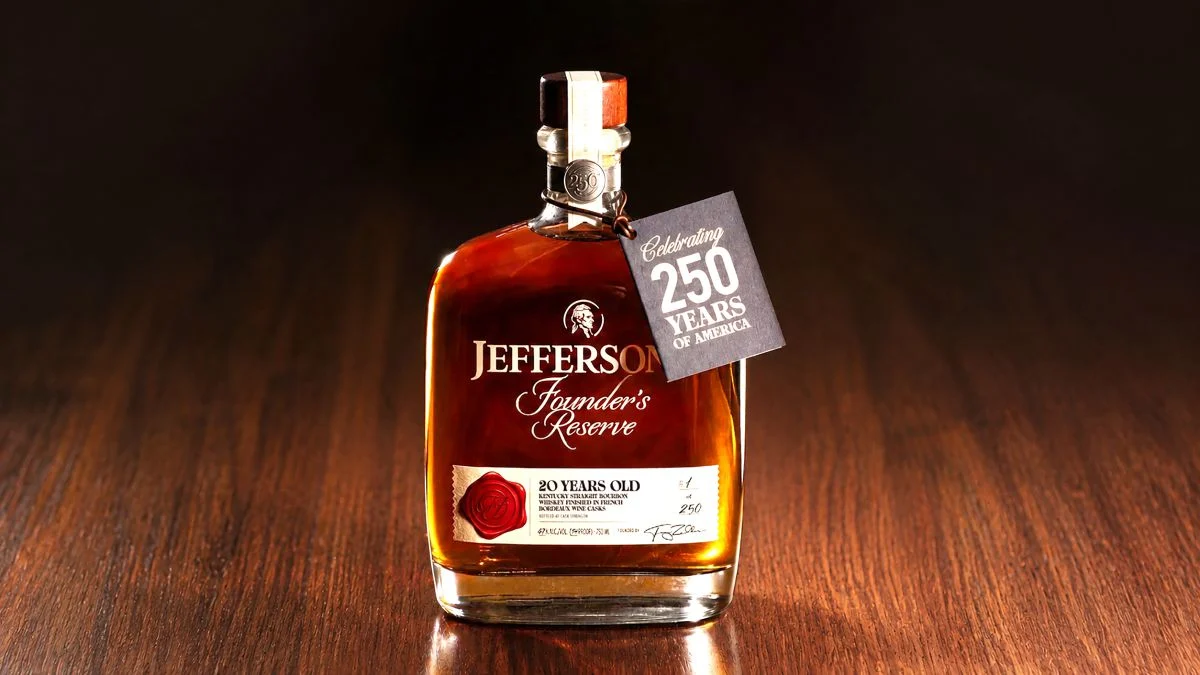
Welcome to Taste Test, where every week our critic Jonah Flicker explores the most buzzworthy and interesting whiskeys in the world. Check back each Sunday for his latest whiskey review.
In the world of spirits, age statements are a double-edged sword. For a single malt Scotch, twenty years is a milestone of maturity, often signaling a whisky entering its prime. In the realm of American bourbon, however, twenty years is a lifetime. Once a barrel passes the 15-year mark, the risk of the liquid becoming overwhelmed by the barrel—succumbing to a profile best described as “sucking on wet wood”—increases exponentially. It takes a master’s touch to shepherd a spirit through two decades of Kentucky weather without losing its soul to the tannins.
While legends like Michter’s 20-Year and the elusive Pappy Van Winkle line have set the gold standard for long-aged bourbon, a new challenger has emerged. Jefferson’s Bourbon, a brand synonymous with unconventional maturation techniques, has just unveiled its Founder’s Reserve. This 20-year-old expression is a rarity in the market, made even more intriguing by a deliberate, final maturation in French Bordeaux wine casks.
Main Facts: A Rare Vintage
The Jefferson’s Founder’s Reserve is a Kentucky straight bourbon, though the exact provenance of the liquid remains a well-guarded secret. What we do know is that it has undergone an extensive aging process, followed by a finishing period in French Bordeaux wine casks. Bottled at 94 proof, this release is incredibly limited, with a production run of only 250 individually numbered and signed bottles. Priced at $500 per unit, it is positioned firmly in the ultra-premium category.
Despite the low proof—a byproduct of the specific humidity levels in the rickhouses where the barrels were stored—the whiskey presents a robust, complex profile. It avoids the trap of being an “oak bomb,” instead delivering a symphony of flavors ranging from dark chocolate and cherry syrup to subtle hints of leather and barrel-aged maple.
A Chronology of Innovation: The Jefferson’s Legacy
To understand the significance of this release, one must look at the trajectory of Jefferson’s. Founded in 1997 by the father-son duo Trey and Chet Zoeller, the brand quickly established itself as an outlier in a traditional industry. While the elder Zoeller has since passed, Trey Zoeller has remained the brand’s guiding force, maintaining its reputation for experimentation even after the company was acquired by Pernod Ricard in 2019.
The brand’s history is a timeline of “what if” scenarios. They have never been content to simply wait for the clock to run. Their Ocean Aged at Sea series, which involves shipping barrels on container vessels to traverse the globe, challenged the notion that whiskey needs to sit still to mature. Similarly, their Tropics Aged in Humidity series explored the aggressive maturation environment of Singapore, where heat and moisture forced the whiskey into the wood at an accelerated rate.
The Founder’s Reserve is not the first time Jefferson’s has experimented with age; they have previously released expressions aged for 21, 25, and even 30 years. However, this new 20-year-old release feels like a synthesis of their history: the patience of a multi-decade aging program paired with the adventurous finishing techniques that defined their rise to prominence.
Supporting Data: The Science of the Finish
The decision to finish a 20-year-old bourbon in a wine cask is, by any standard, a high-stakes gamble. Critics and enthusiasts often view such finishes with skepticism, fearing they are used to mask the bitterness of over-oaked, dry, or otherwise “tired” spirit.
However, chemical analysis and sensory evaluation suggest a different narrative. The Bordeaux cask adds a layer of complexity—specifically notes of Concord grapes, dark fruit, and a pleasant, light tannin structure—that complements rather than competes with the long-aged bourbon. The 94-proof bottling strength is particularly effective here; at a higher proof, the wine finish might have felt discordant or "hot," but at 94, it integrates seamlessly into the profile, acting as a bridge between the deep, leathery notes of the aged corn-based spirit and the fruity, acidic character of the French wine.

Official Responses and Philosophy
When asked about the necessity of finishing a 20-year-old whiskey, Trey Zoeller offered a perspective rooted in the brand’s original mission. “We didn’t want to just bring out another age-statement bourbon; it’s not our style to be so typical,” Zoeller stated. “We wanted to showcase the liquid in a unique Jefferson’s way, one that reflects the backbone of how the brand was built, with a pioneering spirit and love of experimentation, paired with real expertise in maturation and finishing.”
This response highlights the tension between the "purist" market, which demands nothing but pure, unadulterated age, and the "innovator" market, which seeks new sensory experiences. For Jefferson’s, the goal was clearly to prove that twenty years of age does not have to be the end of the story, but rather a canvas upon which a final, artistic flourish could be added.
Implications for the Whiskey Market
The release of the Founder’s Reserve has several implications for the future of the bourbon secondary market and the industry at large.
1. The Ceiling of Age
First, it pushes the boundaries of how we define "drinkable" age. By successfully finishing a 20-year-old whiskey, Jefferson’s has provided a roadmap for other distillers to utilize long-aged stocks that might otherwise be considered "dry" or "tannic." This could lead to a wave of secondary finishes on ultra-aged barrels across the industry.
2. The Scarcity Factor
With only 250 bottles available, the Founder’s Reserve is destined to become a "unicorn" bottle almost instantly. In an era where enthusiasts are constantly chasing the next Pappy or Buffalo Trace Antique Collection, this bottle provides a high-quality alternative that carries the prestige of an ultra-aged statement. Collectors should expect the secondary market value to rise sharply, potentially far exceeding the initial $500 retail price.
3. The Shift in Consumer Taste
The success of this release suggests that the modern bourbon drinker is becoming more receptive to wine-cask finishes. Historically, American consumers were wary of anything that moved away from the traditional charred oak profile. However, as the palate of the American drinker becomes more sophisticated—partly due to the influence of global spirits like Scotch and Cognac—the acceptance of secondary maturation is clearly growing.
Conclusion: A Masterclass in Balance
Is the Jefferson’s Founder’s Reserve worth the hype? Based on my evaluation, the answer is a resounding yes. It manages to balance the gravity of twenty years in the barrel with a delicate, fruit-forward finish that elevates the spirit without burying its character.
Score: 95
While the hunt for Michter’s 20 and the Pappy Van Winkle collection will surely continue, the Founder’s Reserve deserves a place in that conversation. It is a bold, experimental, and thoroughly delicious entry into the pantheon of ultra-aged bourbons. For those lucky enough to secure a bottle, it serves as a reminder that the best whiskey is not just about how long it spends in the barrel, but what the blender decides to do with it when the time finally comes.
 Ali Ikhwan
 Laily UPN
 Raul Delapena Setiawan
