

Introduction: The Persistence of the Imaginative
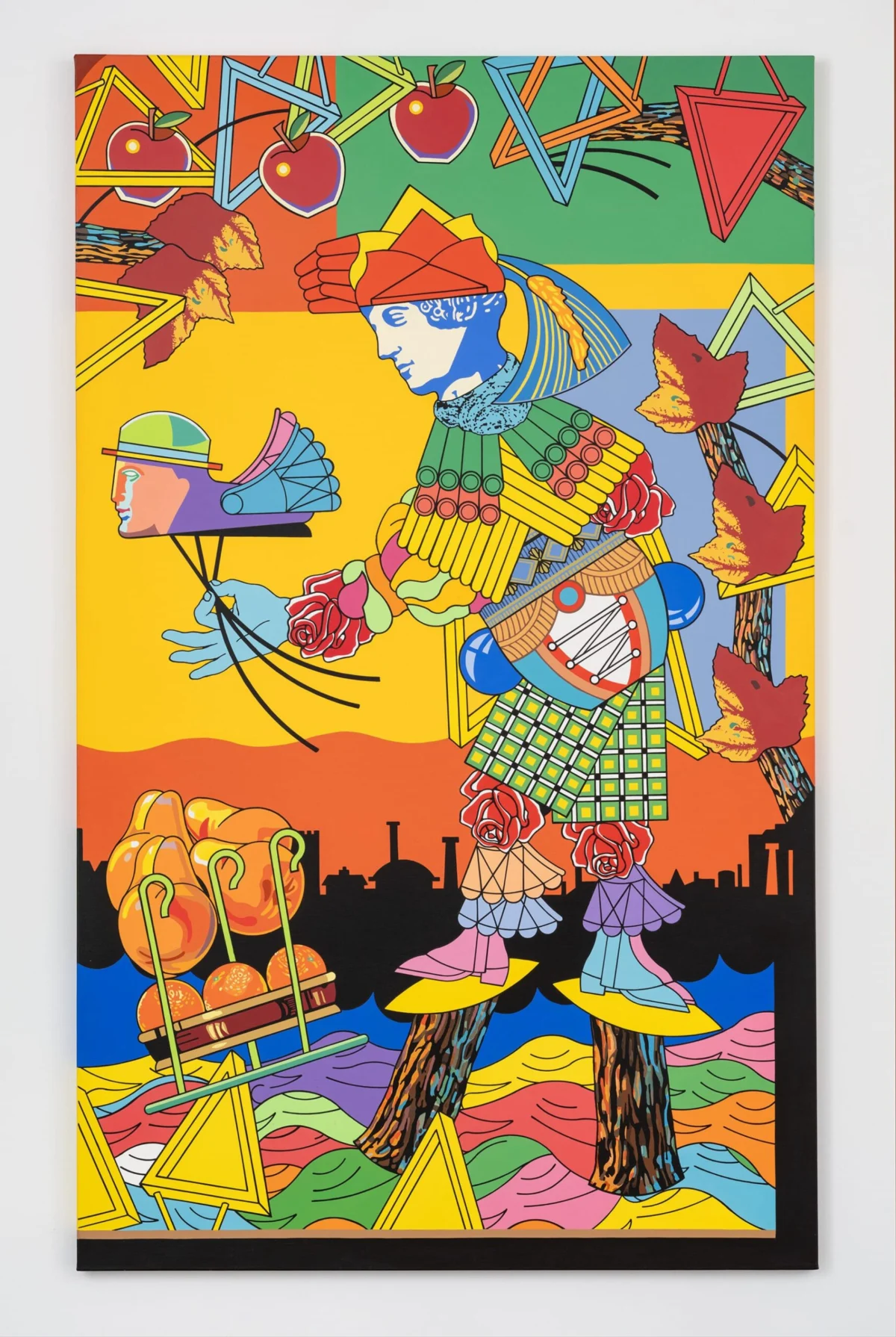
In a contemporary art climate increasingly dominated by the demand for literalism, didactic sociopolitical commentary, and the transparency of "meaning," the work of British-born, New York-based artist Trevor Winkfield stands as a defiant, colorful, and utterly necessary anomaly. His recent exhibition, The Mermaid’s Revenge: Paintings 1991–2001 at the Tibor de Nagy Gallery, offers a rare, concentrated glimpse into a decade of output that rejects the comfort of certainty.
Winkfield’s practice is not merely an exercise in aesthetic construction; it is a profound philosophical statement on the role of the imagination. By creating worlds that are simultaneously vibrant, sinister, and stubbornly inscrutable, he challenges the viewer to abandon the hunt for a singular "key" to his work. To engage with a Winkfield painting is to accept an invitation into a logic-defying, meticulously crafted dreamscape where the pursuit of art is an end in itself, rather than a vessel for pre-packaged answers.
Chronology: A Trajectory of Polymathic Exploration
To understand the depth of Winkfield’s work, one must trace his unconventional trajectory from Northern England to the heart of the New York avant-garde.
- 1967: Having completed his foundational art education in Leeds, Winkfield earns his master’s degree from the Royal College of Art.
- 1969: He relocates to New York City, quickly embedding himself within the orbit of the New York School of writers and artists.
- 1968–1972: During this period, he manages the publication of the literary magazine Juillard, signaling his lifelong devotion to the intersection of text and image.
- 1970s (The Formative Years): Working for Arthur Cohen—a specialist in Dada and Surrealist ephemera—Winkfield hones his skills as a writer and researcher, contributing to encyclopedic catalogs that reflect his unmatched knowledge of minor modernists like Gerald Murphy and Ronald Firbank.
- 1976: Winkfield makes a pivotal return to painting, while simultaneously engaging in collaborations with prominent poets such as John Ashbery, Charles North, and Ron Padgett.
- 1977: His New York debut exhibition is held, coinciding with his translation of Raymond Roussel’s How I Wrote Certain of My Books.
- 1991–2001: This decade, the focus of the current Tibor de Nagy exhibition, marks a period where the artist secured studio space to experiment with larger-scale surfaces, culminating in the complex acrylic-on-linen works currently on display.
The Synthesis of the Literary and the Visual
Critics have long attempted to map the influence of Raymond Roussel—the 20th century’s most notorious eccentric—onto the work of Winkfield. Roussel’s writing relied on linguistic constraints, such as homophonic puns, to drive his narratives. While the structural rigor of Roussel’s prose finds a spiritual parallel in the grid-like, collaged precision of Winkfield’s paintings, to suggest a direct causal link is to miss the point of the work.

Winkfield is, in every sense, a dual-citizen of the page and the canvas. His intellectual output, including his incisive essays on Georges Braque, Jasper Johns, and Florine Stettheimer—collected in Georges Braque and Others—proves that he treats art history not as a set of rules, but as a vocabulary to be subverted. His paintings are not "illustrated poetry," nor are they "visual prose." They are autonomous artifacts that possess a complete duality: they are deeply literary in their references yet entirely visual in their execution.
Technical Analysis: The Architecture of the "Artificial World"
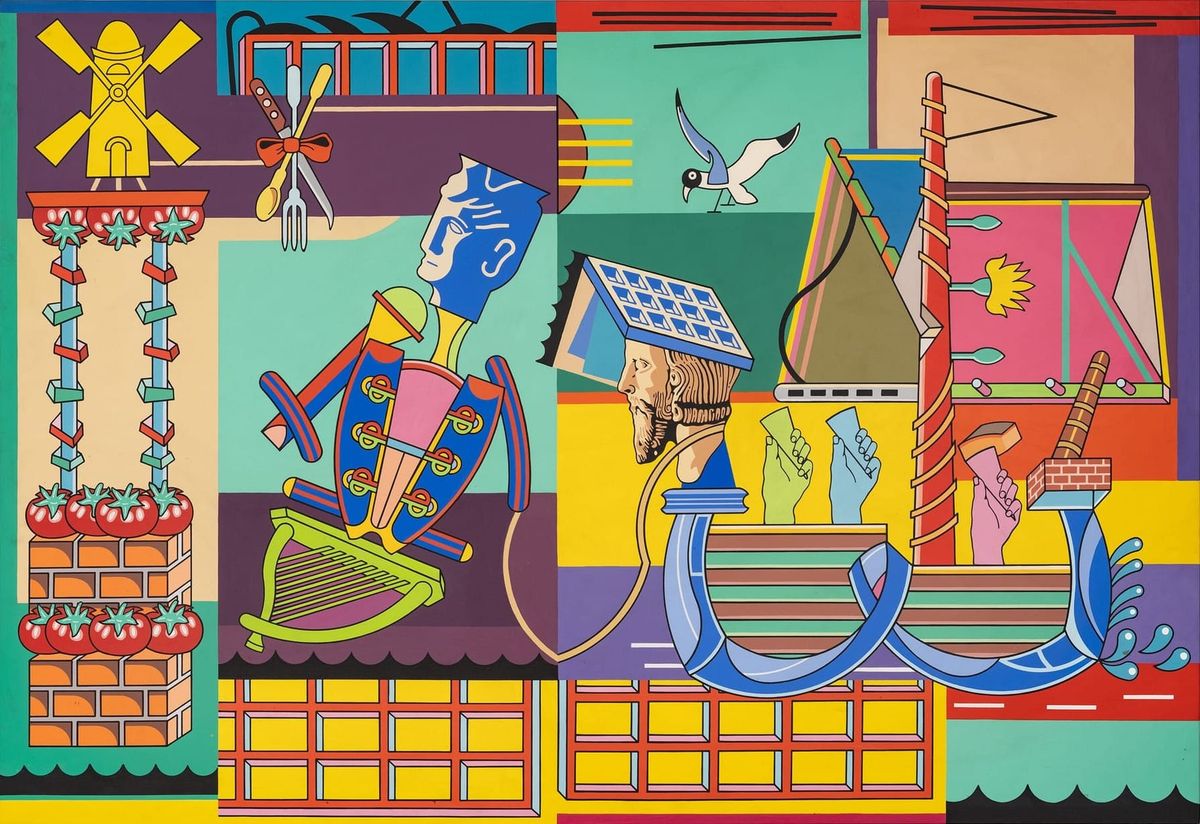
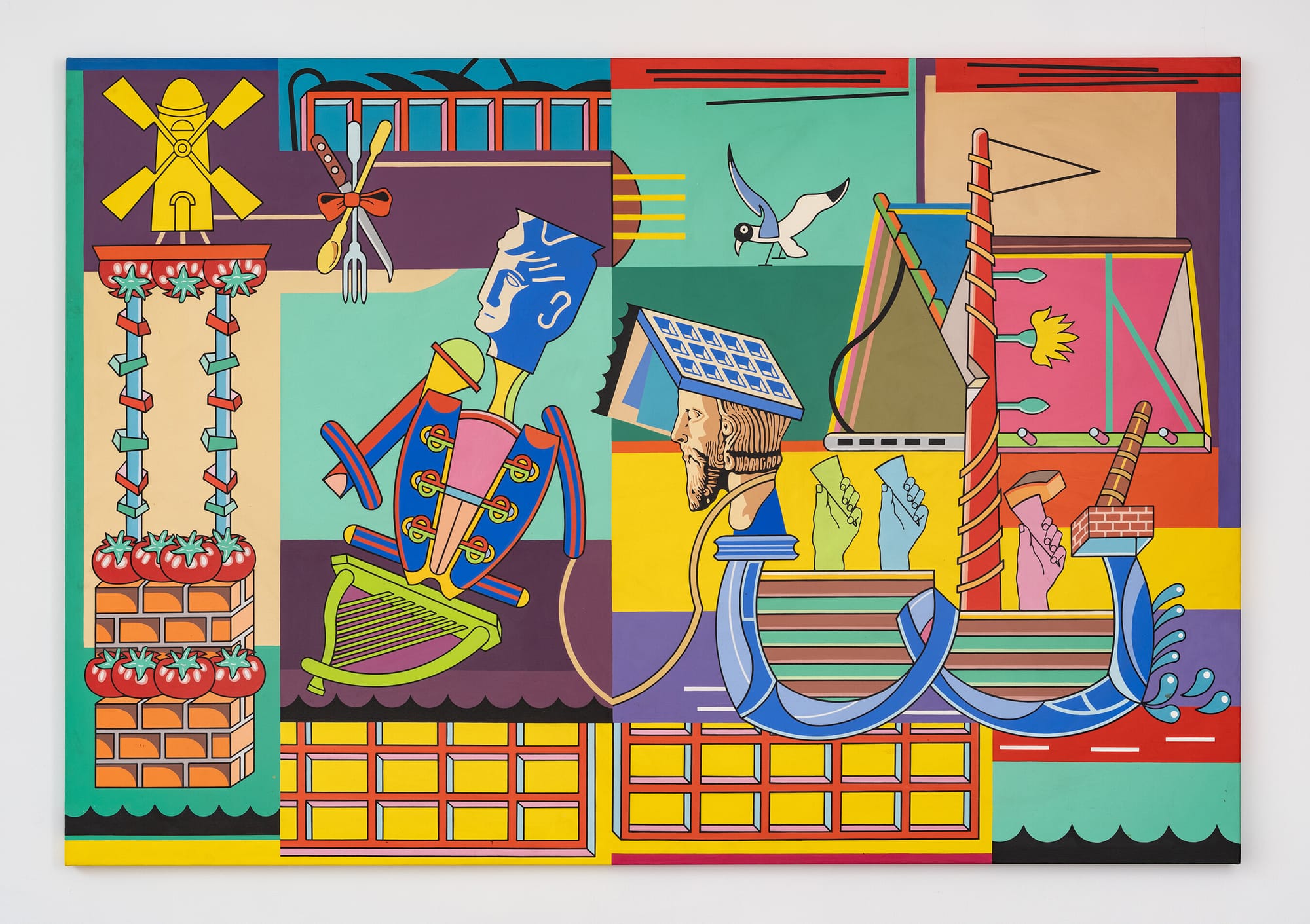
The works featured in The Mermaid’s Revenge serve as an essential case study for Winkfield’s methodology. Measuring between 35.5 x 19.5 inches and 45 x 72 inches, these paintings represent a shift toward a more expansive, immersive scale.
The Playroom Aesthetic
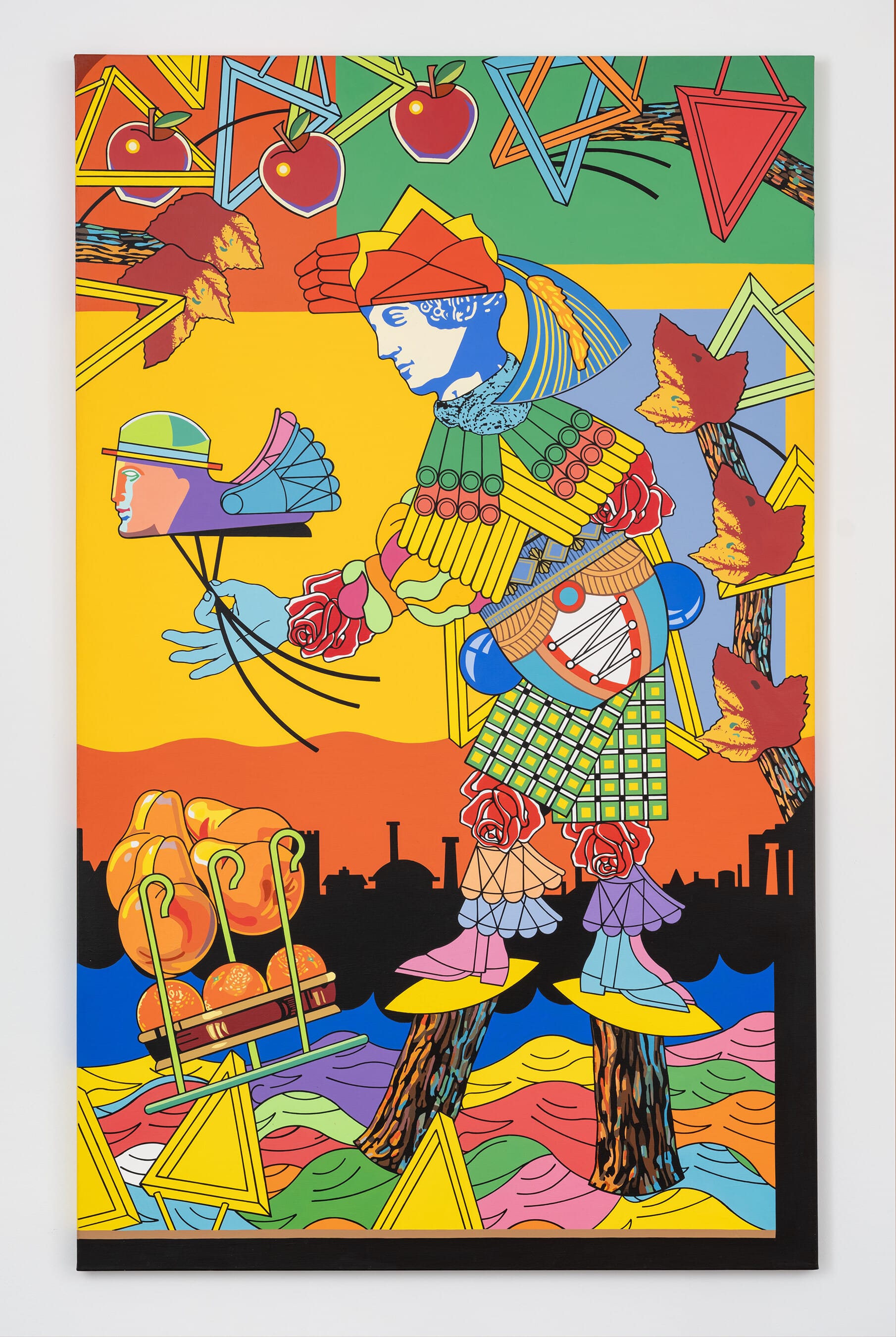
Winkfield employs a palette of flat, saturated colors reminiscent of a child’s playroom or early 20th-century commercial illustration. However, this brightness is a calculated deception. Within these flat planes, he strategically inserts volumetric, highly rendered details that force the viewer’s eye to oscillate between two-dimensional graphic design and three-dimensional depth.
The Solitary Surrogate
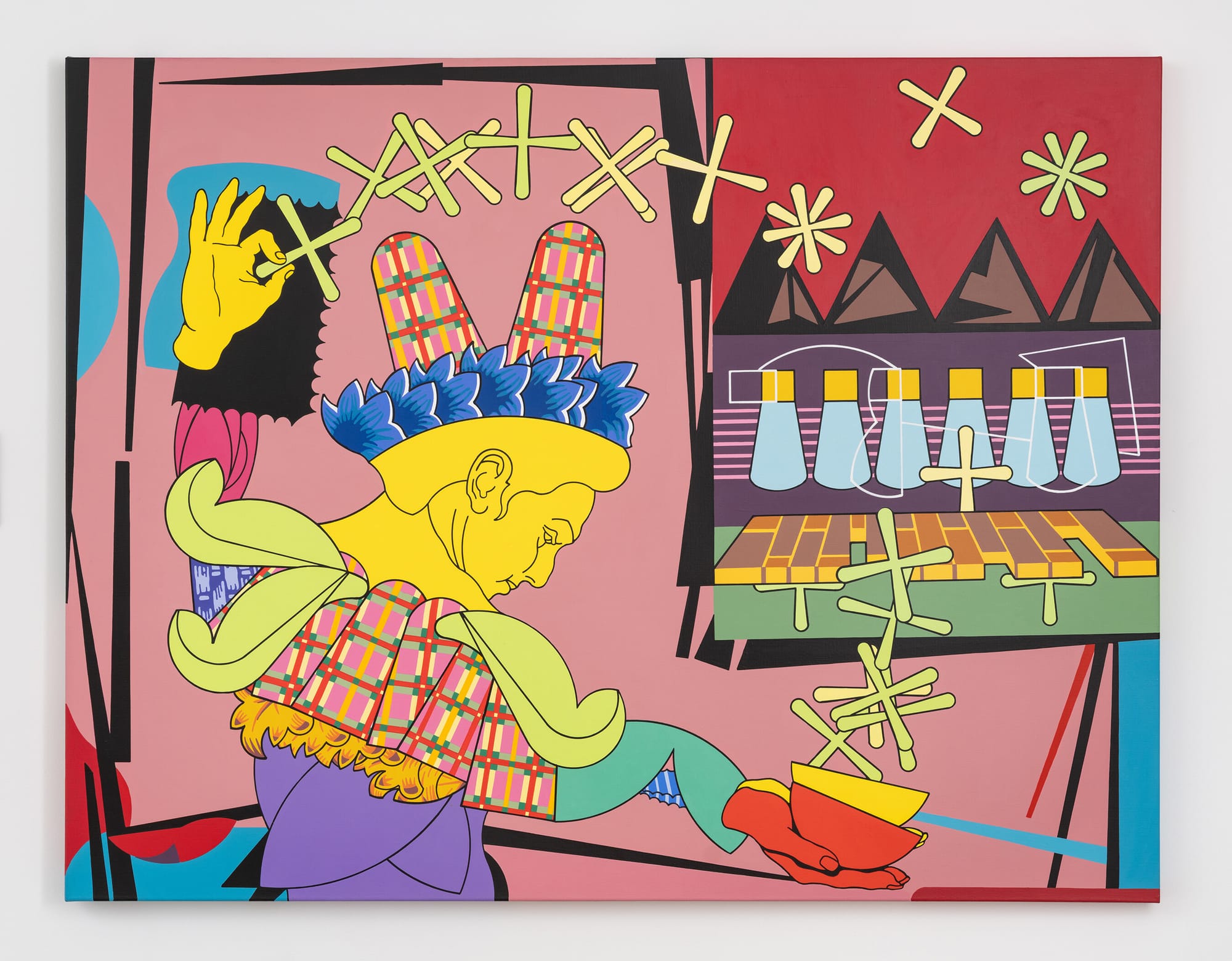
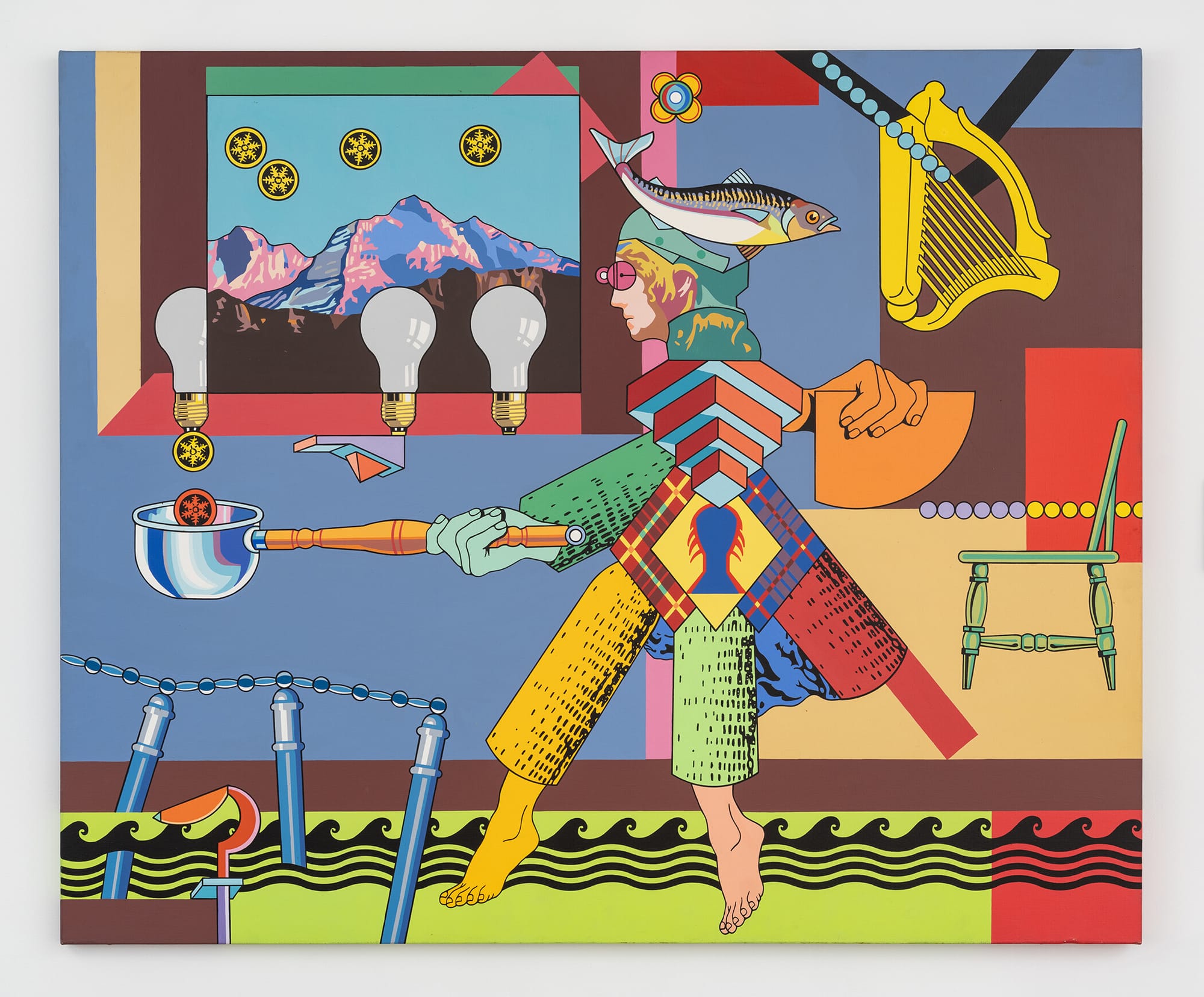
The recurring motifs of these paintings—the "Navigator," the "Student," the "Astrologer"—act as surrogates for the artist himself. These figures are almost always engaged in cryptic, solitary tasks. In "The Student" (1999), the protagonist is depicted wearing a bizarre helmet containing a fish and an optical apparatus, catching snowflake-patterned tokens released by an overhead lightbulb. This imagery is quintessential Winkfield: a meticulous construction of impossible physics. The fragmentation of the figures—with hands and feet painted in disparate colors—suggests the mechanics of a shadow puppet, reinforcing the sense that we are witnessing a play whose script remains forever hidden.
Implications: The Urgent Need for Ambiguity
In the current cultural climate, the "hermetic" nature of Winkfield’s work is often viewed with suspicion. Why, many ask, does the artist refuse to provide a clear narrative? Why is the symbolism so deliberately obfuscated?
The answer lies in the "rejection of certainty." Winkfield’s practice acts as a necessary counter-balance to the art world’s increasing reliance on moralizing or literalist themes. By refusing to conform to the pressures of transparency, he asserts that the imagination is a muscle that requires constant exercise.
Freedom Through Incomprehensibility
When we look at "The Astrologer" (1991) or "The Navigator" (2000), we are not intended to "solve" them. To solve them would be to exhaust them. By leaving the meaning open, Winkfield grants the viewer a specific kind of freedom: the freedom to exist in a space where logic is secondary to visual delight and intellectual wonder. His work suggests that if an artwork can be fully explained, it has reached its limit—but if it remains "cheerfully incomprehensible," it remains alive.
Conclusion: A Legacy of Unlikely Depth
Trevor Winkfield’s career serves as a testament to the power of the singular path. He has avoided the trends that have swept through the galleries of Manhattan over the last fifty years, choosing instead to deepen his own private mythology.
As we view The Mermaid’s Revenge, we are reminded that art is not solely a social instrument or a tool for political advocacy. At its core, art is a way of constructing an alternate reality—a space where we can retreat from the noise of the mundane and engage with the infinite possibilities of the human mind. In an age of instant, digestible content, Winkfield’s slow, deliberate, and beautifully inexplicable paintings are a profound, urgent, and lasting gift.
Trevor Winkfield: The Mermaid’s Revenge – Paintings 1991 – 2001 remains on view at the Tibor de Nagy gallery in Manhattan’s Lower East Side through July 31. It stands as one of the most intellectually rigorous and aesthetically refreshing exhibitions of the season.
 Asro
Asro
 Jia Lissa
 Nana Wu
