

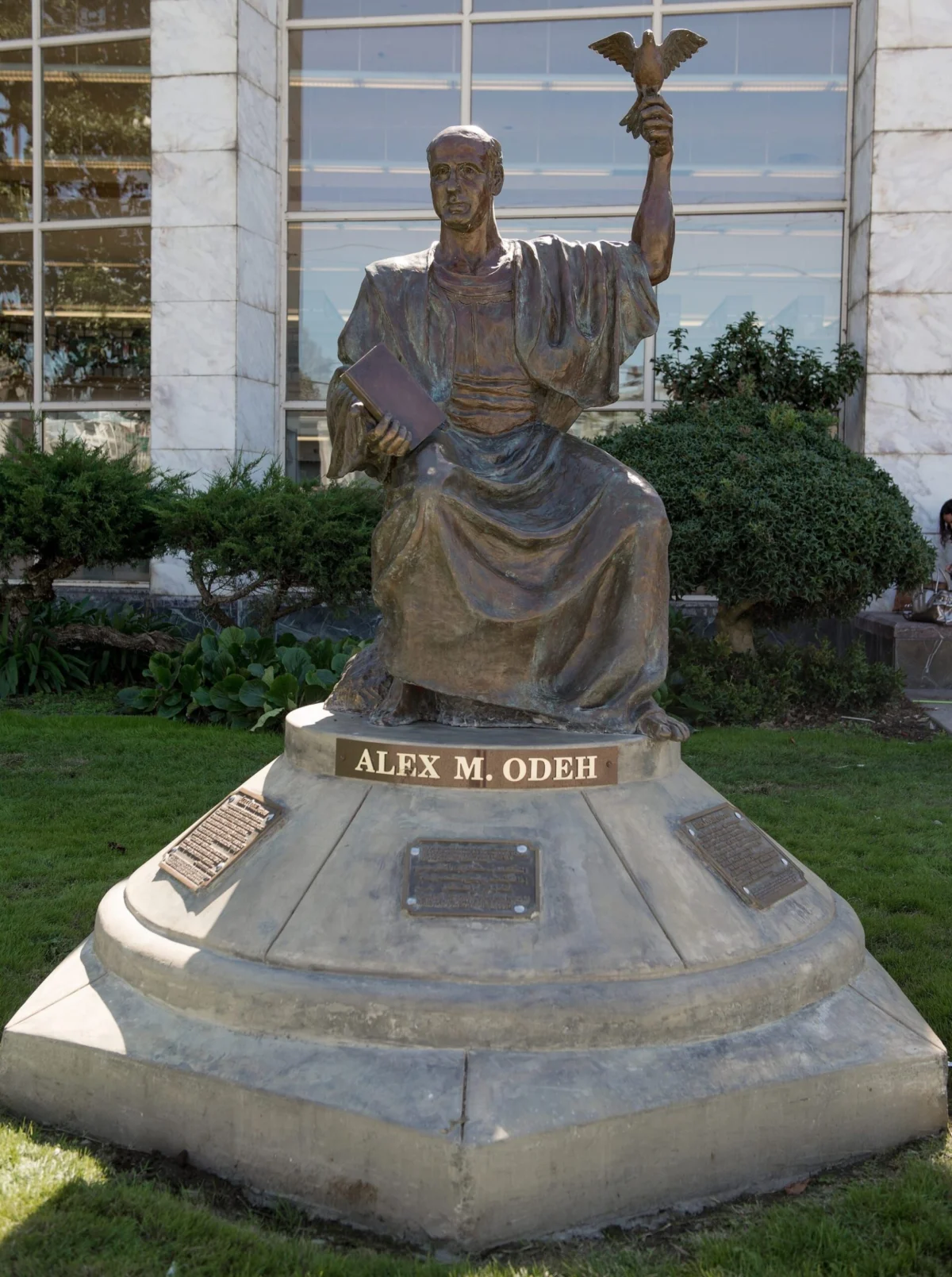
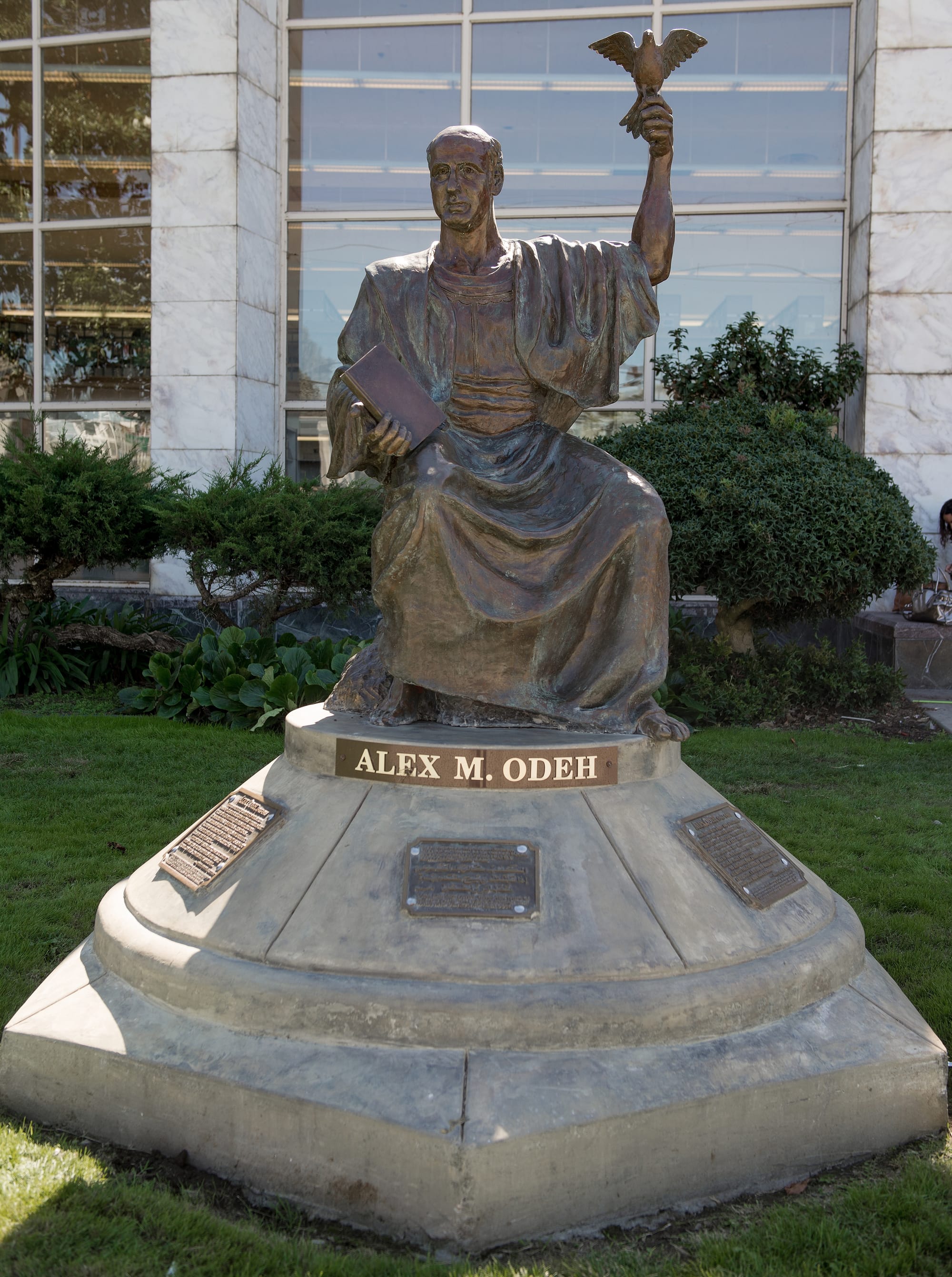
In the quiet plaza outside the Santa Ana Public Library stands a bronze figure that has, for over three decades, served as a lightning rod for both reverence and hate. The statue, created by Algerian-American artist Khalil Bendib in 1994, depicts Alex Odeh—a Palestinian-American poet, scholar, and civil rights activist—holding a book in one hand and a dove in the other. It is a rare monument dedicated to an Arab-American life in the United States, yet its existence has been marred by a recurring cycle of vandalism and erasure.
Today, that statue is undergoing a radical transformation. Through a new participatory art project titled The Stolen Dove, artist Jon Rubin has effectively “liberated” the bronze bird from its stationary perch, turning a static, often ignored memorial into a decentralized, living network of storytelling and social justice. By circulating the dove through homes, galleries, and community gatherings, the project seeks to move Odeh’s legacy from the cold bronze of a public square into the warm, active hands of those committed to his vision of peace.
The Life and Assassination of Alex Odeh
To understand the weight of this project, one must understand the man it commemorates. Born in 1944 in the village of Jifna, Palestine, Alex Odeh’s life was defined by the displacement of the Nakba and the subsequent realities of occupation. Seeking to bridge cultures and advocate for justice, he immigrated to the United States in 1972, eventually earning a Master’s degree in political science from California State University, Fullerton.
Odeh’s life in the U.S. was characterized by a tireless commitment to interfaith dialogue and civil rights. As the West Coast regional director of the American-Arab Anti-Discrimination Committee (ADC), he became a prominent voice against racism and anti-Arab sentiment. He was a man who believed deeply in the power of words—both as a poet and as a lecturer—to bridge the divide between Christians, Muslims, and Jews.
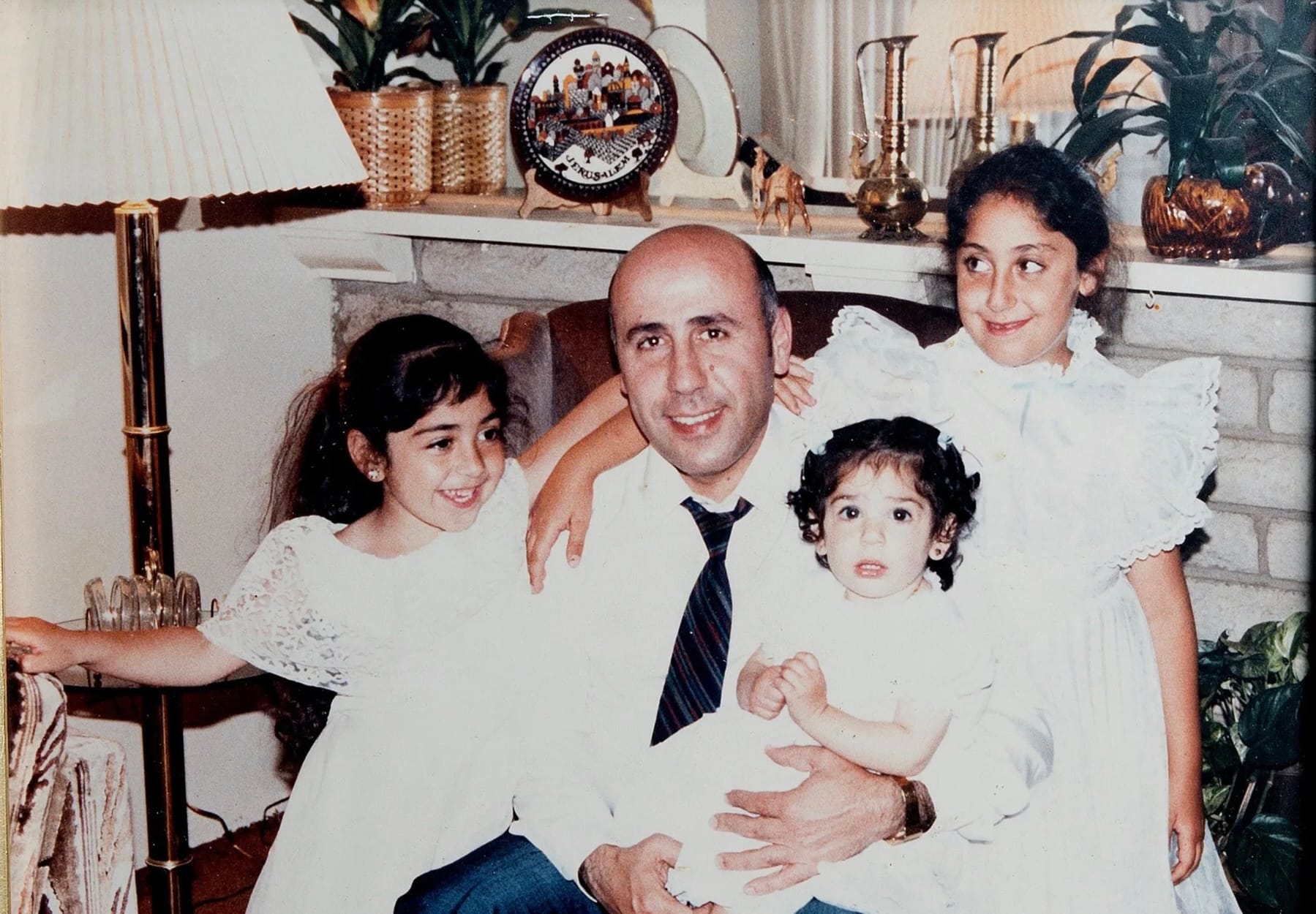
On the morning of October 11, 1985, this voice was silenced. A pipe bomb detonated at the ADC offices in Santa Ana, killing Odeh just hours before he was scheduled to speak at a local synagogue. The investigation into his murder remains a haunting chapter in American history; while the FBI and various investigative journalists have identified members of the Jewish Defense League (JDL), a designated right-wing terrorist group, as primary suspects, the case remains officially unsolved nearly 40 years later.
A Chronology of Vandalism and Resilience
The statue of Alex Odeh has served as a physical proxy for the unresolved trauma of his death. Since its installation in 1994, the bronze monument has been repeatedly targeted by those who wish to suppress his memory.
- 1996–1997: The memorial was repeatedly splashed with red paint, a symbolic act of violence meant to mirror the bloodshed of the assassination.
- 2020: The dove—the symbol of peace in the statue’s grasp—was stolen. While it was eventually recovered and reattached, the act underscored the precariousness of the monument in a polarized public space.
- 2023: Artist Jon Rubin, during a residency at the Grand Central Art Center (GCAC), encountered the statue in a state of disrepair. Bricks lay at its base, evidence of a recent attack. It was during this moment of observation that the seeds for The Stolen Dove were sown.
Reflecting on the discovery, Rubin noted, “Here was a monument that was simultaneously being attacked and overlooked: a work that remained politically charged enough to attract repeated acts of vandalism, yet had become somewhat invisible to the public around it.”
The Concept: A Decentralized Memorial
Rubin’s project, The Stolen Dove, is a profound subversion of the traditional commemorative model. By obtaining permission from the sculptor Khalil Bendib and Odeh’s daughter, Helena, to remove the dove once more, Rubin has shifted the site of memory from the statue itself to the participants of the project.

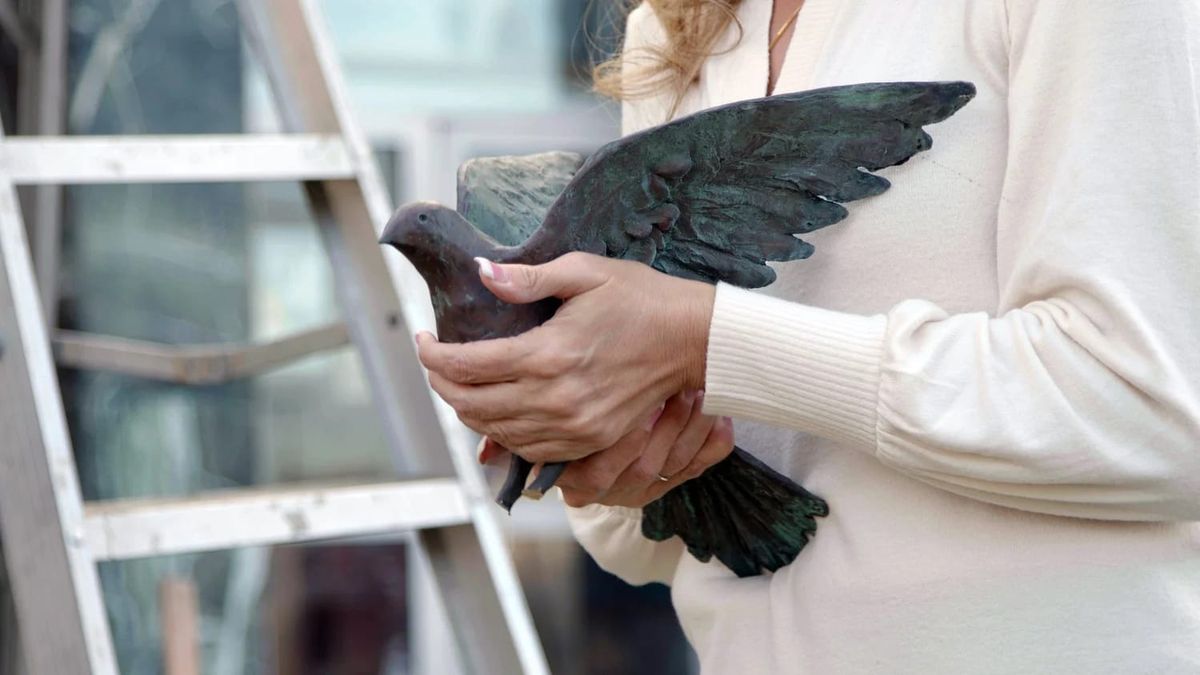
Rather than being a static object, the dove now travels. It is hosted by families, institutions, and community groups who commit to a period of “hospitality.” When an entity hosts the dove, they are not merely displaying an art object; they are engaging in a shared responsibility to keep Odeh’s narrative alive. Each host receives a replica of the statue, creating an ever-expanding flock of memory—a “network of monuments and storytellers” that functions across geographic and social boundaries.
Supporting Data: Connecting the Past to the Present
The urgency of this project is amplified by the current climate. For those involved, the project is a necessary intervention against the erasure of Arab-American history. Liz Hirsch, co-founder of the 839 gallery in Hollywood, which is hosting the dove this July, emphasizes the structural connections between the past and present.
“The project feels urgent because it brings renewed attention to Odeh’s life and legacy, and to the longer history of anti-Arab violence in this country that his assassination has come to symbolize,” Hirsch stated. “It reminds us that occupation and genocide in Palestine are not just things happening ‘over there,’ but are structurally connected to conditions here in the US and beyond.”
The project has already moved through significant spaces, including the Sundance Film Festival, where it was presented in conjunction with the documentary Who Killed Alex Odeh?. It has been held at the home of the Odeh family, the residence of activist Julie Kasem, and even at a Passover seder led by Rabbi Arnold Rachlis—the same rabbi who spoke at the statue’s dedication in 1994.
Official and Community Responses
The project is not without its risks, a reality that the organizers acknowledge with sobering clarity. When asked about the potential for further vandalism or security threats during the traveling exhibition, John Spiak, director of the Grand Central Art Center, was resolute. “There are always concerns, but Alex was a peace activist, and his life was taken. There’s no security with any project you do.”
The community response has been one of deep, often visceral, engagement. Participants have described the act of holding the dove as a bridge between despair and hope. For Rabbi Rachlis, who has lived through the decades of the statue’s history, the project serves as a reminder of the power of interpersonal connection. “We passed around the dove, let people hold it. I didn’t realize how powerful that would be, these feelings of despair and hope.”
Implications: A New Way to Remember
The implications of The Stolen Dove extend far beyond the art world. It challenges the conventional understanding of what a monument is. By turning a “stolen” object into a shared experience, the project argues that history is not something that is handed down in bronze or granite; it is something that must be actively held, carried, and discussed by the living.
As the project continues to travel—with plans for stops in the Bay Area, Pittsburgh, and eventually back to Santa Ana—the network of people who can claim a personal connection to the memory of Alex Odeh continues to grow.
The ultimate goal, according to Rubin, is not to leave the statue empty, but to return the dove in 2027—the 42nd anniversary of the murder—transformed by the collective memory of hundreds of people.
“When the dove eventually returns to the monument, hundreds of people will be able to say, ‘I once held that dove,’” Rubin said. “The hope is that the monument returns carrying the memory of all of those encounters, and that the community around it will never see it in quite the same way again.”
In this way, The Stolen Dove does more than honor a fallen leader; it heals the fractured space around his memorial, ensuring that while the bronze may be vulnerable, the story it tells is now protected by a growing, living community.
 Basiran
 Muslim
 Evan Lee Salim
