

The dust has barely settled on the 2026 FIFA World Cup, but for the global football community, the eyes of the world are already turning toward an unprecedented horizon. In 2030, the FIFA World Cup will celebrate its 100th anniversary—a centennial milestone that has prompted football’s governing body to orchestrate a tournament as sprawling, ambitious, and logistically complex as the history of the sport itself.
Spanning three continents, six countries, and a narrative arc that bridges the past and the future, the 2030 tournament will be a celebration of football’s global reach. From the hallowed, historic turf of Montevideo to the hyper-modern stadiums rising in the Maghreb and the storied cathedrals of European football, the 2030 World Cup is poised to redefine the scale of international sporting events.
The Genesis: A Multi-Continental Vision
The 2030 World Cup represents a radical departure from the traditional single- or dual-nation hosting model. To honor the tournament’s origins, FIFA has devised a "centennial celebration" format. While the primary competition will be hosted by a tri-nation coalition—Spain, Portugal, and Morocco—the tournament’s opening acts will take place in the cradle of the game: South America.
On June 8, 2030, the world will turn its gaze to Uruguay, the birthplace of the inaugural 1930 tournament. The opening match will be held at the Estadio Centenario in Montevideo, the very stadium where Uruguay claimed the first-ever World Cup trophy. Following this, two additional celebratory matches will occur in Argentina and Paraguay, cementing the inclusion of South America in this global anniversary.

This unique configuration honors the 1930 tournament, where Uruguay defeated Argentina 4-2 in a dramatic final defined by a pre-match dispute over which ball to use—a disagreement settled by playing with an Argentine ball in the first half and a Uruguayan one in the second. A century later, the legacy of that rivalry remains the emotional anchor of the event.
Chronology: The Road to the 2030 Final
The logistics of a six-nation tournament are unprecedented in sports history. FIFA has designed a schedule that balances nostalgia with the grueling physical demands of a modern athletic competition.
- June 8, 2030 (The Launch): The tournament commences in Montevideo, Uruguay, with a ceremonial opening match at the historic Estadio Centenario.
- June 9–10, 2030 (The South American Leg): Matches follow in Buenos Aires, Argentina, and Asunción, Paraguay.
- The Intercontinental Transition: Following these three games, teams and fans will embark on an unprecedented transit across the Atlantic. FIFA has committed to building in mandatory rest days to mitigate the physical toll of traveling over 6,000 miles between continents.
- Mid-June to July 21, 2030: The tournament moves to the primary hosts—Spain, Portugal, and Morocco—where the remainder of the 104-match schedule will play out across dozens of host cities.
- July 21, 2030 (The Finale): The final will crown the champion, with the location currently the subject of intense international competition.
Supporting Data: Infrastructure and Capacity
The 2030 tournament will feature a massive expansion of the competition, potentially growing from 48 teams to 64, should a proposal by the South American football body (CONMEBOL) be ratified by FIFA.
Host Country Breakdown
- Spain: Having hosted in 1982, Spain will anchor the tournament with its iconic venues, including Madrid’s Santiago Bernabéu and the legendary Camp Nou in Barcelona, both of which are undergoing massive structural overhauls.
- Portugal: Making their debut as a World Cup host, Portugal will utilize the Estádio da Luz in Lisbon and Porto’s Estádio do Dragão, two of Europe’s most modern and atmospheric venues.
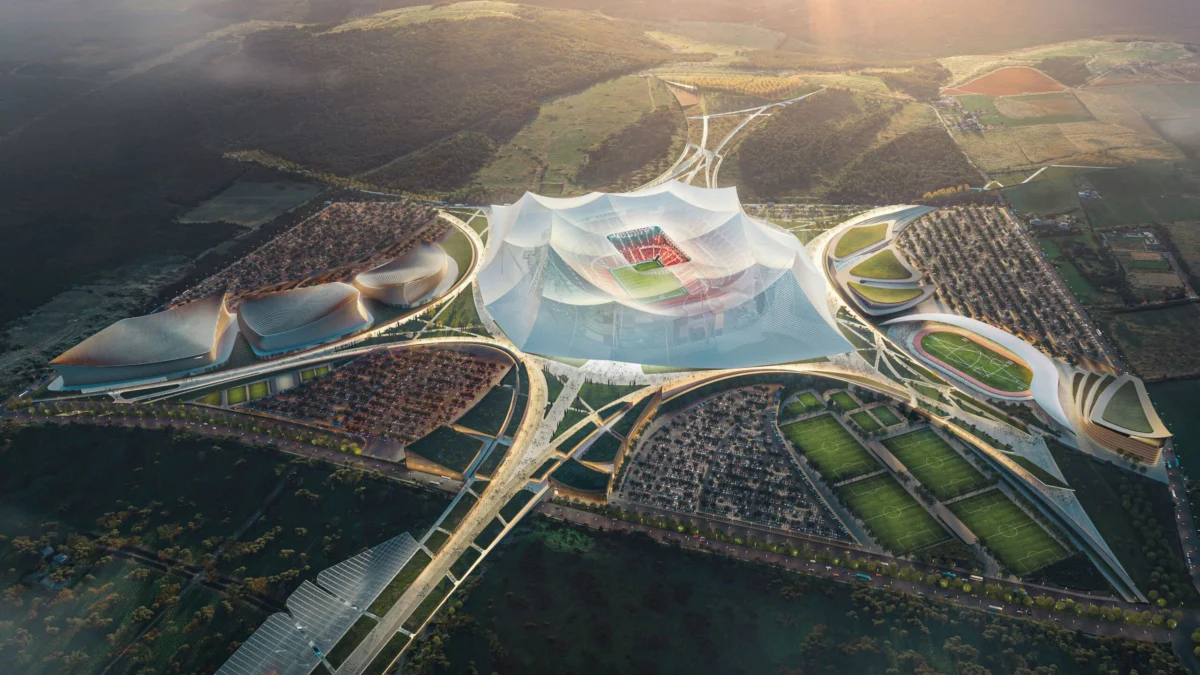
- Morocco: Representing the African continent, Morocco is investing heavily in infrastructure. The crown jewel is the Grand Stade Hassan II in Benslimane. With a staggering 115,000-seat capacity, the stadium is designed to resemble a traditional Moroccan tent and is set to become the largest football arena on the planet upon its completion.
The Centenario Overhaul
To prepare for the centennial, Montevideo’s Estadio Centenario is currently undergoing a 30-month, top-to-bottom renovation. The project, which increases capacity to 63,000, aims to modernize the historic structure while preserving its status as the only stadium designated by FIFA as a "Historical Monument of World Football."

Official Responses and FIFA’s Strategy
FIFA’s decision to spread the tournament across six nations has drawn both praise for its inclusive spirit and criticism regarding its environmental and logistical footprint.
"We are bridging the gap between the birth of our sport and its global future," a FIFA representative noted in recent briefings. The organization maintains that the "extra rest days" integrated into the schedule are a robust solution to player fatigue. Furthermore, the selection of the hosts was a calculated geopolitical move. By linking South America with Europe and Africa, FIFA is attempting to foster a "United World" theme that transcends regional boundaries.
However, the question of the final remains the most sensitive point of discussion. The selection of the venue is expected to be finalized in December 2026. The competition between Madrid, Barcelona, and Casablanca represents not just a choice of stadium, but a symbolic declaration of which region will claim the center of the footballing world for the next century.
Implications: The Geography of the Future
The 2030 World Cup poses a fascinating case study in modern infrastructure. The proximity of Spain and Morocco—separated only by the Strait of Gibraltar—offers a unique opportunity for cultural exchange. Fans will be able to cross between Europe and Africa via high-speed ferry or the Al Boraq high-speed train system in Morocco, potentially attending matches on two different continents in a single day.

This proximity is a deliberate feature of the tournament’s design, intended to demonstrate the viability of cross-continental hosting. Should the 2030 tournament succeed, it could set a template for future World Cups, where "hosting" is no longer a localized endeavor but a regional or intercontinental network.
The 2034 Horizon
While the 2030 event is the immediate focus, the trajectory of the tournament is already set for 2034, which has been awarded to Saudi Arabia. The rapid succession of these massive, multi-nation tournaments suggests a shift in FIFA’s philosophy: moving away from the "legacy" model of hosting toward a model defined by massive, interconnected infrastructure projects that can accommodate an ever-expanding roster of teams and a global audience numbering in the billions.
Conclusion: A New Era
The 2030 World Cup is not merely a football tournament; it is a grand, high-stakes experiment in global unity. By acknowledging the history of the game in South America while embracing the modern architectural marvels of Africa and Europe, FIFA is attempting to weave together a narrative that spans a century.
For the fans, the tournament offers an unparalleled travel experience. For the players, it presents the ultimate test of endurance and adaptation. And for the host nations, it is an opportunity to showcase their cultures to a captive global audience. As the clock ticks toward that opening whistle in Montevideo, the world remains transfixed, watching to see if this ambitious, sprawling vision can deliver on the promise of its history.

The game is changing, the map is expanding, and in 2030, the world will once again gather to see who can write their name into the next chapter of football history.
 Sagoh
Sagoh
 Asro
Asro
