

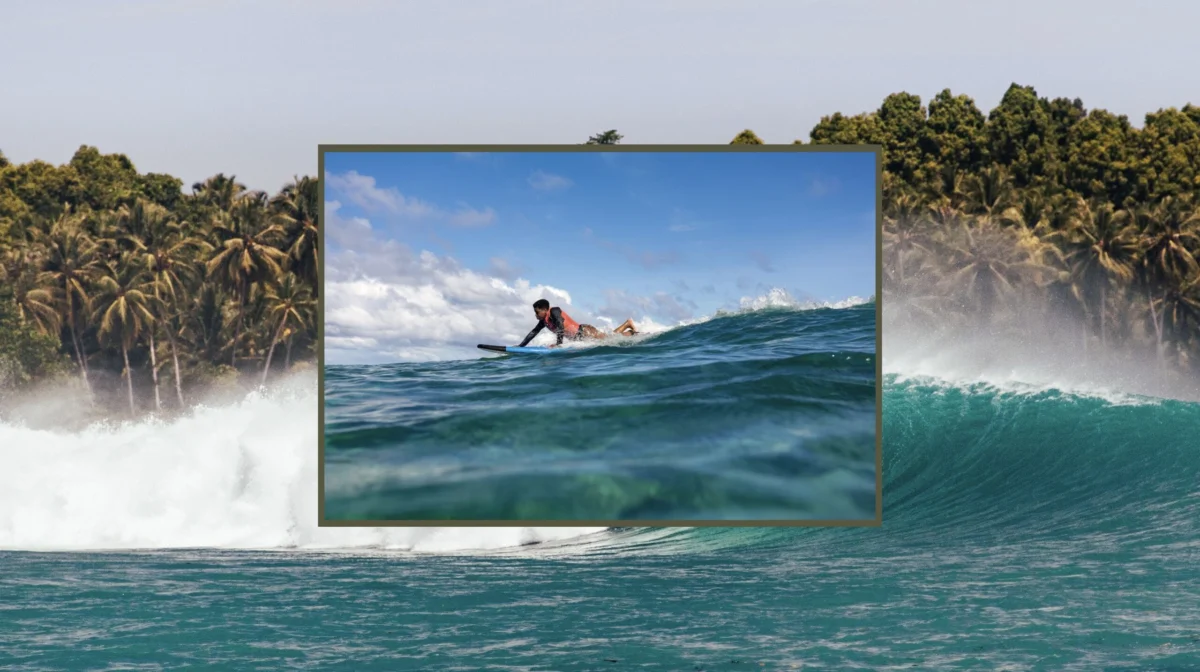
For most, the ocean is a playground—a vast, shimmering expanse of leisure and potential. For me, it has always been a gargantuan, indifferent monster. My aquaphobia was not merely a case of nerves; it was a deep-seated visceral response to the power and depth of the sea. I grew up viewing the water through the lens of Katsushika Hokusai’s The Great Wave off Kanagawa, where the ocean is rendered as a cluster of merciless, grasping claws. My fear was cemented in the mid-1980s by the cinematic dread of Steven Spielberg’s Jaws, a film that left an entire generation of children terrified of the surf.
But my reluctance was also rooted in a hard, physical reality: I suffer from negative buoyancy. While others float with the grace of otters, I sink like a stone. Treading water for me is not a rhythmic activity; it is a frantic, exhaustive battle against gravity. For decades, I remained a spectator, watching from the safety of the shore or the deck of a boat, nursing a secret desire to experience the marine world while paralyzed by the prospect of being swallowed by it.
The Psychology of Avoidance: From Water to Writing
My relationship with the ocean became a microcosm of my broader psychological struggles. This fear-based procrastination bled into my professional and personal life. I became adept at avoiding the daunting—shirking bureaucratic tasks, ignoring complex forms until the late fees mounted, or staring at a blank page on my laptop until the urge to vacuum the house became overwhelming.
As the philosopher George Addair famously posited, "Everything you’ve ever wanted is sitting on the other side of fear." For years, I ignored this, choosing the comfort of the known over the potential of the unknown. It wasn’t until my 40th year that I finally asked myself the critical, rational question: "What is the worst that can actually happen?" By analyzing the risk, I realized that my fear was a construct, one that had cost me two decades of witnessing the sublime beauty of coral reefs and marine life.
A Chronology of Courage: The Road to the Mentawai Islands
My journey toward reconciliation with the sea began with small, measured steps. At age 40, I began snorkeling in the Philippines, clutching my companion’s side with the desperation of a whale calf. This led to further, albeit cautious, excursions in the waters of Antigua, Kenya, and the Maldives, where a giant manta ray drifted past me, indifferent to my trembling.
Yet, these were calm, protected waters. The true test remained the waves. A brief, disastrous encounter with a six-foot wave in Santa Monica, California, resulted in me inadvertently attempting to "drown" a friend by using her shoulders as a stepping stone. It was clear that if I were to truly conquer this fear, I needed more than just calm water—I needed a controlled, professional environment.
This led me to the remote Mentawai archipelago in Indonesia. Historically, this region was the exclusive domain of "hardcore" surf enthusiasts drawn by the Indian Ocean’s consistent, powerful swells. However, the rise of accessible, family-oriented resorts like Aloita has opened these legendary breaks to novices. Under the guidance of my instructor, Victoria Lvova, I finally stepped onto a surfboard.
The Reality of the "Wipeout"
The physical environment of the Mentawai Islands is breathtaking—a turquoise expanse bordered by dense coconut palm forests. It was the perfect stage for my baptism. However, the reality of surfing was far different from the ethereal images seen in magazines.
The Anatomy of a Wipeout
The experience was a masterclass in controlled failure. When I drifted too far into the path of a wave, I was met with the reality of the "Hokusai wall"—a mass of water that flipped my board and tossed me into the surf. Expecting catastrophe, I emerged to find the water shallow and my instructor, Victoria, calm and waiting. The wipeout, the very thing I had feared for decades, was remarkably mundane. It was a momentary loss of control followed by an immediate return to safety.

The Physical Toll: The Unexpected Adversary
The true challenge was not the shark-filled depths or the crushing power of the wave, but the sheer, unadulterated physical exertion of paddling. My fear of drowning was eclipsed by the immediate, burning reality of shoulder exhaustion. This shift in focus—from a paralyzing, irrational dread to the tangible, manageable pain of athletic effort—was the pivot point of my transformation.
Supporting Data: Why Exposure Therapy Works
The efficacy of my journey is supported by established psychological principles regarding exposure therapy. By confronting the object of a phobia in a controlled, safe environment, individuals can "re-wire" their neural responses to that stimulus.
According to marine safety experts and surf instructors, the primary deterrent for new surfers is the fear of the unknown—what lies beneath the surface. By utilizing life jackets and working with certified instructors in shallow, consistent breaks, the risk of injury is minimized, allowing the brain to move from a "fight-or-flight" state to a "learning and adaptation" state. The Mentawai archipelago, with its consistent, low-amplitude shoulders, offers a unique environment for this type of cognitive recalibration.
Official Perspectives: The Role of Controlled Environments
Resorts like Aloita operate under strict safety protocols, emphasizing that the "surf virgin" market is a significant growth sector in adventure tourism. Instructors are trained not just in technical board mechanics, but in the psychological management of their students.
"The fear is the biggest wave they have to catch," notes Victoria Lvova. "Once they realize the board provides buoyancy and the instructor provides a tether to safety, the ocean changes from a monster into a partner." This sentiment is echoed by travel psychologists who suggest that "transformative travel"—travel that forces a person to step outside their comfort zone—is the most effective method for long-term personality development and anxiety reduction.
Implications: Beyond the Surf
The implications of my Indonesian experience extend far beyond the water. The confidence I gained in the Mentawai archipelago did not stay in the Indian Ocean; it returned with me to my desk.
The "tsunami of tasks" that once paralyzed me—the complex forms, the administrative backlog, the blank page—now seems manageable by comparison. I realized that my fear of the blank page was identical to my fear of the ocean: it was a fear of being overwhelmed, of sinking, of losing control.
By proving to myself that I could endure a wipeout, survive the exhaustion of the paddle, and stand, however shakily, on a board in the middle of the Indian Ocean, I unlocked a new capacity for resilience. I may not have become a professional surfer, and I may have looked ridiculous in my life vest, but I achieved something far more profound: I stopped viewing the world through the lens of what might go wrong and started viewing it through the lens of what I could accomplish.
The ocean remains powerful, deep, and unpredictable. But I am no longer just a spectator watching from the shore. I have learned that the worst-case scenario is rarely fatal, and that the only true "monster" in my life was the one I allowed to grow in the quiet corners of my own mind.
 Asro
Asro
 Siti Muinah
