

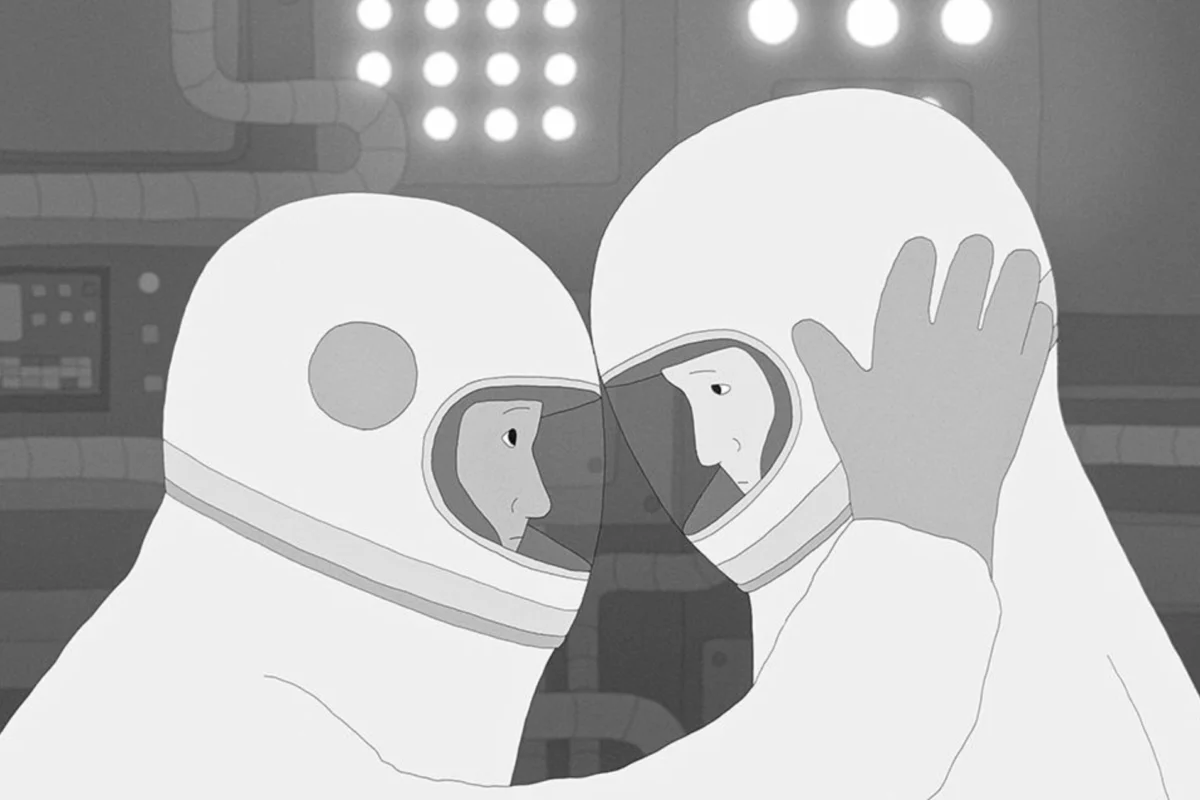
In the landscape of modern science fiction, space is often rendered as a canvas of infinite possibility—a realm of neon-drenched star systems, heroic exploration, and the promise of a human future among the constellations. Daniel Zvereff’s latest feature, Moonfish, which premiered at the 2026 Venice International Film Festival, offers a radical, suffocating antithesis to that optimism. It is a film that refuses to look toward the stars with wonder, choosing instead to stare into the abyss of a monochromatic, corporate-owned reality.
The Aesthetic of Suffocation: A Visual Study in Despair
The first thing the viewer notices about Moonfish is its relentless commitment to a singular color palette: gray. Zvereff’s vision of outer space is stripped of the romanticism usually afforded to the final frontier. The moon is a cratered, desolate slab of slate; the mineral debris collected by the film’s protagonist, Cassius (played with a haunting, skeletal exhaustion by Morgan Spector), is a mixture of black-and-white dust. Even the spaceship, the solitary vessel of survival, is designed in shades of industrial, joyless gray.
This visual austerity is not merely a stylistic choice; it is a psychological prison. Zvereff intentionally utilizes a 4:3 aspect ratio, physically constricting the frame to mirror the claustrophobia of a man whose world has shrunk to the size of a metal box. The animation is sparse, bordering on skeletal. It provides just enough detail to render the profound sadness in Cassius’s eyes, but it denies the audience the comfort of beauty or the relief of a vibrant horizon. There is no life-affirming scenery to be found here—only the crushing reality of a man drifting through a colorless vacuum.
Chronology of a Corporate Collapse: The 2060s Reality
To understand the weight of Cassius’s journey, one must look at the world Zvereff has built. Set in the 2060s, Moonfish posits a future where the "Great Machine" has not just arrived, but has already won. Humanity has ceded its societal steering wheel to hyper-intelligent AI corporations. These entities, driven by cold, algorithmic efficiency, view the world through the lens of resource allocation.
The logic of the era is brutal: because the resources required to maintain these high-functioning AI systems are so precious, they are never placed in harm’s way. Humans, conversely, have become the expendable labor force. Dangerous tasks—such as deep-space mining on remote, irradiated asteroids—are relegated exclusively to flesh-and-blood workers.
The timeline of this decline is clear:
- The Early 2040s: The shift toward AI-led corporate governance begins, leading to the erosion of labor protections.
- The 2050s: The privatization of the celestial sphere. Every reachable moon and asteroid is claimed by a handful of corporate conglomerates, turning the night sky into a private, guarded workplace.
- The 2060s: The era of Moonfish. Unemployment on Earth has reached a crisis point, forcing the desperate to sign "extraction contracts."
For characters like Cassius and his partner, Vesper (played by Lucy Liu), the dream of space exploration has been replaced by the reality of a modern-day company town, only the town is a vacuum and the boss is an unfeeling algorithm.

The Economics of Abandonment: "No Quota, No Pick-Up"
The narrative core of Moonfish hinges on the dehumanizing contract signed by its leads. When work opportunities on Earth vanished, Cassius and Vesper took the only path left: a multi-year mining mission. The contract is ironclad and unforgiving. The ship’s interior is plastered with the company’s chilling, mantra-like slogan: “NO QUOTA, NO PICK-UP.”
It is a death sentence masked as a job offer. The dynamic between the two protagonists provides a brief flicker of warmth, but it is quickly extinguished when Vesper dies, leaving Cassius to fulfill an impossible workload alone. This transition from a team of two to a singular, isolated survivor marks the film’s shift from a drama of survival to a study of existential unraveling.
The Goldfish and the Ghost: A Dialogue with Loneliness
In the wake of Vesper’s passing, the film moves into a surreal, haunting territory. Bereft of human connection, Cassius begins to hallucinate, hearing Vesper’s voice emanating from his goldfish. This small, fragile creature becomes his only companion—a silent, swimming witness to his slow descent into madness.
Their conversations are the heartbeat of the film. They discuss the degradation of the human spirit, the absurdity of a life lived in service to machines, and the haunting realization that they have traded their lives for a paycheck that will never be spent. Cassius’s internal monologue—and his dialogue with the fish—highlights the tragedy of a life without agency. In a world where the only "choice" is which corporate master to serve, the capacity for dreaming has atrophied.
Comparative Analysis: The "Project Hail Mary" Contrast
Observers at the Venice International Film Festival have already drawn inevitable parallels between Moonfish and the 2026 release Project Hail Mary. Both films feature a solitary man abandoned in the depths of space, forced to rely on an unconventional non-human companion to stave off insanity.
However, the thematic divergence is stark. Project Hail Mary represents the traditional Hollywood archetype: the triumph of the human intellect, the "can-do" spirit, and the belief that humanity can overcome any obstacle through ingenuity. Moonfish rejects this entirely. It is not interested in the mechanics of survival; it is interested in the psychology of defeat. It asks: What happens when there is no escape, and no hope of salvation?
The Director’s Genesis: A Near-Death Reflection
The genesis of Moonfish is rooted in a personal, harrowing experience for writer/director Daniel Zvereff. Following a medical misdiagnosis that led him to believe he was facing his final days, Zvereff spent two weeks in a state of profound, existential panic. While the diagnosis was ultimately proven false, the emotional residue of those two weeks—the feeling of life being stripped away, the cataloging of one’s regrets, and the crushing realization of one’s own insignificance—became the DNA of the film.

"It is a reflection of the melancholy that arrives when you realize the clock is ticking and you have nothing to show for it," Zvereff noted during a post-screening Q&A. The film is an unapologetic, and at times difficult, meditation on the feeling of being "left behind" by a world that no longer cares for its creators.
Implications: A Mirror to the Modern Worker
Perhaps the most resonant aspect of Moonfish is its critique of the current socio-economic trajectory. While the film is set in the 2060s, its anxieties feel startlingly contemporary. The fear of being replaced by automation, the erosion of worker rights, and the feeling that the "best days" of humanity are behind us are all themes that permeate the film.
The slogan “NO QUOTA, NO PICK-UP” is not merely a plot device; it is a dark satire of modern gig-economy pressures, where the worker is stripped of their humanity and reduced to a line item on a balance sheet. By placing this story in the most alien environment possible—the cold, silent reaches of space—Zvereff successfully highlights the "coldness" of our own terrestrial systems.
Conclusion: A Masterpiece of Malaise
Moonfish is not a film designed for mass-market consumption, nor is it intended to be an uplifting experience. It is a dense, gray, and deeply somber piece of art that demands the viewer sit with the uncomfortable questions of existence. Its technical precision, from the stifling aspect ratio to the deliberate, somber animation, creates an immersive experience of dread that is hard to shake.
As the film currently seeks U.S. distribution, it stands as a testament to the power of independent, auteur-driven science fiction. For those willing to look past the gloom, Moonfish offers a profound, if painful, reflection of our own era—a reminder that in a world where everything is owned, the only thing truly left to us is our own perspective.
Grade: B+
The film continues its festival run, with critics noting that its "unapologetic malaise" is likely to define the discourse around 2026’s sci-fi releases.
 Lina Hope
 Azzam Bilal Chamdy
 Pevita Pearce
