

When Sian Heder’s CODA premiered at the 2021 Sundance Film Festival—a quiet, digital-only event held during the height of the global pandemic—few could have predicted the cultural seismic shift that would follow. The film went on to capture the Academy Award for Best Picture, but for those who followed Heder’s career, the triumph was less about the prestige and more about the filmmaker’s singular ability to infuse a familiar genre with profound, necessary dimension.
Now, Heder returns with Being Heumann, a sweeping yet tightly focused biopic that marks a return to form for the director. By eschewing the traditional "cradle-to-grave" biopic structure in favor of a laser-focused look at one of the most pivotal moments in the American disability rights movement, Heder has crafted a film that is as much an adrenaline-fueled political thriller as it is a character study of a titan.
The Architect of Equity: Judy Heumann’s Fight for Section 504
To understand the stakes of Being Heumann, one must understand the landscape of the 1970s. The film opens in 1972, introducing us to a young, indomitable Judy Heumann—portrayed with electric, fierce brilliance by Ruth Madeley. We first encounter her zipping through the chaotic, inaccessible streets of New York City. For the average viewer, this is a sequence of frustration; for Judy, it is simply Tuesday.

As a wheelchair user since early childhood following a bout with polio, Judy lives in a world fundamentally hostile to her existence. The film’s opening act does not shy away from the physical reality of this exclusion: the lack of curb cuts, the condescending stares, and the constant, grinding battle for basic mobility.
However, the film’s narrative engine kicks into high gear as it transitions to the late 1970s, focusing on the stalled implementation of Section 504 of the Rehabilitation Act. While signed into law in 1973, the act sat in a bureaucratic purgatory for years. Despite its status as the first federal legislation to mandate civil rights for people with disabilities—covering everything from education to public accessibility—it required a final signature from Joseph Califano, the then-Secretary of Health, Education, and Welfare.
A Chronology of Resistance: From Madison Avenue to San Francisco
The brilliance of Heder and co-writer Rebekah Taussig’s script lies in its ability to distill complex legal and legislative battles into a visceral human experience. The film tracks a deliberate, high-stakes timeline:

- 1972: Judy Heumann and eighty fellow activists stage a seminal sit-in on Madison Avenue, protesting the vetoing of early disability protections.
- 1973: Section 504 is signed into law, yet its implementation is indefinitely delayed, sparking widespread indignation among the disability community.
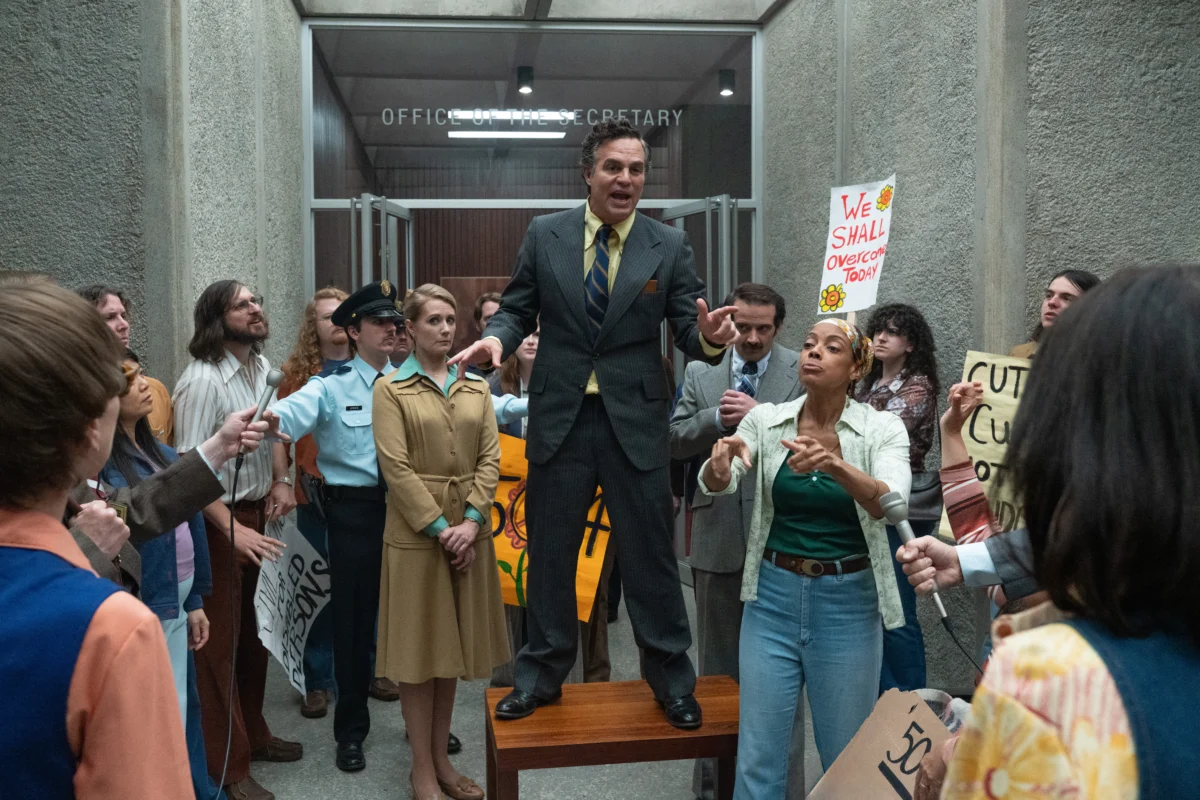
- 1977-1978: The narrative culminates in the historic 504 Sit-in. Faced with a foot-dragging federal government, Heumann leads a pack of activists into the San Francisco federal building. What began as a protest quickly transformed into the longest occupation of a federal building in U.S. history.
Mark Ruffalo, portraying the beleaguered and morally conflicted Joseph Califano, serves as the perfect antagonist—not because he is a mustache-twirling villain, but because he is a bureaucrat paralyzed by the prospect of budget cuts. The film masterfully highlights the tension between government fiscal responsibility and the moral imperative of human rights.
Casting the Revolution: Authenticity as a Narrative Tool
Heder’s decision to cast disabled performers in key roles is not merely a statement of ethics; it is a masterclass in narrative immersion. The cast list is a who’s-who of talent, bringing a raw, lived-in reality to the production:
- Ruth Madeley as Judy Heumann: The anchor of the film, delivering a performance that balances flinty, uncompromising toughness with hidden vulnerabilities.
- Madeline Delp as Kitty Cone: Bringing a necessary warmth to the movement’s internal strategizing.
- Daniel Durant, re-teaming with Heder after CODA, shines as Steve McCleeland.
- Supporting Cast: The ensemble, including Andrew Pilkington (Hale Zukas), Antwan Tolliver (Brad Lomax), and Roberta Colindrez (Joni Breves), creates an authentic, tactile community that feels lived-in and historically grounded.
The production design by John P. Goldsmith and costumes by Danny Glicker recreate the 1970s with a gritty, unglamorous fidelity that avoids the "period-piece" sheen. Every prop and garment feels like a tool for survival, not a fashion statement.

Beyond the Policy: The Joy of the Struggle
Perhaps the most surprising aspect of Being Heumann is its sense of playfulness. It would have been easy for the film to become a dry, educational lecture on civil rights. Instead, it captures the, at times, "frisky" nature of the 504 Sit-in.
The film depicts the logistical, romantic, and social lives of the protesters during the occupation. It highlights the formation of "sex tents" and the genuine camaraderie that blossomed under the pressure of government indifference. By showing that these activists were not just icons, but fully realized human beings with their own joys, anxieties, and infighting, Heder elevates the film from a biography to a celebration of the human spirit.
Implications for Future Biopics
The success of Being Heumann suggests a new template for the biopic genre. By refusing to document every childhood trauma or career milestone, the film finds the universal in the specific. It argues that a person’s impact is best measured by their contributions to the collective, rather than a checklist of life events.

As the film moves toward its climax, it emphasizes that fighting for justice is a dynamic process—one that requires as much introspection as it does outward confrontation. Judy’s growth, from a woman who trusts only her own instincts to a leader who learns the power of coalition building, serves as the film’s moral arc.
Conclusion: A Call to Action
Being Heumann is, by every definition, a rousing piece of cinema. It reminds the audience that the rights we often take for granted—the curb cut, the accessible bathroom, the integrated classroom—were not granted by the benevolence of the state, but won through the relentless, organized, and joyous labor of people who refused to be hidden.
The film is not without its minor flaws; at times, the sprawling ensemble leaves some narrative threads feeling slightly thin. However, these are minor grievances in a work of such immense heart and historical weight. As Judy Heumann herself proved, one should never be afraid of joy, even in the midst of a battle. Being Heumann captures that philosophy in every frame.

Film Details:
- Director: Sian Heder
- Writers: Sian Heder, Rebekah Taussig
- Starring: Ruth Madeley, Mark Ruffalo, Madeline Delp, Daniel Durant
- Grade: B+
- Release: Being Heumann premiered at the 2026 Toronto International Film Festival. Apple will release the film in select theaters on Friday, November 6, 2026, followed by a global streaming release on Apple TV+ on Friday, November 13, 2026.
 Jia Lissa
 Lina Irawan
 Iffa Jayyana
