

By Editorial Staff
September 11, 2026
In the heart of the Eternal City, hidden beneath the sprawling ruins of the Baths of Trajan, a monumental secret has been brought into the light. This week, Rome’s Mayor, Roberto Gualtieri, officially unveiled what archaeologists believe to be the largest ancient Roman wall mosaic ever discovered. The discovery, which also includes an exquisitely preserved fresco, offers an unprecedented glimpse into the sophisticated artistic and architectural landscape of the 1st century CE—a period of immense imperial transformation.
The unveiling, which took place on the slopes of Oppio Hill, just a stone’s throw from the iconic Colosseum, marks the culmination of decades of careful excavation and restoration. For history enthusiasts and scholars alike, the discovery is not merely an archaeological triumph; it is a bridge spanning two millennia, connecting modern Rome with the opulent, often enigmatic world of its ancestors.
The Facts of the Find: Scale and Spectacle
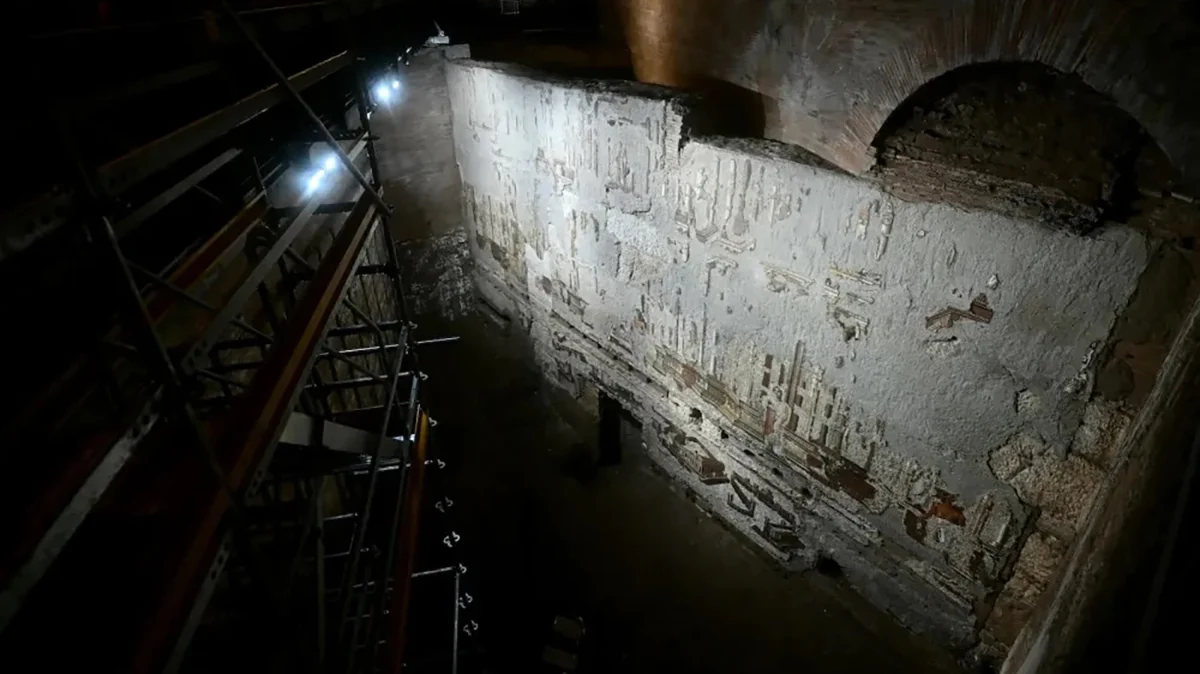
The sheer scale of the discovery is staggering. Tucked away in a subterranean gallery that once served as part of the structural foundation for the Baths of Trajan, the mosaic spans an impressive 33 feet in height and stretches more than 50 feet across.
Initial reports from the site suggest that these dimensions are only a fraction of the original composition. The upper reaches of the artwork were severed during the construction of the Baths themselves in the early 2nd century, while the base of the mosaic remains buried beneath layers of unexcavated earth.
The artistry displayed within the work is equally remarkable. The upper tiers feature a complex narrative of mythological figures and human forms set against a rhythmic backdrop of classical columns. Below this celestial-like imagery lies a granular, breathtaking rendering of a port city. The level of detail is extraordinary; observers can discern fortified stone walls, towering gatehouses, and the distant, elegant silhouette of a temple, all rendered with a precision that suggests the work of a master craftsman.
A Chronological Journey: From Nero to Trajan
To understand the significance of this discovery, one must look at the turbulent history of the Oppio Hill.
The Neronian Foundation (c. 64–68 CE)
The site was once the location of the Domus Aurea, or "Golden House," the extravagant palace built by Emperor Nero following the Great Fire of Rome in 64 CE. The palace was a symbol of imperial excess and artistic innovation. After Nero’s suicide in 68 CE, subsequent emperors sought to erase his legacy by burying the palace and building over it.
The Rise of the Baths (104–109 CE)
By the turn of the 2nd century, Emperor Trajan sought to provide the Roman public with a massive leisure complex. The Baths of Trajan, dedicated in 109 CE, were a marvel of Roman engineering, covering over 15 acres. They were not merely bathing facilities; they included libraries, gymnasiums, and cultural hubs designed to solidify the emperor’s favor with the Roman citizenry.
The 1990s Excavations
The artworks unveiled this week were first identified during exploratory excavations in the 1990s. However, the sheer fragility of the remains and the complexity of the site meant that full exposure and restoration could not be safely undertaken at the time. For thirty years, the mosaic remained a whispered secret among archaeologists, protected by the very soil that had hidden it for centuries.
Supporting Data: The Fresco and the Mystery of the Port
Adjacent to the mosaic, archaeologists uncovered a secondary treasure: a fresco depicting a bird’s-eye view of a separate Roman urban center. This mural, characterized by its vibrant color palette and distinct perspective, includes a theater, a temple, and a dense network of residential dwellings.
The presence of these two distinct masterpieces in the same subterranean chamber has fueled intense debate among researchers. Are these depictions of real, functioning Roman trade hubs of the 1st century, or are they idealized "fantasy cities" intended to showcase the Roman Empire’s dominance over the Mediterranean?
"Either way," says Francesco Pacetti, a lead archaeologist on the excavation team, "it has been painted in great detail. The technical skill required to render such a perspective at this scale suggests these were commissioned by a patron of significant wealth and status."
The prevailing theory is that these artworks originally adorned a domus—a private mansion for a member of the Roman elite—that predated the construction of the Baths of Trajan. Alternatively, some scholars posit that the rooms could have been part of the peripheral structures of the Domus Aurea itself, repurposed by subsequent emperors before being permanently sealed beneath the concrete foundations of Trajan’s leisure complex.
Official Responses and Preservation Strategy
The unveiling of the mosaic is a major coup for Mayor Gualtieri’s administration, which has prioritized the integration of Rome’s archaeological heritage with modern urban life.
"This discovery is a testament to the fact that Rome is a living, breathing history book," Mayor Gualtieri stated during the ceremony. "Every time we peel back a layer of earth in this city, we find not just stones, but stories. The preservation of this mosaic is a priority, and we are committed to ensuring it survives for future generations."
However, the opening of the site is not without its challenges. The atmospheric conditions of an underground gallery are notoriously difficult to control. To protect the integrity of the fragile pigment and the integrity of the mosaic tiles, the site will initially only be accessible to small, controlled groups of 15 people.
This "trial period" is essential, according to conservationists. The influx of human breath, heat, and moisture can be catastrophic for ancient pigments. Over the next year, sensors will monitor the micro-climate of the chamber, providing data that will dictate whether the site can eventually accommodate larger tour groups or if digital, high-definition projections will be required to supplement physical viewing.
Implications for Archaeology and Tourism
The discovery of the mosaic has far-reaching implications for the study of Roman urban planning and interior design. It provides a rare, tangible link to the domestic art of the 1st century—a period for which many of the surviving visual records are fragmentary.
Understanding Roman Domestic Life
The choice of imagery—the port city and the mythological columns—offers insight into the values of the Roman elite. The focus on trade, maritime power, and religious devotion suggests a society deeply invested in both the physical expansion of their world and the spiritual traditions that underpinned their daily existence.
Boosting Rome’s Cultural Profile
For the tourism sector, the find is a significant development. Rome is constantly seeking ways to distribute foot traffic away from the most overcrowded sites like the Colosseum and the Roman Forum. By opening the underground galleries of the Oppio Hill, officials hope to create a new "itinerary of the depths," encouraging visitors to explore the city’s subterranean history.
The Ethics of Excavation
The discovery also raises important questions about the ethics of modern archaeology. As technology advances, we are increasingly capable of recovering sites that were previously considered too fragile to touch. This creates a dilemma: do we uncover everything we find, or do we leave some of history buried for the benefit of future generations who may have even better preservation tools?
"The choice to uncover this mosaic was made with the utmost caution," says Dr. Elena Rossi, an expert in Roman art conservation. "We are walking a fine line between the desire for public access and the duty of stewardship. We have a responsibility to act as the final generation of caretakers, not the final generation of viewers."
Conclusion: A Living Legacy
As the first groups of visitors descend into the cool, shadowed gallery beneath the Baths of Trajan, they are doing more than just looking at art. They are witnessing the resilience of history. The mosaic has survived the fall of the Roman Empire, the shifting of landscapes, and the weight of centuries of urban construction.
For now, the mosaic rests in the relative silence of its subterranean home, its painted towers and stone gates glowing under the soft, controlled lighting of the modern age. It serves as a potent reminder that the history of Rome is never truly finished. Every discovery is a new beginning, a chance to refine our understanding of the people who built the foundations upon which our modern world stands.
As the city of Rome continues its delicate, ongoing dialogue with its past, one thing is certain: the Great Mosaic has been brought to light at exactly the right moment, offering a profound sense of continuity in a world that often feels disconnected from its origins. Whether it represents a real harbor or an idealized dream, the city within the wall remains, as ever, a part of the enduring spirit of Rome.
 Pevita Pearce
 Suro Senen
 Sagoh
Sagoh
