

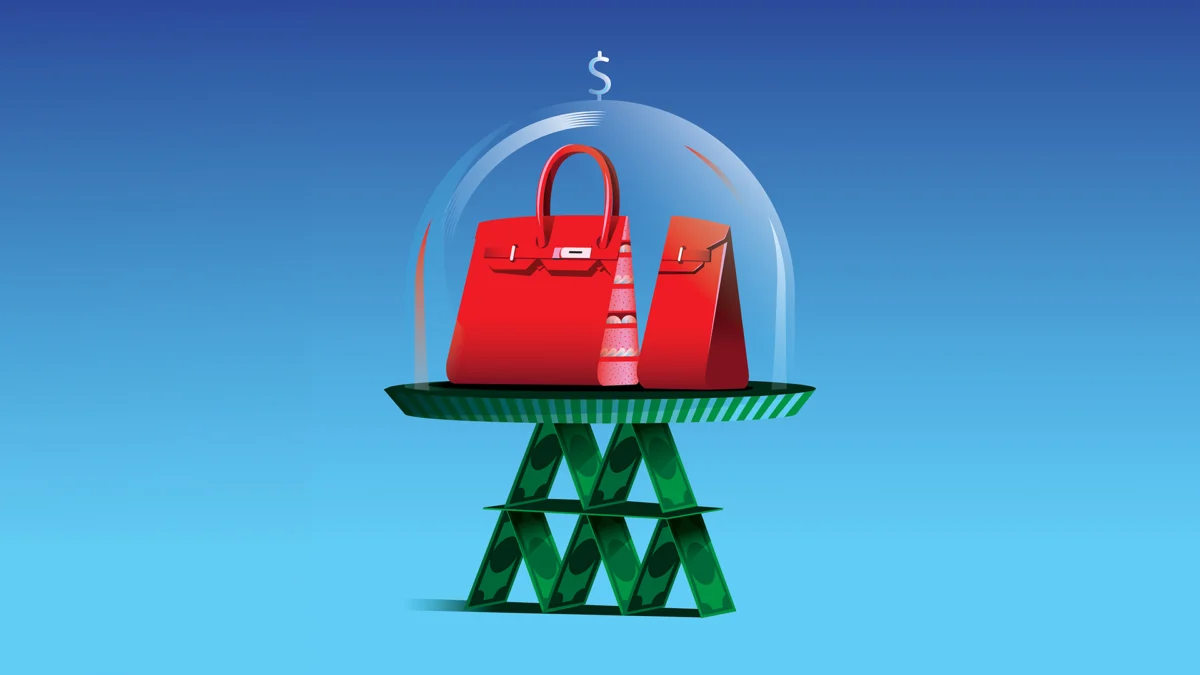
In the quiet, climate-controlled corners of private vaults and the bustling, high-stakes atmosphere of secondary market boutiques, a radical transformation is taking place. Once the domain of passionate collectors and socialites, luxury goods—ranging from Hermès Birkin bags and Patek Philippe timepieces to rare colored diamonds—are being aggressively repositioned as sophisticated financial instruments. This "wealth-tech" movement promises to turn occasional indulgences into the modern equivalent of treasury bonds, yet as the industry matures, it faces a reckoning between genuine market potential and the volatile risks of speculative bubbles.
The Genesis of the "Investor Consumer"
The movement gained significant momentum in the wake of recent global economic uncertainty. For Dana Auslander, a Blackstone alumna and founder of the wealth-tech startup Luxus, the inspiration was born from the volatility following the 2024 reelection of Donald Trump. "I knew we were in for a volatility shit show," Auslander recalls. Recognizing that traditional wealth-preserving assets like gold historically thrive in unpredictable environments, she began to wonder if a similar upside could be found in the rarefied world of high-end commodities.

Her gaze fell upon Madison Avenue, specifically the boutique displays of Hermès. Having been a loyal customer for two decades, Auslander had observed a tightening supply of the brand’s most coveted assets—the Birkin and Kelly bags. With Hermès stock soaring from roughly €53 in 2004 to over €2,300 by late 2024—a staggering 3,550 percent increase—she identified a clear path: leveraging the brand’s momentum to offer investors exposure to this appreciation.
Chronology of a Niche Market
The rise of the "investor consumer" is not an overnight phenomenon; it is a trend that has evolved over two decades, often mirroring broader shifts in the global economy.

- 2003: Rayah Levy establishes what is widely considered the world’s first art fund in Australia, testing the waters for using retirement-style vehicles to acquire tangible, high-value assets.
- 2021: Auslander launches Luxus Fund 1, raising $1 million from accredited investors to acquire Birkin and Kelly bags on the secondary market.
- 2021: Rares, a platform founded by former NFL safety Gerome Sapp, makes headlines by purchasing a pair of Air Yeezy 1 Prototypes for $1.8 million at Sotheby’s, signaling the arrival of "social investing" in sneakers.
- 2022–2024: Following pandemic-era highs, several startups in the space face headwinds. Some, like Otis, are acquired and subsequently shuttered, while others, such as the Watch Fund, become mired in legal battles over contractual performance.
- 2025–Present: The market reaches a point of bifurcation, where firms focusing on "fundamental scarcity"—like colored diamonds—continue to thrive, while those relying on "manufactured hype" struggle to maintain viability.
Supporting Data and The "Hard Asset" Thesis
The argument for luxury as an investment class rests on three pillars: scarcity, historical performance, and portability. According to Niki McMorrough, who runs the consultancy firm Affluent Audiences, the wealthiest buyers are increasingly viewing every luxury purchase through the lens of capital preservation. "Everything they buy is an asset," she notes. "It’s all an investment, to either keep as an heirloom or sell in the future for an appreciated value."
The data supports this to an extent. Luxus, for instance, reports a 44.9 percent net return on its initial fund, having sold 46 of its 56 acquired bags through partners like Sotheby’s and The RealReal. Similarly, Rayah Levy of FCD Invest cites a case where a client turned a $2.5 million investment in rare colored diamonds into $6 million over a four-year holding period.

These assets also offer a unique advantage in terms of mobility. In an era of global instability, high-value items like loose, polished diamonds can act as portable wealth, escaping the scrutiny—and limitations—of currency control systems that restrict the movement of cash across borders.
Official Perspectives and Industry Risks
Despite the allure, experts caution that the bridge between a "hobby" and an "investment strategy" is often built on thin ice. Winston Chesterfield of Barton Consulting provides perhaps the most critical assessment of the sector. He argues that the emergence of these funds is often driven by opportunism rather than sound financial logic.

"The real commodity markets are built on fundamental rarities rather than manufactured, and potentially transitory, rarity," Chesterfield warns. He points to the recent collapse of high-profile sneaker funds, which saw valuations plummet after the public downfall of Kanye West. "What if the brand decides to go crazy? The whole thing is much more variable… and it’s a dangerous variable to base an investment on."
Furthermore, legal and structural challenges have plagued the industry. The Watch Fund’s 2021 court loss in Singapore, where it was ordered to repurchase timepieces after failing to meet contractual obligations, serves as a cautionary tale for investors. The lack of transparency in secondary market pricing and the ever-present risk of counterfeiting remain significant hurdles, even for firms that utilize rigorous, multi-layered authentication audits.

Implications: The Future of Alternative Assets
The implications of this shift are profound for the broader wealth management industry. As Gen Z wealth grows—a demographic that allocates significantly more of its portfolio to collectibles than previous generations—the pressure on traditional advisers to account for these "cultural assets" will only intensify.
However, the industry faces a vital transition. As the "easy money" of the post-pandemic era evaporates, the market for luxury collectibles is undergoing a "flight to quality." Firms that cannot prove long-term value—relying instead on the hype-cycle of sneakers or the transient interest in trending brands—are likely to follow the path of Rares and Otis. Conversely, firms focusing on intrinsic, geologic scarcity, such as Rayah Levy’s colored diamonds, may find a permanent seat at the table of alternative investments.

Ultimately, the distinction remains clear: A collection of vintage cars or a vault of Patek Philippes may be a beautiful store of value, but it is not a substitute for a diversified financial portfolio. As Chesterfield succinctly puts it: "Yes, a Patek Philippe is a nice piece to hand down, and it’s a nice piece to own, but it’s a game. It’s a hobby… It’s not a strategy."
For the prospective investor, the message is clear. While the allure of beating the FANG stocks with a Hermès bag or a rare diamond is undeniable, the risks—reputational, regulatory, and market-driven—are substantial. The "investor consumer" must be prepared to navigate a world where the line between passion and profit is as thin as the leather on a Birkin and as hard to penetrate as a vault of diamonds. Those who treat these assets as true commodities, rather than mere status symbols, may find the returns they seek, but they must be prepared for the volatility that comes with investing in the "cultural capital" of the elite.
 Pevita Pearce
 Suro Senen
 Sagoh
Sagoh
