

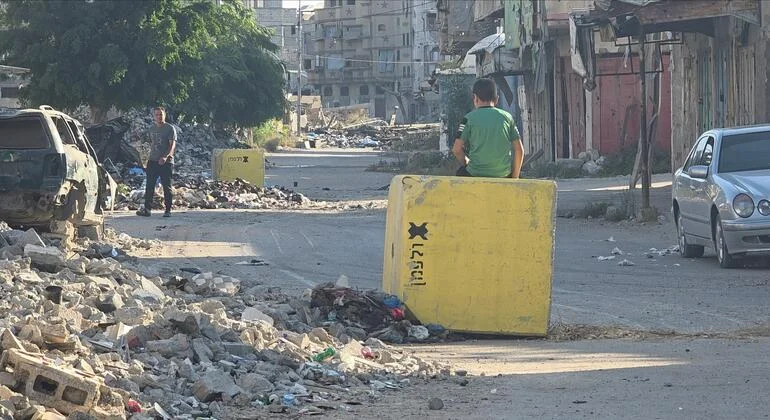
For the 2.1 million Palestinians currently displaced within the Gaza Strip, the concept of a "safe zone" has become a cruel abstraction. At the heart of this humanitarian catastrophe lies the "yellow line"—a physical and psychological boundary established following the October 2025 ceasefire agreement. What was intended as a demarcation of stability has, in reality, become a tightening noose, systematically squeezing the civilian population into an ever-diminishing sliver of territory.
As Israeli military forces continue to push the boundary inwards, the residents of Gaza find themselves trapped in a state of perpetual transit, living on the razor’s edge of an existential crisis where the question, "Where do we go?" is no longer a rhetorical expression of despair, but a daily, life-or-death logistical necessity.
The Geography of Containment: Understanding the "Yellow Line"
The "yellow line" is not merely a border; it is a manifestation of shifting military control. Following the ceasefire agreement reached in October 2025, the Gaza Strip was bifurcated. The eastern zone was designated as an area under Israeli military oversight, while the western zone was intended to house the bulk of the Palestinian population.
Initially, this arrangement left approximately 47 percent of the Gaza Strip accessible to the Palestinian population. However, data from the United Nations Office for the Coordination of Humanitarian Affairs (OCHA) confirms a consistent, methodical contraction of this space. Today, Palestinians are confined to less than 40 percent of the Strip’s total land area. This reduction has not been a static process but a fluid, aggressive encroachment that forces families living near the demarcation line to abandon their homes repeatedly, often with little notice and no clear destination.
A Chronology of Displacement and De-facto Annexation
To understand the current crisis, one must look at the timeline of the "yellow line" since its inception:
- October 2025: The ceasefire agreement is announced. The "yellow line" is established as a buffer, intended to separate civilian populations from areas of active or potential military friction.
- Late 2025 – Early 2026: Initial stability gives way to "creeping displacement." Military patrols and the hardening of the demarcation line force the first wave of families out of the eastern sectors of Al-Tuffah and Al-Zaytoun.
- Mid-2026: The OCHA reports a significant reduction in the land available for humanitarian aid and shelter, noting that the "yellow line" is being pushed inward by several hundred meters in various sectors.
- August – September 2026: An intensification of military operations occurs despite the ongoing ceasefire. Local authorities report over 1,300 deaths since the October agreement, with civilian infrastructure in the border zones being systematically dismantled or restricted.
- Current Status: The line remains a volatile boundary. Families report that they are effectively "homeless while at home," waiting for the next directive or the next sound of heavy machinery that signals it is time to move once again.
The Human Toll: Voices from the Edge
The statistics provided by international bodies struggle to capture the profound psychological erosion of the population. For those living in the shadow of the yellow concrete blocks that define the boundary, life is a cycle of packing, fleeing, and mourning.
Ibtisam Malika, a resident of the Al-Zaytoun neighborhood, embodies the exhaustion of a population pushed beyond its limit. "Every two to three months, we are forced to move and leave our belongings behind," she says. "We can’t take it anymore. We lost half of our children in the war, and only remnants of us remain."
Her testimony is echoed by thousands who reside in the Al-Tuffah and Al-Zaytoun districts. These areas, now sitting on the front lines of the "yellow line," are home to families who have stayed behind, not out of choice, but out of a lack of alternatives. Safaa Mushtaha, another resident, notes that the uncertainty has stripped away the basic dignity of planning for the future. "Where do we go? This is a question we’ve been asking ourselves for three years," she says. "We accepted living near the yellow line, but it’s become unbearable."
For the children of Gaza, the situation is even more harrowing. Ahmed Arhim, also from Al-Zaytoun, describes a life defined by the relentless noise of drones and gunfire. "We don’t sleep every night. The children can’t sleep. They are scared and they wet themselves. We are displaced every day, always displaced. This is not life."
Supporting Data: The Humanitarian Assessment
The logistical nightmare of housing 2.1 million displaced people within an area that continues to shrink is documented by a grim set of metrics:
- Shelter Crisis: According to OCHA, approximately 1.98 million people—roughly 94 percent of Gaza’s population—are in dire need of shelter and non-food items.
- Substandard Living: Over 84 percent of these families reside in conditions classified as "extremely difficult," utilizing makeshift tents or damaged buildings that offer zero protection against the elements.
- The "No-Go" Factor: The UN has noted that the search for safe sites to establish new camps has hit a wall. Much of the land that might be suitable for housing displaced people is either prohibited or classified as a "restricted area" by the Israeli military, located east, south, or north of the yellow line.
- Casualty Figures: Since the ceasefire of October 2025, 1,334 deaths and 4,429 injuries have been recorded by local health authorities. The UN Human Rights Office highlighted that in just one five-day period in late August 2026, 24 Palestinians were killed in air raids, including four children and a woman.
Official Responses and the Stalled Peace
The response from the international community and human rights organizations has been one of mounting alarm. The UN Human Rights Office recently issued a statement declaring that "the bloodshed in Gaza must stop," emphasizing that the continued military operations are undermining the very foundations of the ceasefire agreement.
While the ceasefire remains technically in effect, the "yellow line" serves as a daily reminder that the conflict has not ended; it has merely transitioned into a different phase of containment. Humanitarian agencies argue that the restriction of movement and the encroachment on habitable land constitute a violation of the spirit, if not the letter, of the 2025 agreement.
Israeli authorities have generally maintained that these measures are necessary for security and to mitigate the risks posed by remaining insurgent elements. However, human rights monitors argue that the cost of these security measures is the total collapse of the civilian support system in Gaza.
Implications: A Future in Suspension
The implications of the current "yellow line" policy are profound and dangerous.
- Erosion of Civilian Infrastructure: As more land is designated as restricted, hospitals, schools, and utility centers fall behind the line, becoming inaccessible to the people who need them most.
- Psychological Trauma: The normalization of "daily displacement" is creating a generation of children defined by chronic anxiety and a total lack of security, the long-term impacts of which will be felt for decades.
- The Failure of Humanitarian Aid: Aid organizations are finding it increasingly difficult to deliver essential supplies. When the population is constantly shifting, distribution networks collapse, leading to increased rates of malnutrition and preventable disease.
- The Political Impasse: By shrinking the "habitable" zone, the current military policy effectively makes the prospect of a two-state or even a stable one-state solution impossible. The physical fragmentation of the Gaza Strip mirrors the political fragmentation of the region.
As the yellow line continues to move, the space for a diplomatic resolution moves with it, narrowing until it threatens to disappear entirely. For the families in Al-Zaytoun and Al-Tuffah, the question "Where do we go?" remains unanswered, not because there are no answers, but because there is, quite literally, nowhere left to go. The world watches as the map of Gaza is redrawn in real-time, and with every inch of land lost, the hope for a return to normalcy recedes further into the horizon.
 Nana Muazin
 Azzam Bilal Chamdy
 Layla Zulfa
