

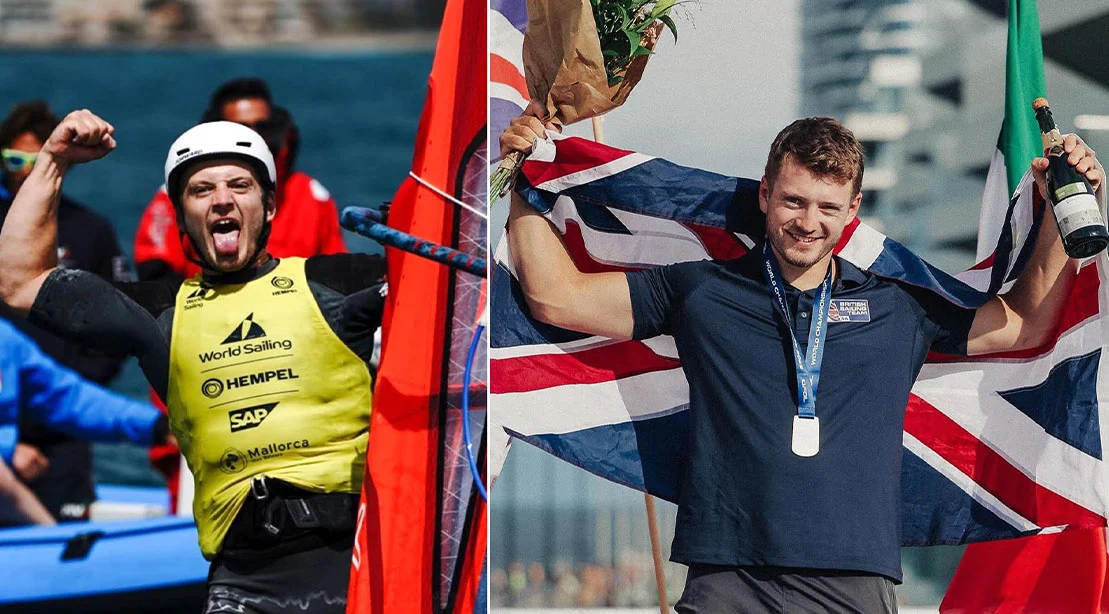
The tranquil waters of Weymouth & Portland National Sailing Academy are set to become a cauldron of intensity this September. As the 2026 iQFOiL World Championships arrive on the English coast, the spotlight is firmly fixed on Glasgow’s own Andy Brown. A reigning world champion, Brown enters the competition not just as a favorite, but as an athlete who has fundamentally redesigned his body to survive and thrive in one of the most physically punishing disciplines in modern sport.
In a nation that holds the title of the most successful sailing country in Olympic history—boasting over 30 gold medals—the pressure on Brown is immense. Yet, as he prepares to defend his crown against a fleet of over 40 nations, including some of the most decorated European and Olympic medalists, Brown’s focus is not on the history books, but on the physiological demands of the hydrofoil.
The Evolution of Olympic Windsurfing
To understand the stakes, one must understand the sport. iQFOiL is not the leisurely sailing of yesteryear. Introduced by World Sailing at the 2024 Paris Olympic Games, it represents the high-speed evolution of the discipline. The boards utilize advanced hydrofoil technology, which lifts the entire apparatus out of the water, drastically reducing friction and drag.
This technological leap allows athletes to hit blistering speeds of up to 35 knots (65 kph/40 mph). While the spectator might see a serene glide across the surface, the reality for the athlete is a high-octane, full-body workout. "It’s a surprising sport," Brown explains. "You look like you’re cruising, but actually, your core is tensed, your legs are burning, your forearms are pumped. You need to properly go for it."
Anatomy of an Athlete: The Training Regimen
The physical toll of iQFOiL, particularly in light wind conditions, cannot be overstated. When the breeze dies, athletes must employ a technique called "pumping"—a rhythmic, explosive movement of the sail that generates artificial wind. Brown describes the sensation as "rowing upright," a process that demands immense cardiovascular endurance and muscular power.
To maintain his competitive edge, Brown has committed to a staggering 25-hour weekly training schedule on the water, supplemented by rigorous gym sessions. Under the watchful eye of the GB Sailing Team’s strength and conditioning coach, Will Barnes, Brown has shifted his focus toward building a robust, high-performance physique.
The Strength and Conditioning Blueprint
Coach Barnes, who initially found the physical requirements of iQFOiL to be an "eye-opening" experience, has implemented a periodized training program designed for durability and raw output.
"The workouts for Andy are whole-body training sessions," Barnes notes. "Windsurfers focus heavily on lower-body power and strength to make every pump as efficient as possible." The program centers on:
- Lower Body: Barbell Romanian Deadlifts (RDLs), back squats, split squats, and belt squats to build the explosive drive required for pumping.
- Upper Body: A heavy emphasis on vertical and horizontal pulling, including weighted pull-ups and bench pulls, ensuring the athlete can maintain a vice-like grip on the sail under high tension.
- Core and Stability: Dedicated work on rowing machines, which mimics the specific kinetic chain of the on-water pumping motion.
"At this point in the season, the aim is strength," Barnes adds. "We keep reps and sets low—three sets of three to six reps—with around two reps in reserve to ensure we aren’t burning him out before the competition."
The Bulking Strategy: Fueling the Champion
For Brown, the quest for the 2026 title has necessitated a deliberate change in body composition. To compete with the world’s best, Brown has targeted a weight class of 88 to 90 kilograms (194 to 198 pounds).
To achieve this, Brown has adopted a structured nutritional plan aimed at a 600-calorie surplus per day. "Quite a lot of that is carbohydrates," he explains. "We are fueling for the sessions on the water. It’s not just about weight; it’s about having the glycogen stores to sustain 25 hours of on-water work per week."
This deliberate "bulk" is essential for safety as much as performance. The high speeds of iQFOiL mean that crashes are frequent and potentially dangerous. A more robust, stronger frame provides a protective buffer against the high-impact nature of the sport, allowing Brown to remain competitive throughout the grueling multi-stage race format of the World Championships.
The Road to the Competition Format
Winning in Weymouth is not a matter of a single race. The event is a test of attrition. Surfers must navigate a complex multi-stage qualifying series, where only the top ten finishers earn a spot in the final day’s elimination series.
The final day is a high-stakes, winner-take-all environment. Any lapse in concentration, any mechanical failure, or any physical fatigue from the preceding days can result in the loss of the world title. For Brown, the challenge is maintaining the intensity required to peak at the right moment. "What I really enjoy is the chase of it," he says, acknowledging the mental fortitude required to stay at the top.
Implications for the Future of British Sailing
Beyond the 2026 Championships, Andy Brown’s trajectory is firmly pointed toward the 2028 Olympic Games in Los Angeles. His role as a mentor within the Royal Yachting Association (RYA) underscores his commitment to the future of the sport. By bridging the gap between his own high-level performance and the development of the next generation, Brown is helping to ensure that Great Britain’s dominance in the sailing world remains unchallenged.
However, the path to LA 2028 begins here. A victory in Weymouth would not only cement Brown’s legacy as one of the finest windsurfers of his generation but would also validate the rigorous, data-driven approach to strength and conditioning that he and Coach Barnes have pioneered.
Conclusion: A Legacy in the Making
As the countdown to September 4, 2026, continues, the sailing community watches with bated breath. The iQFOiL World Championships will be a crucible of skill, endurance, and physical prowess. For Andy Brown, the preparation is complete. He has sacrificed, trained, and rebuilt his body to be the "strongest possible sailor."
Whether he can hold off the world’s best remains to be seen, but one thing is certain: he will arrive at the start line in the best shape of his life, ready to push the limits of windsurfing to their absolute edge. The waters of Weymouth have seen many champions, but few have prepared with the scientific precision and sheer determination of Andy Brown.
Event Details:
- Event: 2026 iQFOiL World Championships
- Location: Weymouth & Portland National Sailing Academy, England
- Dates: September 4–12, 2026
- Official Information: iQFOiL Class Official Site
- Follow Andy Brown: Instagram Profile
 Nana
Nana
 Iffa Jayyana
 Reynand Wu
