

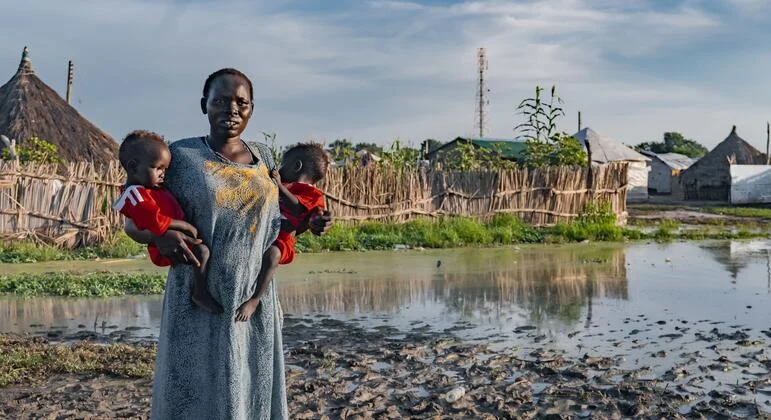
The planet’s hydrological stability—the invisible framework upon which global agriculture, industry, and human survival depend—is fracturing. A landmark report released by the World Meteorological Organization (WMO), the State of Global Water Resources 2025, confirms a sobering reality: the world is not merely experiencing a series of isolated droughts, but is locked into a persistent, decade-long cycle of water instability that threatens to fundamentally alter how nations manage their most precious resource.
For decades, Earth’s natural water storage systems—glaciers, groundwater, and soil moisture—acted as a planetary "savings account," absorbing the shocks of lean years to ensure steady supply during dry spells. According to the WMO, that account is being rapidly overdrawn, and the consequences of this systemic depletion are already manifesting in the form of erratic weather, catastrophic regional disasters, and the premature loss of critical glacial buffers.
The Core Crisis: A Planet Under Pressure
The data from 2025 paints a grim picture of a global water cycle in disarray. It was recorded as one of the driest years for river flows in the last 35 years, with 36 percent of the world’s river basin areas experiencing below-normal discharge.
Perhaps more concerning than the individual year is the persistence of the trend: 2025 marked the seventh consecutive year in which rivers with historically "normal" flow patterns remained in the clear minority. This statistical anomaly is no longer an anomaly—it is the new baseline. As Celeste Saulo, Secretary-General of the WMO, noted during the report’s presentation, "This is not a single bad year, but a persistent decade-long signal."
The Erosion of the Global ‘Savings Account’
Water storage on land—encompassing groundwater, lakes, and soil moisture—serves as the planet’s primary buffer against drought. Historically, these reserves allowed humanity to weather single-season dry spells without descending into crisis. However, the WMO report indicates that terrestrial water storage has been in a steady state of decline since the 2014–2016 period.
The depletion of groundwater is particularly alarming. In 2025, nearly two-thirds of monitored groundwater wells were found to be outside their normal range, with trends shifting heavily toward deficit rather than replenishment. While some regions, such as parts of South America and central and southern Africa, have seen localized recoveries in lake levels, these are exceptions to a broader, more ominous global trend of chronic water poverty.
A Chronology of Decline: From Stability to Erraticism
To understand the current crisis, one must look at the historical trajectory of the last decade:
- 2014–2016 (The Inflection Point): Scientists identify this period as the beginning of a significant and sustained drop in terrestrial water storage.
- 2020–2022 (The Accelerating Trend): Climate variability begins to manifest more intensely. The frequency of extreme water-related events, such as flash floods and multi-year droughts, rises significantly in Asia and Africa.
- 2023 (The Cryospheric Warning): All 19 major glacier regions on Earth report net mass loss, marking a turning point in how much meltwater can be relied upon for seasonal supply.
- 2025 (The New Normal): River discharge reaches near-record lows. The "savings account" of groundwater is confirmed to be in a state of deficit, and the WMO declares that the historical patterns used to plan infrastructure for the last century are no longer valid.
Supporting Data: The Cryospheric Collapse
The most visceral evidence of this shifting reality lies in the world’s mountain ranges. For the fourth consecutive year, every major glacier region on Earth lost mass. The scale of this loss is staggering: in 2025 alone, glaciers shed approximately 408 gigatonnes of ice. Over the three-year period between 2023 and 2025, the cumulative loss hit 1,400 gigatonnes—a volume equivalent to roughly one-third of the total freshwater humanity withdraws annually.
The "Peak Water" Threshold
Wayne Jenkinson, WMO’s Director of Hydrology and Cryosphere, issued a stark warning regarding "peak water." In regions with smaller glaciers, such as the Caucasus, Central Europe, and parts of western North America, the transition has already occurred.
"After this point, the glacier gives less meltwater each year simply because there is less ice left to melt," Jenkinson explained. This is a ticking time bomb for downstream communities. Historically, these glaciers provided a reliable, cold-water flow during the heat of summer. As they shrink, those communities face a future where the timing and volume of water delivery become increasingly unpredictable, leading to agricultural failure and severe water scarcity.
Official Responses and Strategic Imperatives
The WMO’s report is not merely a catalog of disasters; it is a call for a radical shift in policy. Experts are urging governments to move away from reactive crisis management toward proactive "water security" planning.
The Need for Data Sovereignty
One of the most significant improvements noted by the WMO is the dramatic increase in monitoring capacity. When the agency published its first report five years ago, only seven countries provided data from 14 river-flow stations. Today, 52 countries contribute data from over 3,100 stations.
However, major gaps persist. Asia and Africa, which have accounted for over 50 percent of reported water-related extreme events and more than 80 percent of related fatalities in the last five years, remain the regions with the most significant data deficiencies. Celeste Saulo emphasized that "water respects no borders," highlighting the necessity of international cooperation. Without shared standards, cross-border data-sharing, and harmonized early-warning systems, individual nations remain vulnerable to transboundary water disasters.
Addressing the "Moving Baseline"
The concept of a "moving baseline" is central to the WMO’s policy recommendations. Governments must accept that the hydrological data of the 20th century is no longer a reliable guide for the 21st. Infrastructure design—dams, irrigation systems, and urban water management—must now be built to accommodate a climate that is fundamentally more volatile.
Narelle van der Wel, Head of Cryosphere Monitoring, offered a glimmer of hope amidst the dire statistics: "Some glacier loss is inevitable, but total loss of glaciers is not yet inevitable." The window for mitigation remains open, provided that global emissions are drastically curtailed. The eventual scale of the disaster is not predetermined, but the time for passive observation has passed.
Implications for a Changing World
The implications of the 2025 findings are profound and far-reaching. As the water cycle becomes more erratic, the economic, social, and political ramifications will intensify:
- Agricultural Instability: As groundwater levels drop and glacial runoff becomes unreliable, the global food supply chain will face unprecedented strain. Regions reliant on glacial melt for seasonal irrigation will be the first to experience the "peak water" decline, potentially triggering food price spikes and migration.
- Increased Conflict: Water, as a finite and essential resource, is increasingly becoming a point of friction between and within nations. The lack of reliable data and shared management frameworks, as seen in the recent China-Nepal rock and glacier failure, highlights how quickly complex environmental hazards can evolve into geopolitical challenges.
- The High Cost of Inaction: The cost of retrofitting water infrastructure to handle extreme variability is immense, yet it pales in comparison to the economic devastation of water-related disasters. The WMO is signaling that investments in hydrology—monitoring, mapping, and modeling—are not just scientific expenditures, but essential security investments.
Conclusion: Preparing for the New Reality
The WMO’s State of Global Water Resources 2025 is a diagnostic tool for a world in crisis. It confirms that the climate change we discussed in hypothetical terms for decades has arrived in the form of a depleted water balance. As the planet’s "savings account" continues to dwindle, the global community must shift its focus toward resilience.
We are living in an era of moving baselines, where the unpredictability of the water cycle is the only certainty. As Ms. Saulo emphasized, countries must "prepare for those changes that have really already arrived." Whether through better international cooperation, investment in early-warning systems, or aggressive carbon mitigation to save the remaining glacial mass, the actions taken in the next few years will dictate the availability of water for generations to come. The era of water abundance is behind us; the era of water management has begun.
 Nana Muazin
 Azzam Bilal Chamdy
 Layla Zulfa
