A decade after his last solo exhibition in New York City, Beijing-based multimedia artist Liu Wei has returned with a monumental intervention at the threshold of one of the world’s premier cultural institutions. Speculation (2026), Liu’s newly unveiled sculpture series for the Metropolitan Museum of Art’s prestigious Genesis Facade Commission, engages directly with the architectural gravity of Fifth Avenue. On view through June 7, 2027, the four-part installation confronts viewers with the paradoxical friction of our current historical moment: the simultaneous forces of urban collapse and relentless civic transformation.
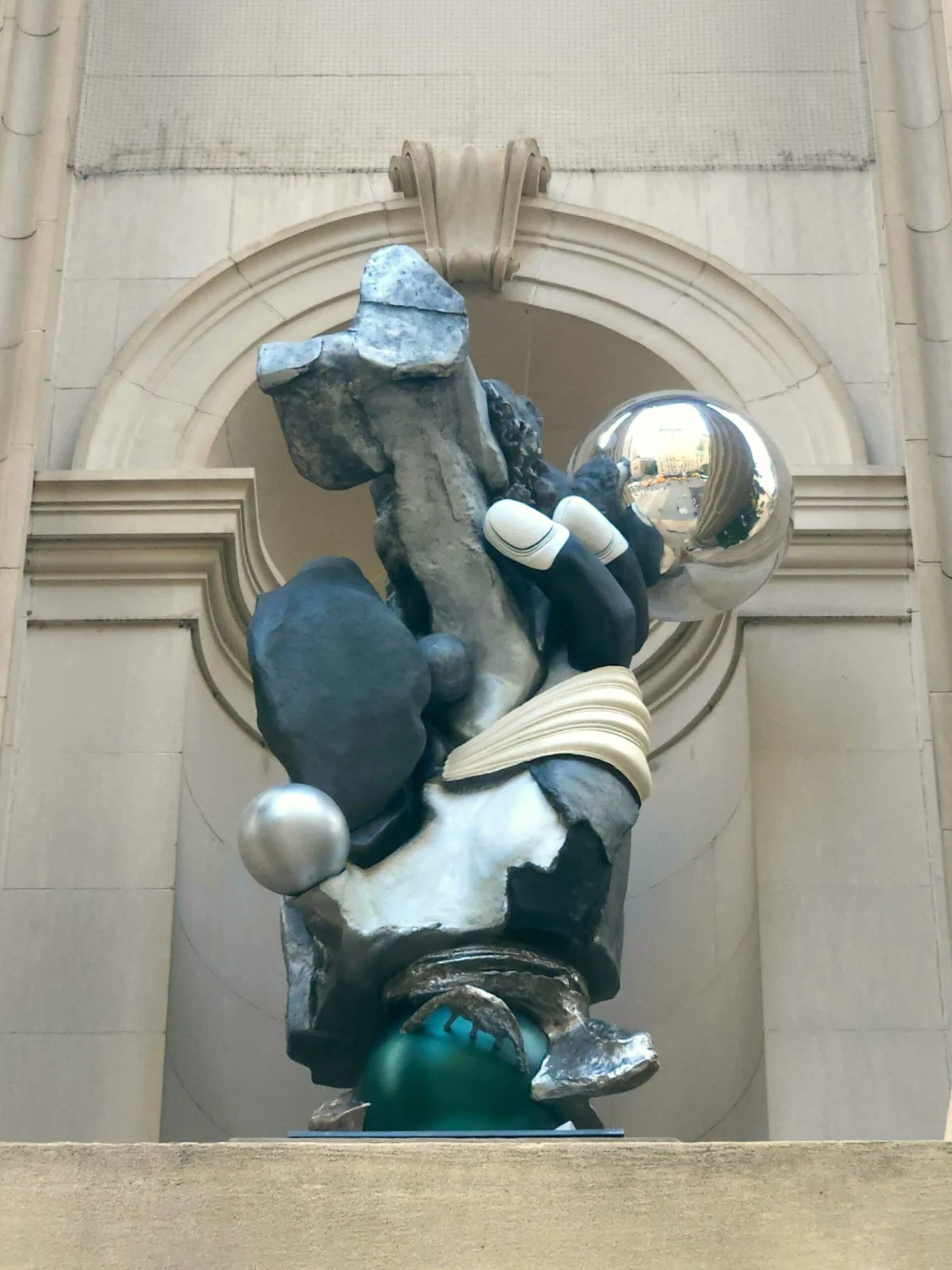
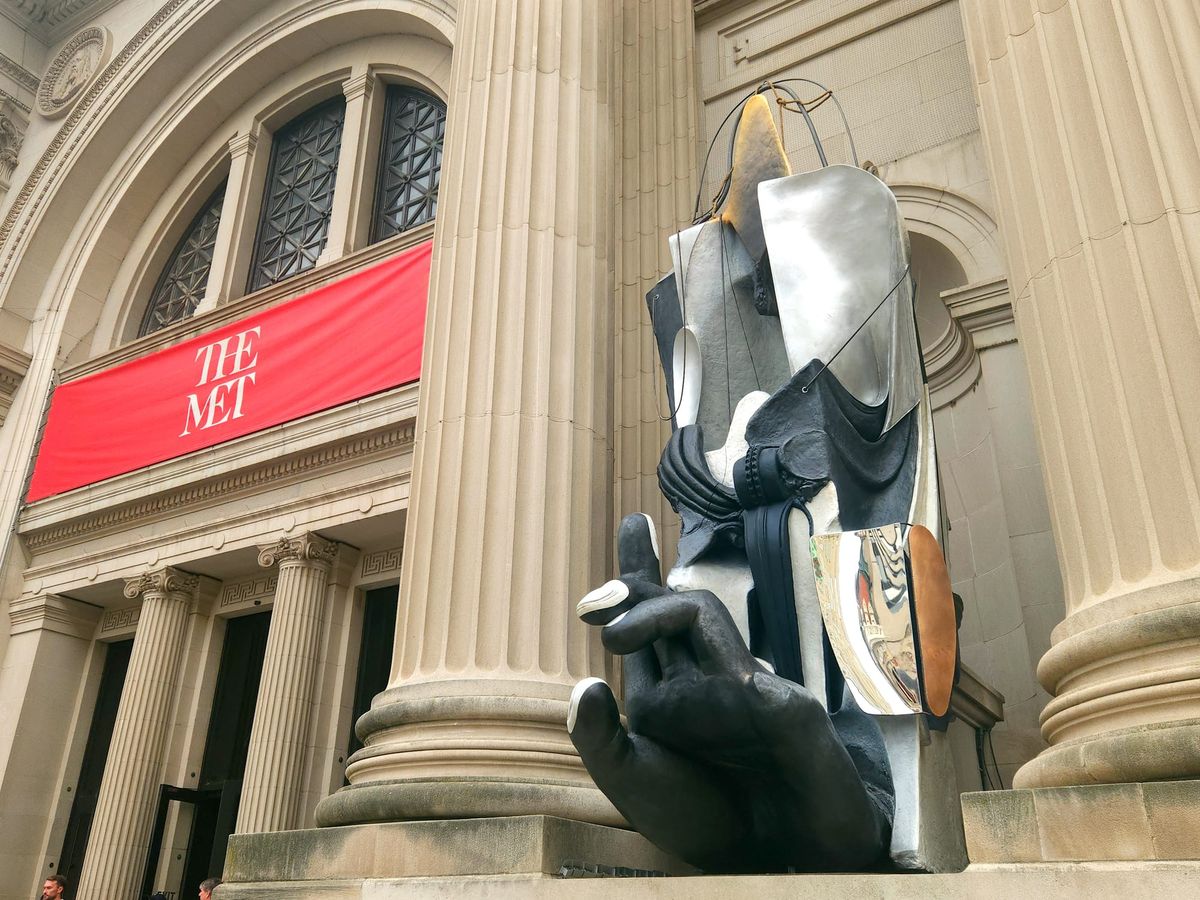
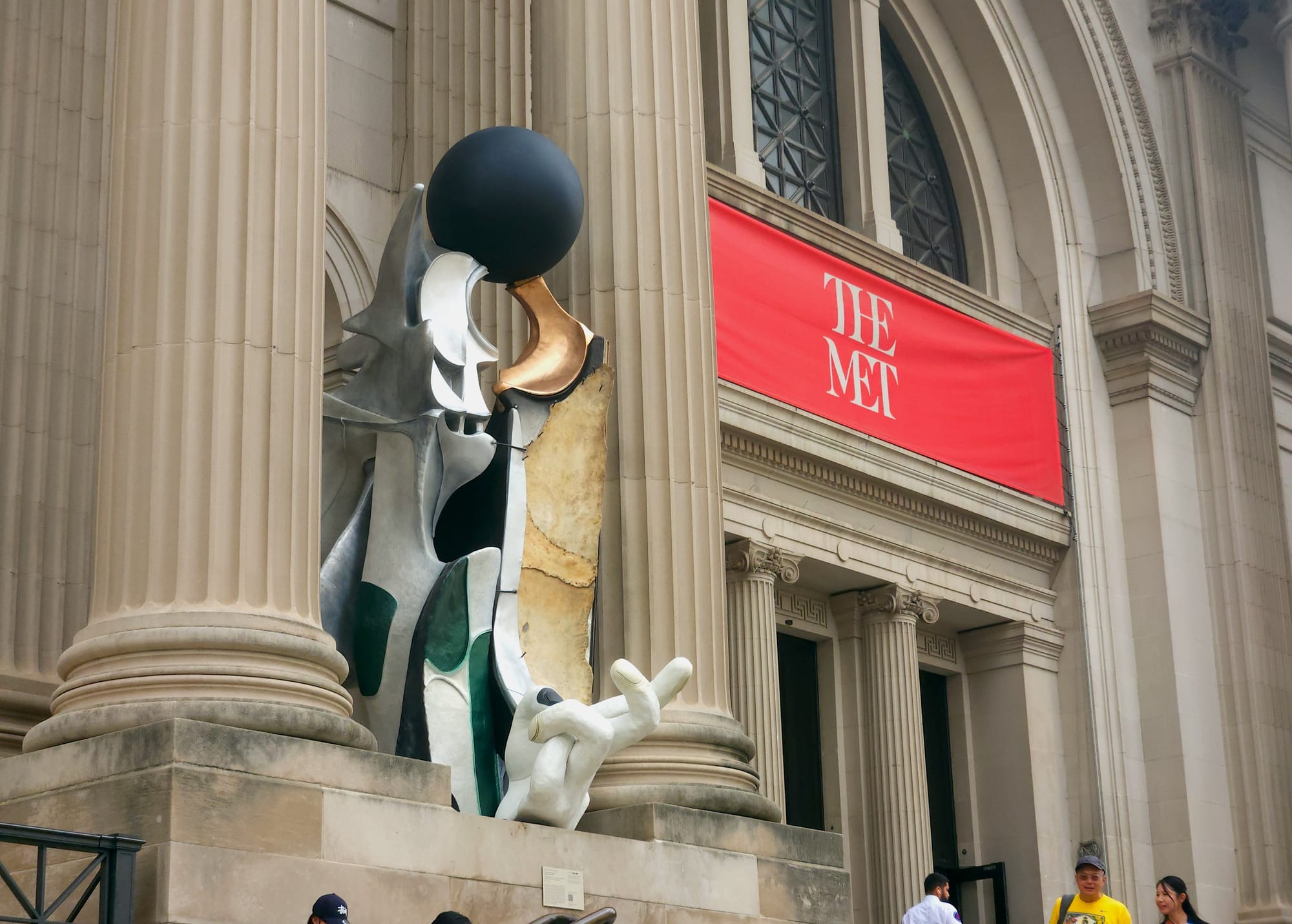
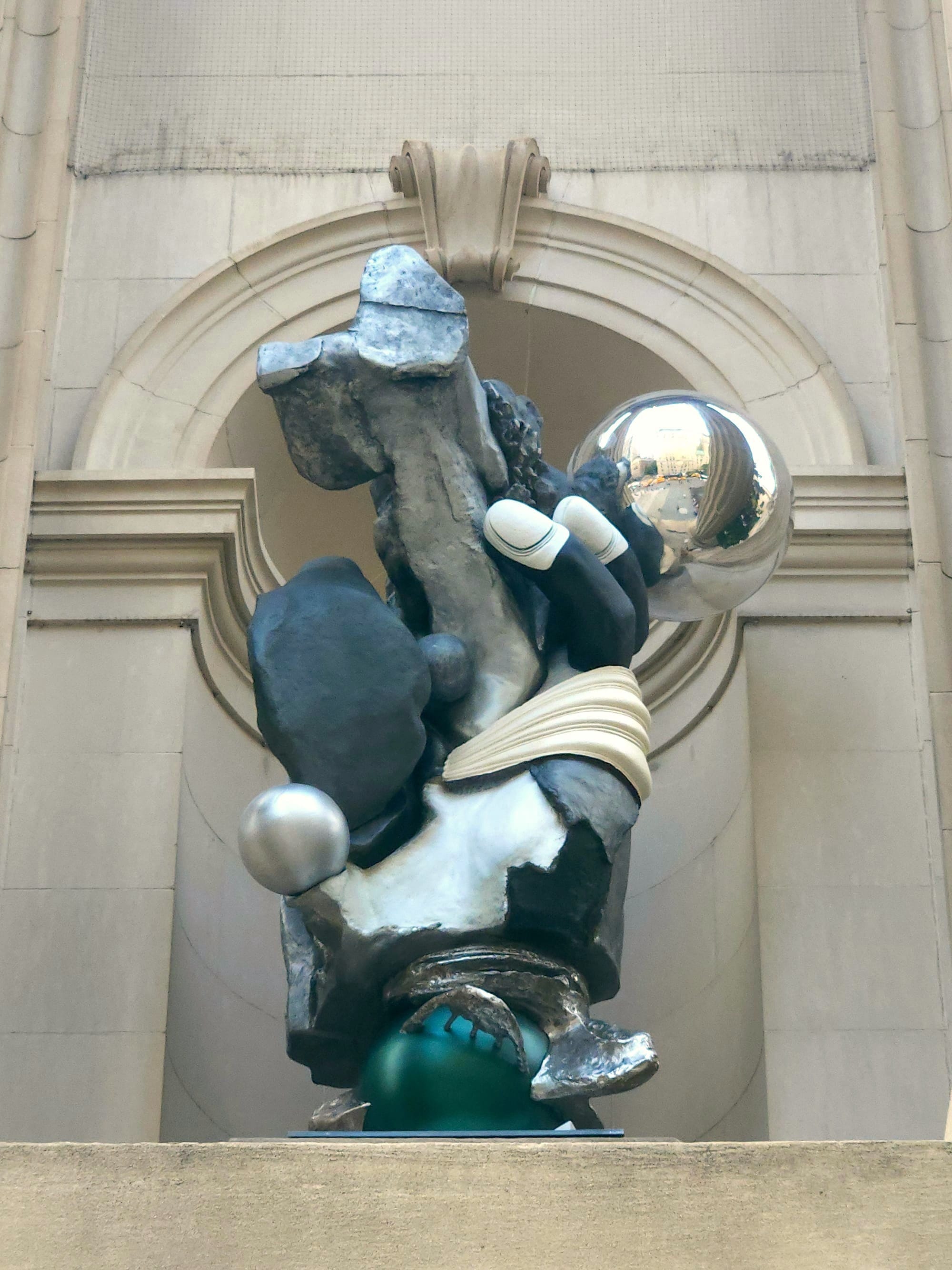
Flanking The Met’s grand neoclassical entrance and its towering Corinthian columns, Liu’s sculptures introduce a jarring, yet deeply contemplative, visual lexicon. Constructed from a hybrid of industrial metal and fiberglass composite forms, the works fuse abstracted archaeological motifs with futuristic architectural blueprints. Reflective, high-gloss surfaces and modernist spheres sit precariously atop towering, biomorphic columns. These vertical masses are punctuated by raw, provisional elements—nails, heavy-duty cords, thick ropes, and exposed metal bars—that visually suggest the forms are only tenuously held together.
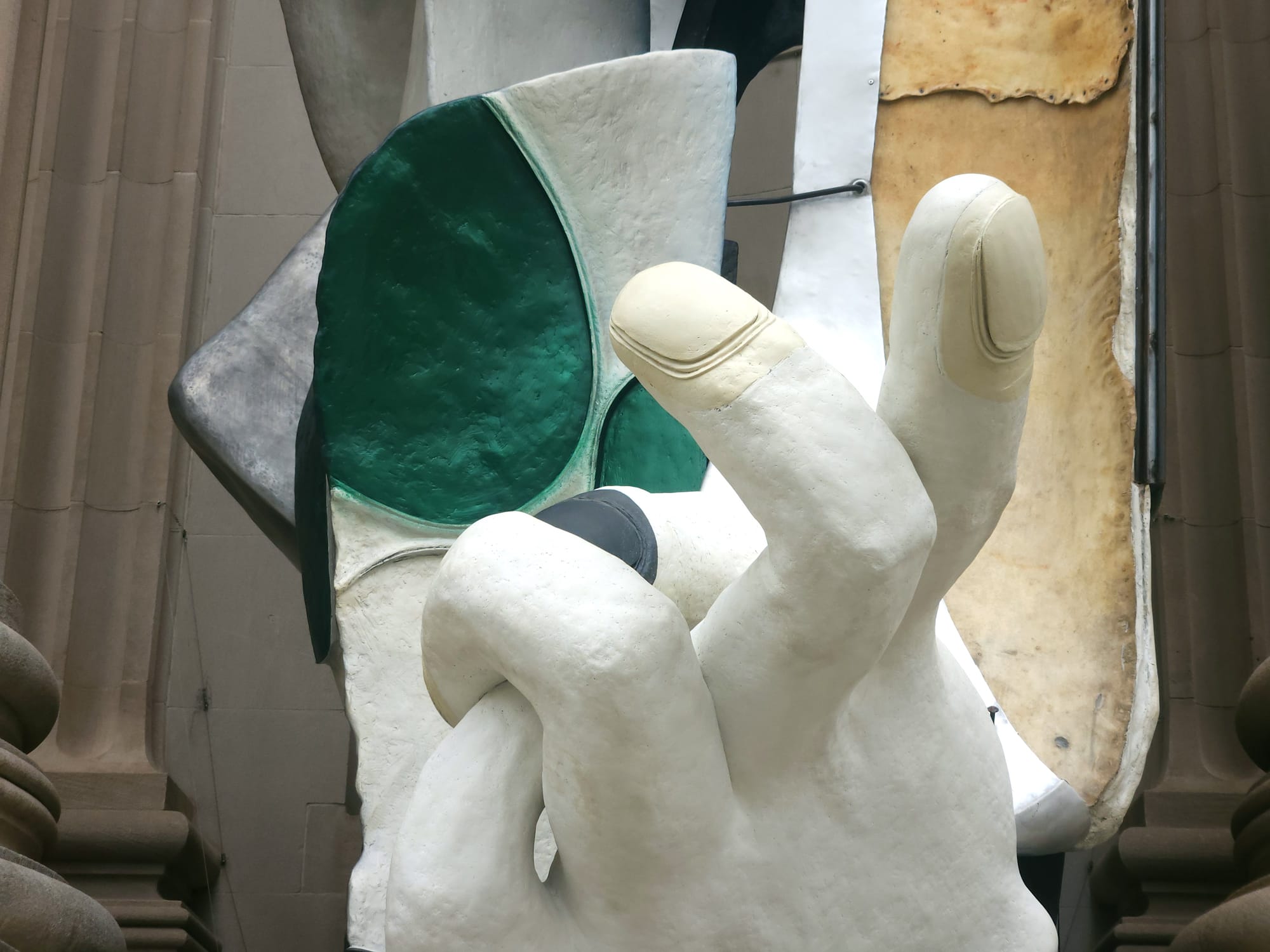
At the base of the two primary sculptures, massive, stylized hands emerge from the groundwork. Evoking distorted mudras—sacred symbolic hand gestures found in Hinduism and Buddhism historically utilized to channel and redirect energy—these figurative anchors ground the abstract structures while foregrounding humanity’s ongoing agency in making the imagined world tangible.
The Anatomy of Speculation: Materials and Metaphors
A closer examination of the individual sculptures reveals Liu’s meticulous blending of disparate organic and industrial materials. On the left-hand sculpture, the artist incorporates a tightly contoured, stitched section of bovine rawhide that hugs the sharp curves of an abstracted synthetic shape. Meanwhile, the right-hand sculpture features a matte black center form that immediately recalls the decorative wooden scrollwork of a traditional fireplace mantel.
By utilizing a wide array of industrial finishes and domestic textures, Liu sets up a deliberate dialogue with The Met’s historic limestone facade. The works neither mimic nor completely reject their environment; instead, they create an abrasive yet harmonious tension. The provisional aesthetic—highlighted by ropes and cords binding heavy metallic elements—serves as a visual metaphor for the precarious nature of modern construction and societal upkeep.
The installation marks the seventh iteration of The Met’s celebrated facade commission program, following a lineage of major contemporary artists who have recontextualized the museum’s exterior. Previous stewards of the niches include Wangechi Mutu, Hew Locke, Lee Bul, and Jeffrey Gibson. Liu’s contribution, however, leans heavily into the anxieties of globalization, manufacturing, and spatial destabilization.
Chronology of an Artist: From Post-Reform China to Fifth Avenue
To understand the conceptual weight of Speculation, one must trace Liu Wei’s trajectory against the backdrop of China’s late 20th-century history. Born in Beijing in 1972, Liu came of age during a period of profound national upheaval. He bore direct witness to the rapid urbanization, sweeping market reforms, and dizzying globalization that transformed China from 1978 onward.
As a key figure in the generation of Chinese contemporary artists who emerged in the wake of the 1989 Tiananmen Square protests, Liu became associated with a wave of creative provocation. Alongside peers who navigated the shifting socio-political landscape, Liu utilized irony, cynicism, and biting skepticism to critique frenetic technological growth and urban sprawl. His early works often toyed with the debris of consumerism, architecture, and political authority, positioning the artist not merely as a creator, but as an urban archaeologist cataloging the collateral damage of progress.
Over the ensuing decades, Liu’s practice evolved from playful, subversive installations made of everyday consumer goods—such as dog chews, books, and computer parts—into large-scale, architectonic sculptures that question the very blueprints of human civilization. The Met commission is a natural culmination of this decades-long inquiry, shifting his lens from the specific growing pains of Beijing to the universal, planetary condition of the 21st century.
Curatorial Vision and Official Responses
The Genesis Facade Commission was secured under the vision of Lesley Ma, curator of Asian art in The Met’s Department of Modern and Contemporary Art. Speaking on the conceptual underpinnings of the exhibition, Ma emphasized that Liu’s work speaks directly to contemporary anxieties surrounding human productivity and environmental endurance.
"In Speculation, Liu Wei asks us to confront our culture’s relentless processes of making and becoming," Ma stated in an official press release.
By inviting an artist whose roots lie in the hyper-accelerated urban expansion of East Asia to intervene in a monument of Western civic architecture, The Met has bridged geographies and histories. The commission arrives during a particularly energetic autumn for the institution. Just this week, the museum broke ground on its long-awaited, multi-million-dollar modern and contemporary Tang Wing—a project designed to overhaul its contemporary programming capabilities. Concurrently, The Met announced a major acquisition of 38 paintings by master Chinese ink painter Chang Dai-chien (Zhang Daqian), further cementing its commitment to global art historical narratives.
Public Reception: Voices on the Met Steps
As the afternoon sun cast long shadows across Fifth Avenue, visitors pausing on The Met’s iconic stone steps offered varied, deeply personal interpretations of Liu’s installations.
Shivani Jayant, a 23-year-old resident of New Jersey, stood with her cousin Raja, who was visiting New York City from New Delhi. The pair spent several minutes examining the contrasting textures and reflective qualities of the bronze and black finishes.
"It’s very New York, with these metal finishes in combination with the historic building," Jayant observed, noting how the sculptures manage to assert a distinct contemporary identity without being entirely swallowed by the monumental architecture behind them.
Raja, drawing on his own cultural background and a close inspection of the forms, noted multiple art-historical and spiritual cross-currents within the abstraction.
"The bronze and black coloration on the left made me think of Ancient Egypt," Raja said, pointing toward the gnarled fingers of the base. "And looking closely at the rightmost sculpture, I see an abstracted, almost geometric form reminiscent of Ganesha."
Reflecting on the tactile elements of ropes and bindings holding the massive structures together, Raja offered a poignant reading of the artist’s underlying thesis: "The ropes signify something being held together, like you’re molding something. It’s incomplete; it’s still being worked on. In that sense, it connotes industrialization, because that is a process that will never be completed."
Implications: The Unfinished Monument
Liu Wei’s Speculation arrives at a time of profound global introspection regarding infrastructure, climate change, and the longevity of civic institutions. By placing forms that suggest both construction and decay at the gates of a museum dedicated to preserving human history, Liu sets up a profound paradox.
The title itself—Speculation—operates on multiple semantic levels. Financially, it points to the speculative real estate bubbles and hyper-capitalist developments that shape modern skylines. Philosophically, it refers to the human habit of projecting futures, imagining architectures that have not yet been built, and forecasting the eventual ruins of those we leave behind.
In an era defined by supply chain disruptions, geopolitical volatility, and the relentless march of technological automation, Liu’s sculptures suggest that modern civilization is held together by increasingly frayed cords. Yet, by anchoring these precarious forms with human hands—gesturing toward energy, mindfulness, and creation—the work offers a cautious counterweight.
As Speculation greets millions of visitors over the coming months, it challenges the public to look past the permanent facade of the museum and contemplate the messy, ongoing, and ultimately fragile process of human becoming.



 Nana
Nana
 Iffa Jayyana
 Muslim
