

NEW YORK — In her ambitious, sprawling, and deeply unsettling new exhibition at the Solomon R. Guggenheim Museum, conceptual artist Taryn Simon confronts the viewer with a paradox of the modern security state: while individual tragedies and monumental historical traumas are meticulously investigated, the final conclusion of her sprawling visual detective story is that no single human being is ever truly accountable.
Entitled Father Country I Do Love You, the exhibition unfurls across the museum’s iconic galleries like a labyrinthine dossier, merging exhaustive forensic research with intensely personal mythologies. Through hundreds—perhaps thousands—of photographs, alongside sculptural installations, video elements, and an immersive exhibition design featuring brightly colored walls and heavy drapery, Simon presents a staggering web of global events. The materials cataloged recount incidents that sound like feverish conspiracy theories, yet they are anchored entirely in hard, verifiable fact.
Yet, by framing this vast geopolitical apparatus through the lens of unverified childhood folklore, Simon constructs a meditation on truth, bureaucracy, and systemic power where the lines between paranoia and historical reality continually blur.
The Genesis of an Investigation: Myth, Memory, and the FBI
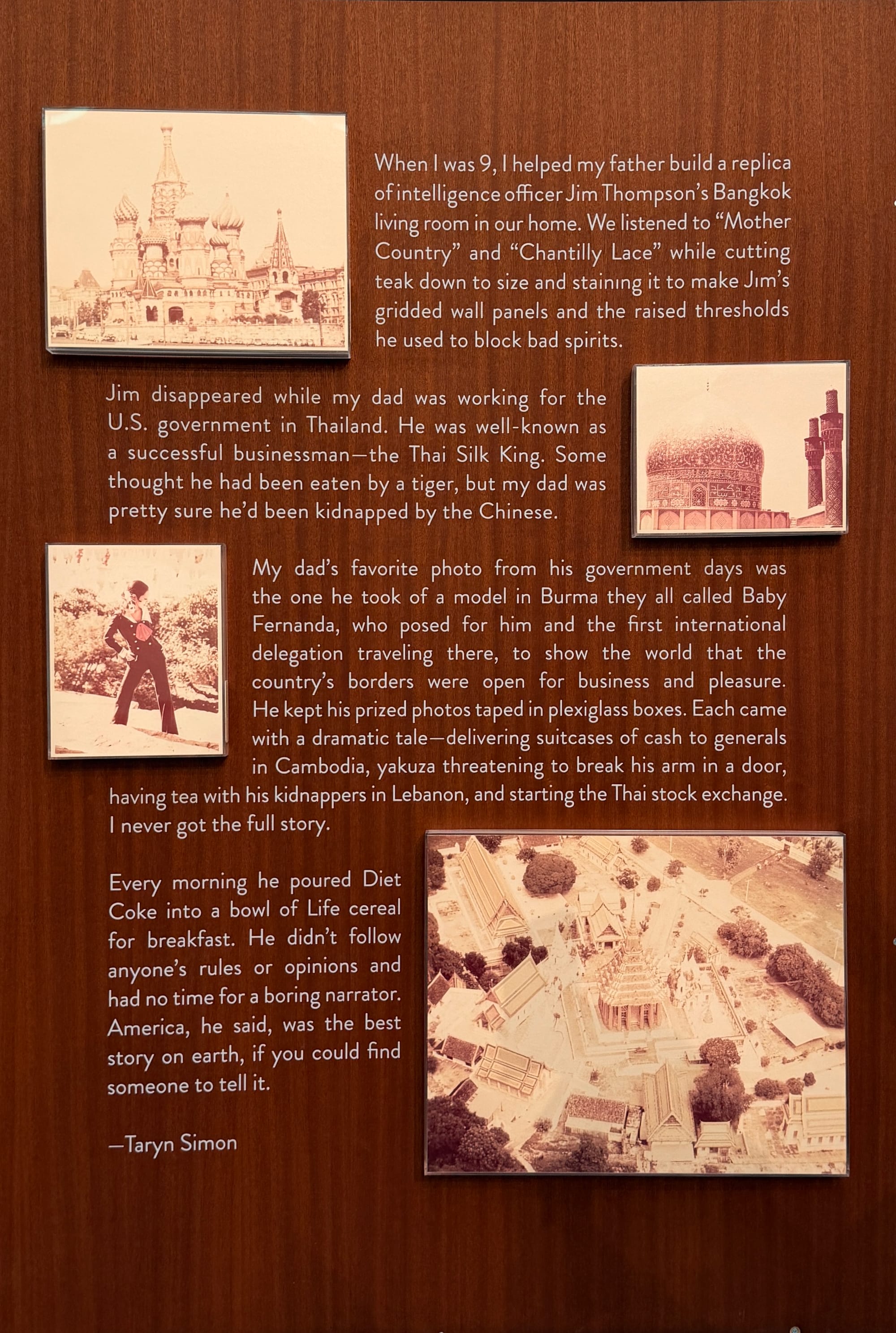
The exhibition opens not with a government document or a declassified file, but with two intimate text panels set against rich teak paneling. This architectural feature is a meticulous recreation of a replica living room—specifically, a replica of a room in Bangkok that Simon had helped her father build in their family home when she was a child, modeled after the quarters of an enigmatic intelligence officer he had befriended.
The first panel recounts her father’s tales of this shadowy figure, who died under mysterious, cinematic circumstances: either consumed by a tiger or abducted by Chinese agents. The text details her father’s eccentric habit of sealing prized photographs in plexiglass box frames, each accompanied by an outsized narrative.
“Each came with a dramatic tale—delivering suitcases of cash to generals in Cambodia, yakuza threatening to break his arm in a door, having tea with his kidnappers in Lebanon, and starting the Thai stock exchange. I never got the full story,” Simon writes.
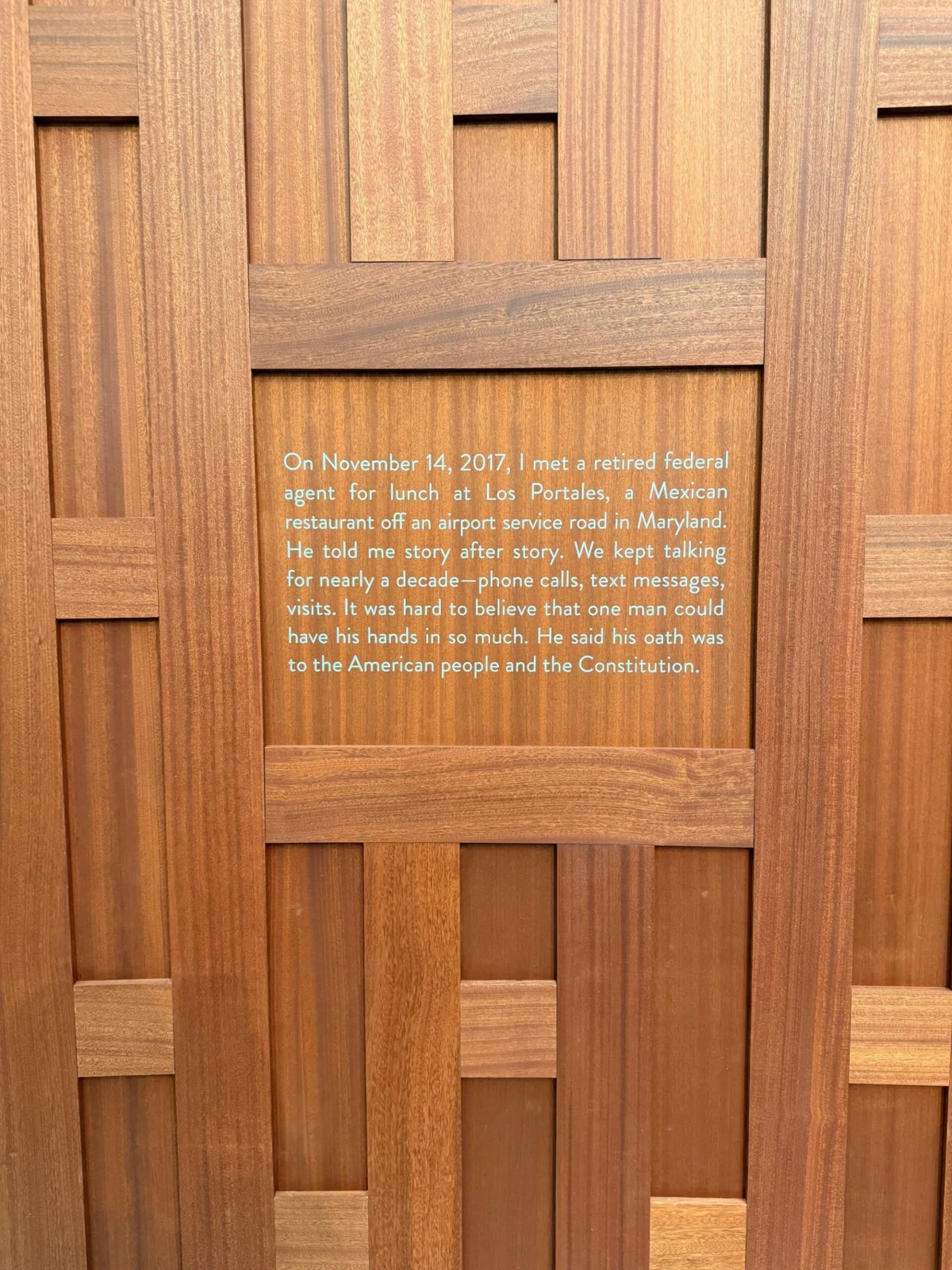
The second panel transitions from her father’s unverifiable recollections to Simon’s own contemporary encounters. A decade ago, she met a retired FBI agent. Over years of mediated communication—meted out through phone calls, encrypted text messages, and guarded in-person meetings—this former federal investigator became the primary protagonist and catalyst for the massive research undertaking that constitutes the Guggenheim exhibition.
Chronology of a Shadow Career: From DC Entrapment to Global Terror
The unnamed retired FBI agent whose recollections drive Father Country I Do Love You enjoyed a career that functioned as a Zelig-like presence across the most consequential crises of late-20th and early-21st-century American history. Simon’s exhibition traces his footprint across a dark chronology of modern trauma, transforming his personal CV into an architectural map of state security and crisis response.
- 1990 — The Entrapment of Marion Barry: Early in the timeline, the agent’s orbit touches domestic political scandal. During the high-profile federal sting operation that led to the drug arrest of Washington, D.C. Mayor Marion Barry, the agent found himself tasked with an incongruous assignment: babysitting the children of the model deployed by federal authorities to entrap the mayor.
- 1996 — The Explosion of TWA Flight 800: Following the catastrophic mid-air disintegration of TWA Flight 800 off the coast of New York, the agent was deployed to analyze the physical remnants of the wreckage, participating in one of the most complex forensic reconstructions in aviation history.
- 1998 — The East African Embassy Bombings: When al-Qaeda coordinated simultaneous truck bombings targeting United States embassies in Dar es Salaam, Tanzania, and Nairobi, Kenya, the agent was among the massive vanguard of approximately 900 federal personnel deployed to foreign soil to process the devastation.
- 1998–1999 — The Impeachment of Bill Clinton: Shifting from international terrorism back to the domestic political sphere, the agent was assigned to establish and oversee the secure evidence room utilized during the impeachment proceedings of President Bill Clinton.
- 2001 — The Pentagon Attack: Following the hijacked airliner attacks on September 11, the agent was dispatched to the Pentagon to sift through the smoldering debris, cataloging the human and material toll of the strike on the nation’s military headquarters.
Supporting Data and the Aesthetic of the Archive
Simon’s artistic practice has long been defined by an obsessive, almost encyclopedic collection of classified, overlooked, or hidden information. In Father Country I Do Love You, this methodology reaches a fever pitch. The exhibition space is flooded with visual data: archival photographs, technical manuals, architectural fragments, and cataloged objects that document the machinery of investigation.
By juxtaposing the grand scale of global cataclysms—such as terrorist attacks and presidential downfalls—with the mundane, bureaucratic labor of policing (such as cataloging airplane shrapnel or setting up an evidence room), Simon highlights the friction between chaos and control. The visual presentation rejects standard museum neutrality. Instead, the heavy drapery and vibrant gallery walls evoke a domestic interior distorted by surveillance, suggesting that the spaces where private life and state power intersect are claustrophobic and heavily curated.

Furthermore, the inclusion of her father’s apocryphal stories acts as an epistemological anchor for the exhibition. Because the viewer is told upfront that the artist “never got the full story” regarding her father’s globe-trotting exploits, a pervasive atmosphere of doubt infects even the most rigidly documented FBI files on display. Are these historical facts any less constructed than a childhood myth? Simon leaves the question hanging.
Official Responses and the Mechanics of Secrecy
The world inhabited by Simon’s primary source—the retired FBI agent—is one governed by non-disclosure agreements, classified clearances, and bureaucratic compartmentalization. In contemporary democratic states, agencies like the FBI operate under the mandate of accountability, yet the day-to-day reality of federal law enforcement and intelligence gathering is defined by opacity.
While the exhibition does not feature direct commentary from current federal spokespersons, the institutional shadow of the Department of Justice and the intelligence community looms heavily over the works. The artifacts and photographs expose the inherent limitations of official investigations. When a plane explodes mid-air, a building collapses from a terrorist bomb, or a political scandal erupts, hundreds of investigators sweep in to recover fragments. Yet, as Simon’s title and curatorial framing suggest, the collection of evidence rarely translates to human closure or genuine moral reckoning.
Implications: A System Without Villains
The most profound takeaway of Father Country I Do Love You lies not in the historical events it revisits, but in its philosophical conclusion about culpability. In traditional detective stories, whether fictional or journalistic, the narrative arc bends toward the exposure of a culprit—an individual actor whose malice, greed, or negligence caused the catastrophe.
Simon subverts this expectation entirely. Through the cumulative weight of her exhibits, injustice and tragedy are revealed to be entirely systemic. The crimes, disasters, and political upheavals cataloged in the museum are shown to be products of vast, bureaucratic machinations rather than the result of isolated individuals behaving badly.
The retired FBI agent is neither hero nor villain; he is a cog in a vast administrative machine, sifting debris, babysitting informants, and setting up evidence rooms because that is what the apparatus demands. By extension, the viewer is left to contemplate a chilling modern reality: in a world governed by sprawling intelligence networks, billion-dollar defense apparatuses, and labyrinthine legal frameworks, monumental harms are committed without anyone ever needing to pull a trigger in malice—and, consequently, no one is ever truly accountable.
Through this monumental exhibition, Taryn Simon succeeds in transforming the Guggenheim Museum into a hall of mirrors, reflecting back an American landscape shaped by paternal myth-making, federal surveillance, and an unending, unresolvable quest for the full story.
 Muslim
 Evan Lee Salim
 Jia Lissa
