

By Olivia Tauber
Published September 9, 2026
Apple’s “Surprise and Shine” keynote presentation on September 9, 2026, showcased the company’s long-anticipated entry into the foldable device market: the $1,999 iPhone Duo. During the highly choreographed corporate broadcast, the hardware appeared almost impossibly seamless, operating with fluid grace that left skeptics and loyalists alike wondering how the Cupertino giant had managed to conquer the notoriously difficult foldable form factor.
However, corporate presentations are carefully controlled environments. Once the livestream ended and early testers, journalists, and high-profile content creators flooded Apple Park to open, close, fold, and game on the physical hardware, a more nuanced picture began to emerge. The real-world verdict? The iPhone Duo is impressively thin, boasts lightning-fast software transitions, and features an internal display that comes remarkably close to eliminating the dreaded center crease—though physics has not been entirely defeated.
Main Facts: What Is the iPhone Duo?
The iPhone Duo represents a watershed moment for Apple, marking its official entry into the foldable smartphone segment years after competitors like Samsung, Google, and OnePlus established the category. Priced at a steep $1,999, the device is positioned as an ultra-premium flagship aimed at productivity enthusiasts, mobile gamers, and early adopters.

Key hardware specifications and features observed during the hands-on sessions include:
- The Display: A sprawling 7.6-inch internal flexible OLED screen paired with a functional, full-sized external cover display.
- The Build Profile: Despite housing a complex hinge mechanism and dual-screen architecture, the device maintains a remarkably thin profile when unfolded, drawing praise for its sleek ergonomics.
- Under-Display Technology: Utilizing advanced engineering, the iPhone Duo features an under-display camera on the interior screen, creating an uninterrupted viewing experience that caught several seasoned reviewers off guard.
- Release Timeline: Following its September 9 unveiling, the iPhone Duo is scheduled to officially hit store shelves and arrive in consumers’ hands on October 23, 2026.
Chronology of the Reveal and Hands-On Period
The rollout of the iPhone Duo followed Apple’s traditional high-impact product launch cadence, quickly spilling over into real-world chaos as creators tested the limits of the new hardware.
1. The Keynote Unveiling (Morning, September 9, 2026)
Apple kicked off its "Surprise and Shine" event with a sleek video package introducing the iPhone Duo. Executives emphasized the device’s durability, seamless software integration, and the proprietary hinge system designed to minimize wear and tear. The $1,999 price tag was announced alongside the October 23 release date, setting off immediate online debates regarding the cost-to-value ratio of first-generation foldables.
2. The Hands-On Floor Opens at Apple Park (Afternoon, September 9, 2026)
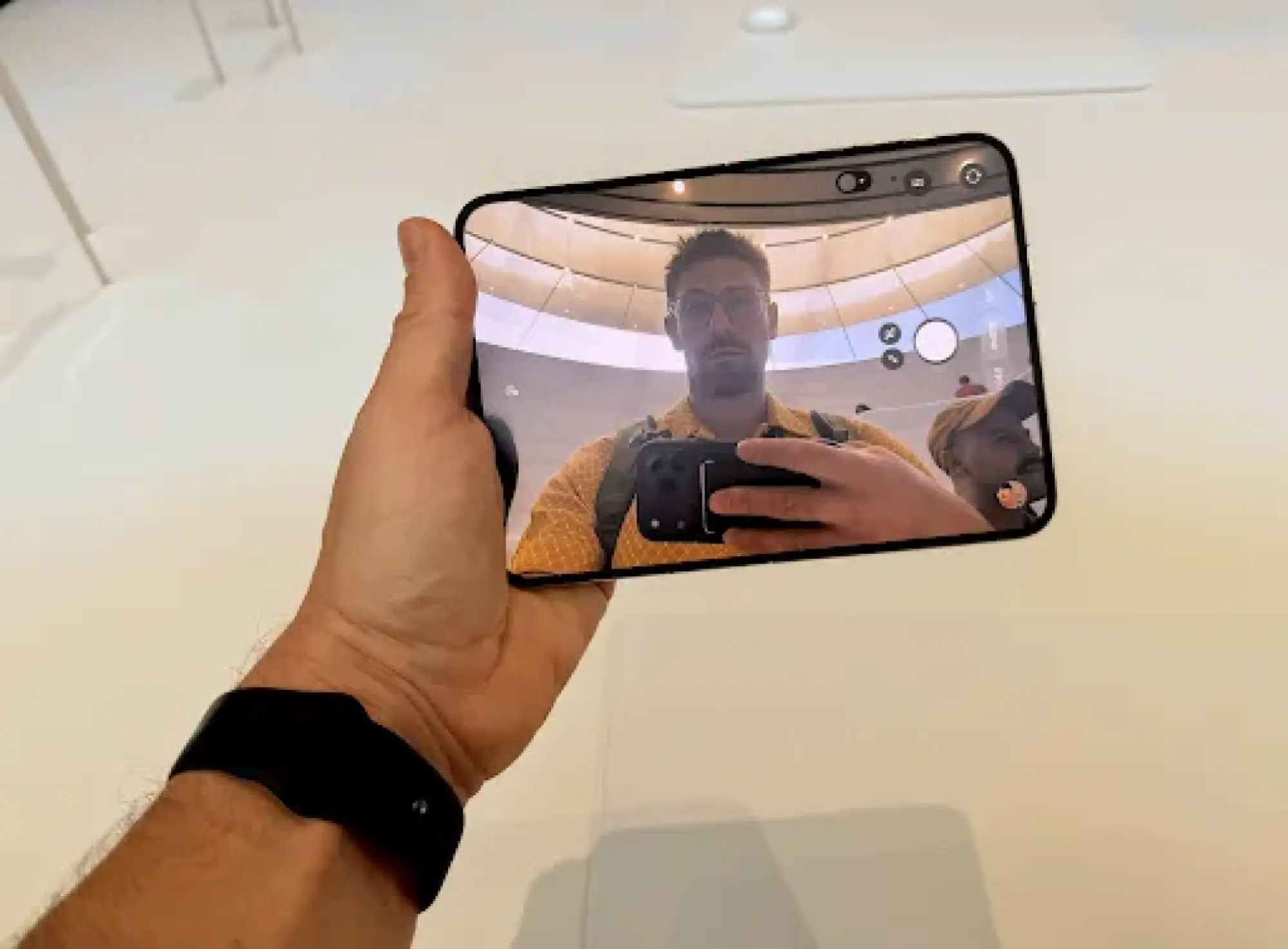
Immediately following the keynote, media members and invited content creators were given physical access to the devices. Mashable Senior Editor Stan Schroeder, stationed on the ground at Apple Park, was among the first to capture the phone’s physical footprint, highlighting its thin profile and testing the internal camera interface.

3. Creator Wave and Social Media Flooding (Late Afternoon, September 9, 2026)
As the afternoon progressed, social media channels were inundated with real-time video demonstrations. High-profile creators—including tech reviewer iJustine (Justine Ezarik), Max Weinbach, journalist Geoff Keighley, and YouTube streamer IShowSpeed—broadcasted their immediate reactions. Livestreams showed users repeatedly folding and unfolding the device, testing multi-app workflows, and running demanding mobile games across the expansive 7.6-inch canvas.
Supporting Data and Creator Observations
Reactions from the hands-on floor varied from unbridled enthusiasm to pragmatic technical critique.
Praise for Form Factor and Software Continuity
Max Weinbach took to social media to declare the iPhone Duo the "bar none best foldable" on the market, expressing particular shock at the efficacy of the under-display camera, which he admitted he "wasn’t expecting" to look so clean.
iJustine demonstrated the device’s media consumption capabilities, showcasing Netflix’s vertical video "Clips" feed as well as standard episodic streaming of Wednesday on the inner display. She also highlighted how the folding architecture allows the outer display to act as a precision viewfinder for high-resolution selfies using the primary camera array.

Journalist Geoff Keighley focused heavily on the device’s fluidity, highlighting the seamless transition animations as content shifts dynamically from the compact outer screen to the expanded tablet-sized interior display. Gamers and tech commentators noted that titles like Pokémon Go paired effortlessly with split-screen multitasking, such as running a social media feed alongside active gameplay.
The Debate Over the Crease
Not every observation was uniformly glowing. Gizmodo Senior Editor Ray Wong provided a vital, grounded perspective by filming the device from multiple lighting angles. When viewed straight-on, the 7.6-inch display appears nearly continuous. However, tilting the phone toward an overhead light source reveals a subtle, vertical crease running down the center of the panel.
"Can definitely see the screen crease at certain angles," Wong noted on social media.
While some online commenters expressed disappointment that Apple had not completely defied the laws of materials science, the broader consensus among hardware reviewers was that the crease is significantly less intrusive than those found on many competing foldable devices. As one tech commentator aptly summarized: "They are magicians, not Gods!"

Official Responses and Industry Context
Apple’s engineering team positioned the iPhone Duo not merely as a folding phone, but as a reimagining of portable computing. By leveraging iOS adaptations specifically tailored for dual-screen environments, Apple aims to solve the software fragmentation that has historically plagued Android foldables.
Competitors in the space are watching closely. The launch of the iPhone Duo validates the foldable category for mainstream consumers in a way that niche releases from Samsung or Motorola have built up to over the past half-decade. However, at $1,999, Apple is explicitly targeting a luxury demographic willing to pay a premium for cutting-edge form factors.
Implications for the Mobile Market
The arrival of the iPhone Duo carries profound implications for the consumer tech industry:
- Mainstreaming the Foldable: Apple’s brand power inherently legitimizes the foldable category. Consumers who previously dismissed folding phones as gimmicky tech experiments are likely to take a serious look at Apple’s ecosystem integration.
- Software Development Shift: With Apple officially backing a dual-screen device, third-party developers will face mounting pressure to optimize their applications for adaptive aspect ratios and multi-window workflows.
- Pricing Pressures: The $1,999 price point establishes a high ceiling for the market, potentially normalizing ultra-premium pricing tiers across competing manufacturers.
- Hardware Evolution: While the iPhone Duo proves that thin profiles and subtle creases are achievable, future iterations will undoubtedly focus on driving manufacturing costs down and improving crease elimination entirely under direct lighting.
As consumers await the official October 23 release date, the early hands-on period has successfully generated immense cultural momentum. Whether the iPhone Duo can sustain its honeymoon phase once it faces the rigors of daily public use remains to be seen, but Apple has undoubtedly altered the trajectory of mobile hardware design for the foreseeable future.
 Neng Nana
 Azzam Bilal Chamdy
 Muslim
