

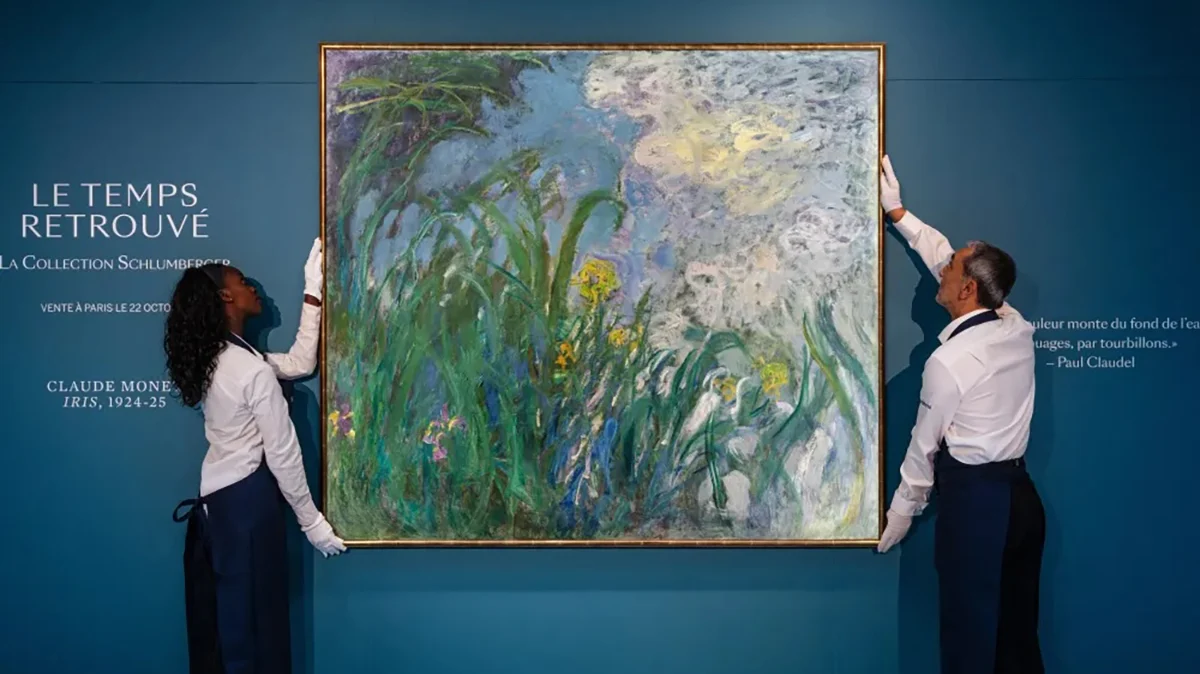
In a revelation that has sent shockwaves through the global art market, Sotheby’s Paris has announced the upcoming sale of a legendary private collection that has remained largely obscured from public view for decades. On October 22, the auction house will present "Le Temps Retrouvé: The Schlumberger Collection," a curated ensemble of 28 exceptional lots that serves as a time capsule of Impressionist and Modern genius. At the heart of this sale is a long-hidden Claude Monet masterpiece from his celebrated "Iris" series—a work so significant that experts predict it will shatter existing auction records for a painting sold in France.
The Crown Jewel: Monet’s Late-Career Vision
The centerpiece of the sale is an evocative, large-scale Monet painting from his Iris series, created between 1914–17 and revisited in 1924–25. Painted only a year before the artist’s death in 1926, the canvas is a masterclass in late-career abstraction. It features a lush, ethereal interplay of purple and yellow irises dancing across the surface of a pond.
Measuring a substantial 63 by 71 inches, this work is the largest example of the Iris series ever to hit the auction block and stands as the most significant late-period Monet remaining in private hands. With a pre-sale estimate ranging from €22 to €30 million ($25 to $34 million), the painting is poised to redefine the market for Impressionist works.
"Demand for Monet’s late works has never been this high," noted Thomas Bompard, Sotheby’s senior international specialist. "Collectors are finally recognizing that these final, more abstract paintings represent the absolute pinnacle of his artistic evolution."
A Chronology of Artistic Genius and Private Stewardship
To understand the gravity of this sale, one must look at the unique history of the Schlumberger collection. The collection is the fruit of an unlikely partnership between two visionary women: Jeanne Schlumberger (1889–1983), the heiress to the Schlumberger oil company, and the renowned art dealer Katia Granoff.
The Granoff-Schlumberger Partnership
In the mid-20th century, when the French art establishment was largely indifferent to the raw, experimental nature of Monet’s final works, Granoff saw something others missed. She famously liquidated much of her own wealth to acquire the contents of Monet’s Giverny studio directly from the artist’s son, Michel Monet.
Jeanne Schlumberger, a woman of independent means and a fierce intellect—noted for being one of the first women in France to hold a driver’s license and for her passion for high-performance sports cars—provided the essential financial backing for this ambitious endeavor. Together, the two women secured a trove of masterpieces, including works by Paul Cézanne, Pierre Bonnard, Gustave Moreau, Chaïm Soutine, and Georges Rouault.
Keeping the Flame Alive
Despite their profound impact on the preservation of these works, the duo operated in the shadows. Schlumberger was famously private, preferring to keep her treasures within the intimate confines of her home rather than courting the attention of Parisian high society. While she was a generous benefactor to museums, she guarded her private collection with a protective instinct, ensuring that these masterpieces remained in pristine condition for decades, away from the prying eyes of the public.
Supporting Data and Market Context
The timing of this auction is deliberate and symbolic. It coincides with the centenary of Monet’s death and an international resurgence of interest in his oeuvre, highlighted by a series of major exhibitions and the prestige of Art Basel Paris.

The Economics of the Impressionist Market
The market for late-period Monet works has seen a meteoric rise in recent years. Data shows that five of the top auction prices for Monet paintings are for works created after 1914. This shift in collector preference reflects a broader art historical consensus: that Monet’s final years, characterized by his move toward pure color and light, were his most revolutionary.
- Key Lot 1: Claude Monet, Iris, 1924–25. Estimate: €22–€30 million.
- Key Lot 2: Claude Monet, Saule pleureur (Weeping willow), 1918–19. Estimate: €9–€12 million. This work, painted with a somber fall palette in the aftermath of the First World War, underscores the artist’s profound emotional depth.
- Key Lot 3: Paul Cézanne, Paysage romantique aux pêcheurs (1862–64). Estimate: €400,000.
The Cézanne lot is particularly noteworthy. As an early, experimental landscape triptych originally intended for the family estate at Jas de Bouffan, it has been officially classified as a "national treasure." This designation grants the French government a 30-month window to exercise a right of first refusal to acquire the work for the nation, adding a layer of bureaucratic drama to the auction proceedings.
Official Responses and Expert Analysis
Thomas Bompard, speaking on behalf of Sotheby’s, emphasized the historical weight of this collection. "Jeanne Schlumberger and Katia Granoff recognized the radical brilliance of these works at a time when many still overlooked them," Bompard stated. "One collected, the other championed; both trusted their instincts when the world seemed to have already made up its mind."
The decision to auction the collection is being viewed as a "coming out" party for works that have defined the private life of the Schlumberger family for nearly a century. By bringing these pieces to the market, the family is not only liquidating a massive asset but also ensuring that these masterpieces enter a new chapter of global appreciation.
The Wider Implications
The sale of the Schlumberger collection serves as a barometer for the health of the high-end art market. In a period of economic uncertainty, "blue-chip" works by artists like Monet and Cézanne continue to act as a hedge, attracting interest from ultra-high-net-worth individuals, institutional buyers, and private foundations.
The Legacy of the Private Collector
The story of Jeanne Schlumberger and Katia Granoff challenges the traditional narrative of the art dealer as a purely commercial agent. By betting on the late works of a dying artist, they acted as custodians of history. Their preference for privacy—while frustrating for art historians of the 20th century—has resulted in the survival of works in a state of preservation that is rarely seen in the contemporary market.
What Comes Next?
As the art world turns its eyes toward Paris in October, the auction of "Le Temps Retrouvé" will be closely watched. If the Iris painting reaches or exceeds its $34 million estimate, it will set a new benchmark for the French market, potentially encouraging other families holding "hidden" masterpieces to follow suit.
For the public, the unveiling of these works is a rare opportunity to witness the final creative output of a genius who changed the trajectory of Western art. Whether these pieces end up in another private collection or find their way into the hallowed halls of major museums, the sale marks a significant moment in art history, closing the chapter on one of the most intriguing, and most private, collections of the 20th century.
 Pevita Pearce
 Suro Senen
 Sagoh
Sagoh
