In the competitive and often self-serious landscape of contemporary downtown theater, bold conceptual gambits are par for the course. However, few productions in recent memory match the audacious, irreverent premise of The Wreck of the Unbelievable, a new off-off-Broadway play written by and starring the artist known simply as Sleth.
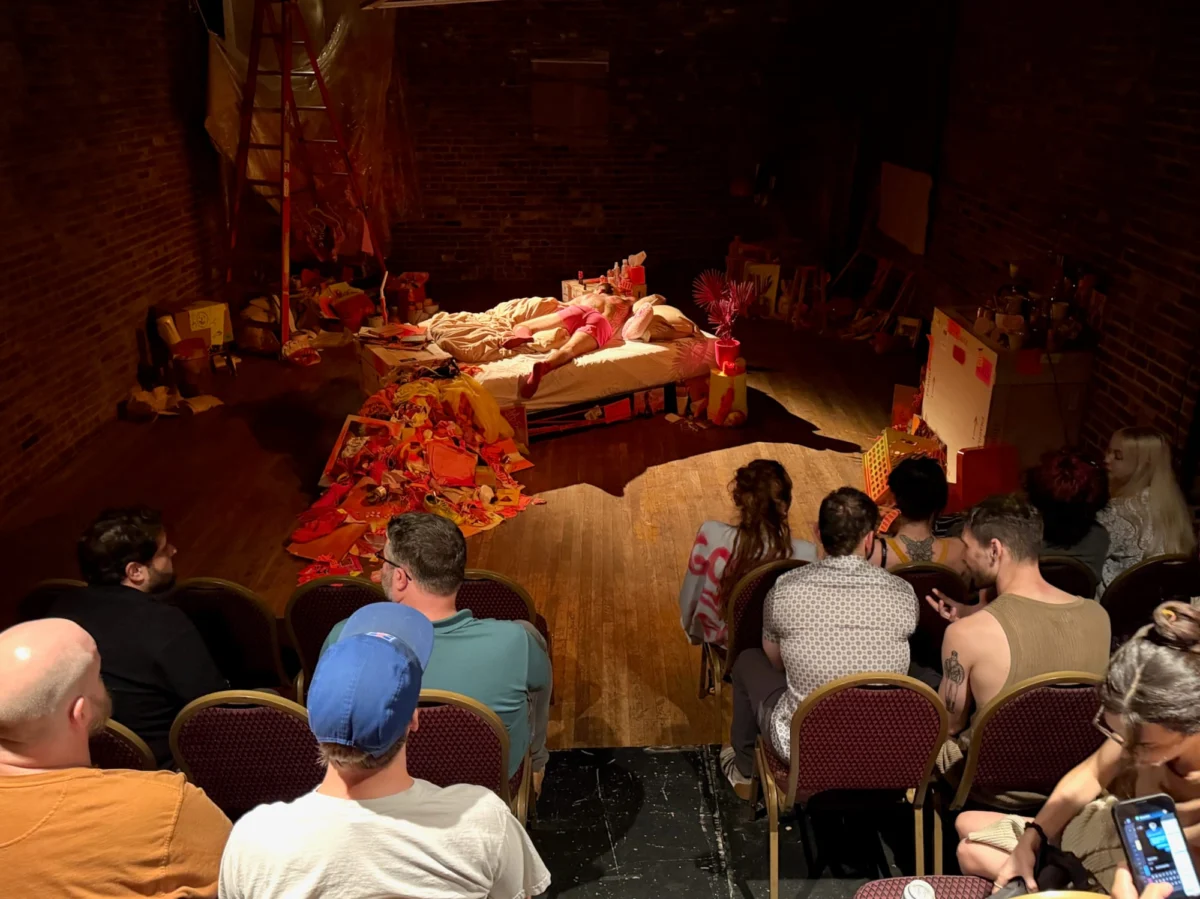
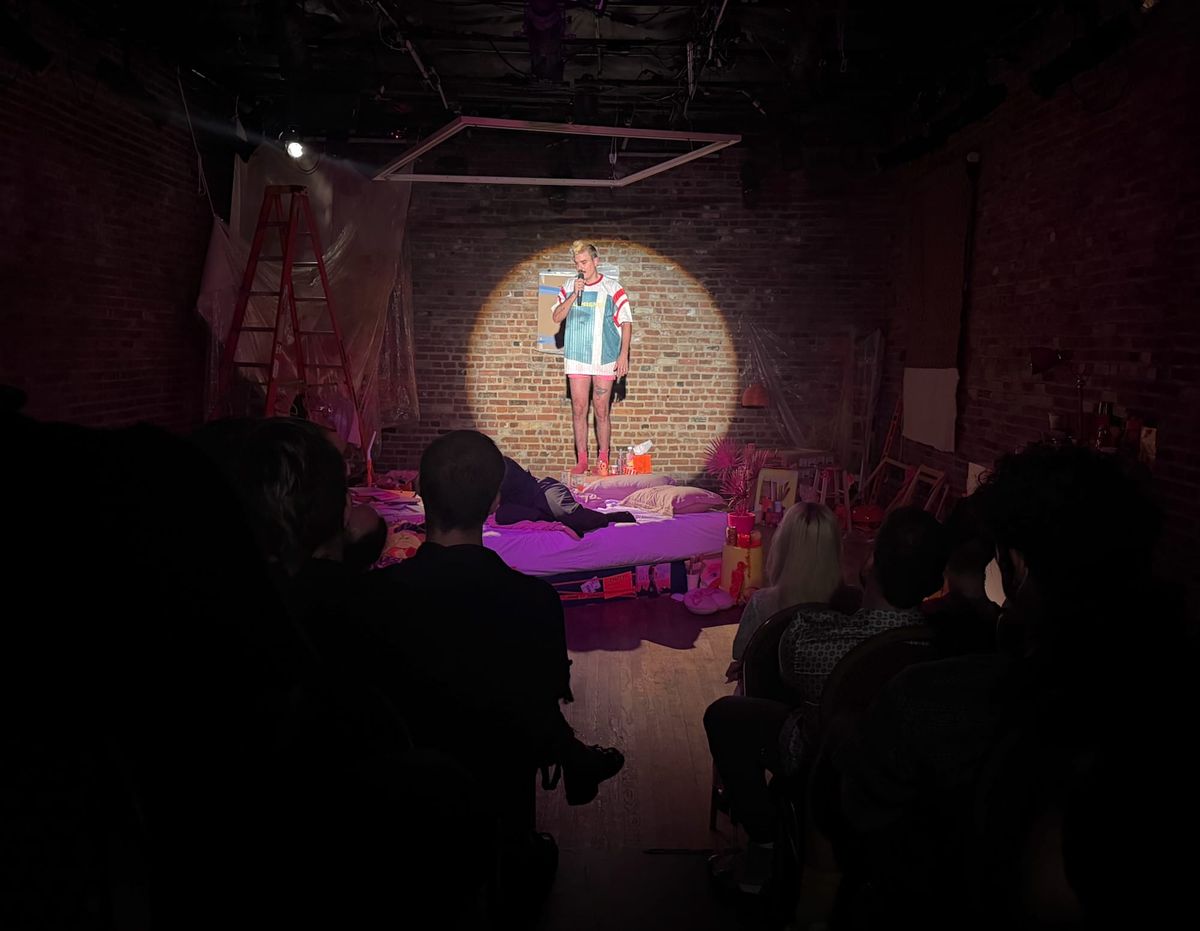
The production centers on a wildly provocative, entirely fictional premise: Damien Hirst—the billionaire titan of the Young British Artists (YBAs) generation—has died, leaving behind a grieving, heartbroken secret lover named Shape. Played with sharp, deadpan charisma by Sleth, Shape is introduced to audiences sprawled face-down, ass-up on a disheveled, debris-strewn mattress. The set piece immediately evokes Tracey Emin’s seminal 1998 installation My Bed, signaling a playful yet biting engagement with contemporary art history right from curtain-up.
To be clear, Hirst is very much alive and, to the best of public knowledge, straight. Yet, by leaning into this fever-dream narrative, The Wreck of the Unbelievable uses the tabloid-ready tabloid fiction of a secret gay affair as a Trojan horse. It explores deeper, more universal themes: the intoxicating nature of infatuation, the corrupting machinery of the art market, and the heavy psychic toll exacted upon young artists who crave nothing less than absolute fame and fortune.
Running at just over 80 minutes, the play has generated considerable buzz within New York’s tight-knit art and performance circles. It pairs raw, confessional dialogue with striking visual cues, blending high-concept absurdity with sharp critiques of institutional opportunism.
Chronology
The Genesis of a Conceptual Drama
The journey of The Wreck of the Unbelievable from concept to stage reflects the DIY ethos of New York’s independent theater ecosystem. Sleth, navigating both the visual art world and the performance scene, conceived the project as an interrogation of how contemporary culture commodifies relationships, legacy, and artistic genius.
The play’s development relied on intimate workshops and readings across Brooklyn and Manhattan art spaces before securing its current off-off-Broadway run. By casting himself as Shape, Sleth embedded a layer of meta-performance art into the production: the creator embodying the fictionalized victim of an art-world titan’s magnetic, destructive pull.
Act I: The Mattress and the Mythos
The production begins before a single line of dialogue is spoken. As theatergoers file into the intimate venue, they are greeted by the sight of Shape resting motionlessly on the aforementioned mattress. The room smells faintly of stale smoke and old memories—an olfactory scene-setting that anchors the audience in the squalor of bohemian romantic failure.
The quiet is broken by the arrival of Mara, an old party friend from Shape’s past who has undergone a conventional professional metamorphosis, landing a prestigious position as an assistant curator at the Guggenheim Museum. The dynamic between Shape and Mara immediately establishes the play’s comedic and dramatic tension. Shape greets her success with scathing indifference, casually joking that the Guggenheim isn’t exactly the kind of institution that truly matters compared to the avant-garde purity of places like the Whitney Museum or MoMA.
Act II: The Curatorial Extraction
As the narrative unfolds, Mara’s true motives come to light. She is not visiting out of nostalgic affection; she is racing against the clock to organize a rushed, high-profile retrospective of Hirst’s work for the Guggenheim. Desperate for a scoop that will cement her curatorial coup, Mara attempts to extract juicy, sensationalized, and deeply private details about her friend’s supposed romance with the late billionaire.
What was the YBA star really like behind closed doors? she probes. Shape feeds her sensational answers, leaning into the mythology while subtly mocking her institutional hunger for scandal. The dialogue dances between genuine heartbreak and grotesque comedy, highlighting how personal intimacy is routinely flattened into marketing copy for museum blockbusters.
Climax and Resolution: Surrealism and Memory
The play’s final act shifts away from naturalistic dialogue toward stylized, expressionistic sequences. Shape and Mara grapple with the ghosts of their shared past, supported by tightly choreographed lighting and stage design. A lingering puff of smoke hovers above the stage like a Surrealist painting, symbolizing the elusiveness of memory. In another striking moment, the stage is suddenly flooded with eerie ultraviolet light, evoking the unsettling, hyper-real photographic tableaux of Sandy Skoglund. Through these transitions, The Wreck of the Unbelievable moves past gossip, leaving the audience with an aching meditation on what it means to be left behind by history.
Supporting Data and Production Details
The Wreck of the Unbelievable
Writer/Lead Actor: Sleth (performing as "Shape")
Format: Off-off-Broadway theater production
Runtime: Approximately 80 minutes (with critics noting potential for a 15-minute trim to sharpen pacing)
Visual References & Homages:
Tracey Emin’s My Bed (1998) – referenced directly through the central set piece.
Sandy Skoglund – evoked through UV-lit, eerie staging sequences.
The Young British Artists (YBAs) – the historical framework underpinning Hirst’s fictionalized legacy in the play.
Key Characters:
Shape: A struggling artist whose work consists of digging holes in the ground; grieving a fictional, secret romance with Damien Hirst.
Mara: Shape’s former party acquaintance turned Guggenheim Museum assistant curator, driving the play’s plot through her quest for retrospective gossip.
Official Responses and Critical Reception
While The Wreck of the Unbelievable has not yet drawn formal statements from Damien Hirst or representatives of the Guggenheim Museum—largely due to its obvious satirical and fictional nature—the theatrical and artistic community has responded with a mixture of amusement, critical analysis, and nuanced critique.
Critical Consensus
Reviewers have largely praised the production’s infectious energy and bold visual ambition, even while noting structural imperfections.
"A strangely infectious, if uneven, little play about obsession that takes on the fantastical premise in which renowned artist Damien Hirst is dead," noted arts coverage of the opening weeks.
Critics have highlighted that while the 80-minute runtime occasionally sags in the middle acts—suggesting a tighter edit could sharpen the narrative punch—the play succeeds on the strength of its world-building. The set design has received particular acclaim for its economy and impact, transforming a modest stage into a dense psychological landscape where high-art aspirations collide with squalid reality.
Artistic Reception
Among indie artists and downtown theatergoers, Sleth’s willingness to skewer the solemnity of the blue-chip art world has struck a chord. By framing Hirst not as an untouchable genius, but as the center of a messy, human web of power imbalances, the play offers a cathartic release valve for younger creatives grappling with systemic inequality in the contemporary art market.
Implications
The Wreck of the Unbelievable is far more than a cheeky, tabloid-baiting theatrical prank; it touches on several critical cultural and economic shifts within the contemporary art world.
1. The Commodification of Intimacy
At its core, the play dissects how institutional forces consume human relationships. Mara’s willingness to mine her former friend’s private grief for a museum exhibition mirrors the broader art market’s appetite for biography over substance. In an era where an artist’s personal brand, lifestyle, and romantic entanglements often outweigh the physical work they produce, Sleth’s play holds up a mirror to the voyeurism inherent in high-culture curation.
2. The Myth of the YBA Legacy
By using Damien Hirst—the ultimate symbol of 1990s excess, market manipulation, and celebrity art-making—as its focal point, the production questions the sustainability and myth-making of the YBA generation. Hirst’s real-world career has long challenged the boundaries between commerce and fine art; The Wreck of the Unbelievable extends this logic into the realm of personal legacy, asking what remains of an icon once the hype machine moves on.
3. The Precarity of Alternative Art Practices
Through Shape’s character—an artist whose physical output consists of literal holes in the ground—the play contrasts institutional wealth with underground precarity. While curators like Mara chase the big names for blockbuster foot traffic, artists operating at the fringes struggle with obscurity and economic instability. The juxtaposition of a Guggenheim curator hunting for gossip against a backdrop of poverty underscores the vast chasm separating the institutional elite from the underground creators who fuel contemporary culture’s raw energy.
Ultimately, The Wreck of the Unbelievable succeeds because it refuses to take itself too seriously while tackling profoundly serious questions. In doing so, Sleth has carved out a unique space on the New York stage—proving that sometimes, the best way to critique the art world’s absurdities is to invent a dead billionaire, a grieving lover, and a mattress full of memories.



 Nana
Nana
 Iffa Jayyana
 Muslim
