

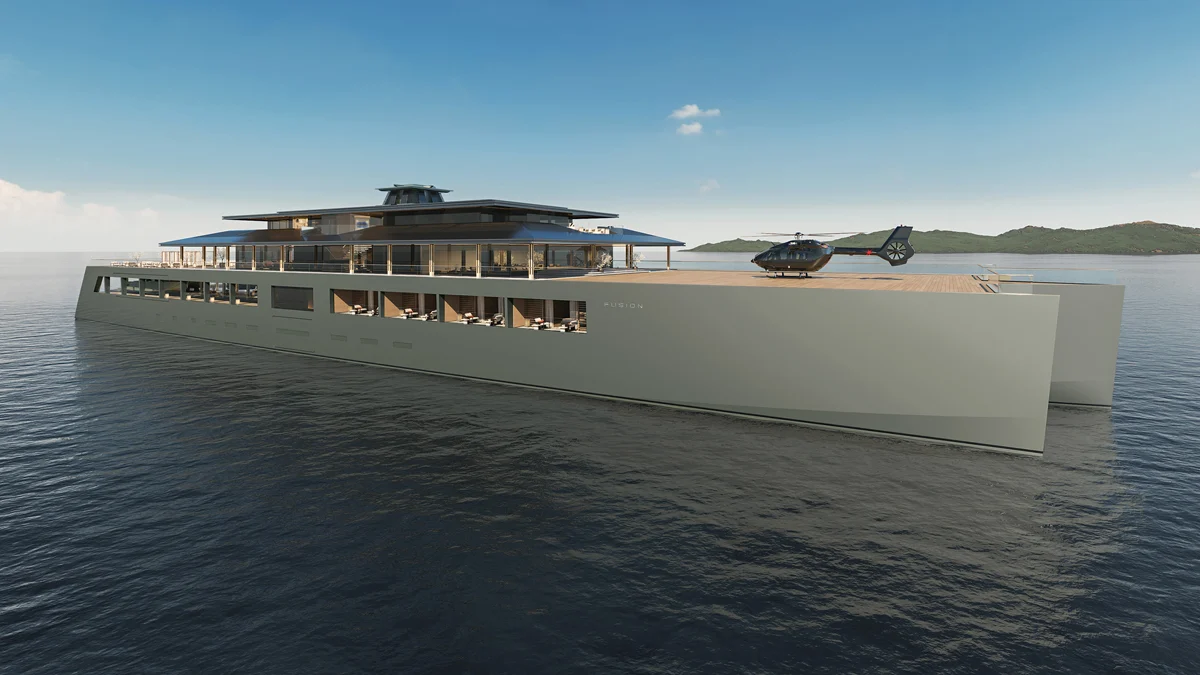
The Monaco Yacht Show has long served as the global stage for the world’s most ambitious maritime designs, but this year, the Dutch design powerhouse Sinot Yacht Architecture & Design has eclipsed the competition with an announcement that promises to redefine the physics of superyacht luxury. The studio, globally renowned for its willingness to push the boundaries of naval architecture, has officially unveiled Fusion—a 387-foot trimaran concept that, if commissioned, would immediately claim the title of the world’s largest vessel of its kind, comfortably dwarfing the current record-holder, the 276-foot White Rabbit.
The Architecture of Excess: Core Facts
Fusion is not merely a vessel; it is a architectural statement. Measuring 387 feet in length and spanning an impressive 98 feet in width, the trimaran utilizes a revolutionary three-hull configuration. Unlike traditional monohull superyachts, which rely on sheer volume and draft to maintain stability, Fusion employs a lengthy, slender center hull flanked by two shorter, high-buoyancy side hulls.
This structural geometry provides a stable, high-performance platform that offers nearly 36,000 square feet of exterior deck space. By distributing the weight and structural requirements across three points of contact, Sinot has managed to create an expansive "floating island" aesthetic that challenges the traditional limitations of yacht design. The result is a hybrid vessel that functions with the grace of a high-speed cruiser and the volume of a deep-sea explorer, effectively eliminating the need for owners to choose between agility and utility.
A Chronology of Innovation: From Vision to Reality
The journey to Fusion began in the design offices of Sinot’s Dutch headquarters, where the primary objective was to address a growing paradox in the ultra-high-net-worth market: the demand for both rugged, long-range exploration and opulent, sedentary luxury.
For years, the design team analyzed the performance of trimarans in the commercial and racing sectors, noting their inherent efficiency and stability at sea. The conceptualization phase took approximately 18 months, focusing on how the "three-hull" architecture could be translated into a living space that feels cohesive rather than fragmented.

Following the initial design phase, Sinot spent the past year refining the engineering feasibility, ensuring that the vessel could comply with international maritime regulations without requiring a total overhaul of the design. During this time, they worked closely with naval architects to ensure that the "Playdeck" and the structural integrity of the triple-hull connection could withstand the demands of the open ocean. The culmination of this research was the official unveiling at the 2026 Monaco Yacht Show, where the design was presented not as a distant pipe dream, but as a "ready-to-build" project.
Supporting Data and Technical Specifications
The technical specifications of Fusion read more like a small city than a private boat. Beyond its staggering dimensions, the vessel is designed for maximum versatility.
Interior and Wellness
- Wellness Center: A dedicated 3,300-square-foot sanctuary featuring a full-service spa, specialized hydrotherapy equipment, and a signature plunge pool.
- The Gym: An expansive health area equipped with a counter-current swimming pool, allowing for endurance training in the middle of the Atlantic.
- Cinema: A state-of-the-art screening room featuring a bespoke 8K MicroLED video wall, providing an immersive experience that rivals the finest land-based media rooms.
- Owner’s Residence: Situated on the private owner’s deck, the master suite includes dual bathrooms, custom-fitted dressing rooms, a private lounge, a dedicated office, and a terrace with panoramic views of the horizon.
The Social Heart
The dining lounge serves as the social nexus of the yacht, anchored by an 18-seat formal dining table. Adjacent to this area is a glass-bottomed pool, which acts as a skylight for the main deck below, where the vessel’s fleet of tenders is housed.
The "Playdeck"
Perhaps the most ambitious feature is the foredeck, which Sinot has branded the "Playdeck." This modular space is engineered to accommodate a full-sized tennis court. When the court is not in use, the space can be transformed into a high-octane open-air sports arena or a sophisticated outdoor nightclub for evening entertainment. Furthermore, the deck is fully equipped to support the landing and storage of helicopters and Vertical Take-Off and Landing (VTOL) aircraft.
Official Statements and Design Philosophy
Sander J. Sinot, the founder and principal designer of the studio, emphasized that Fusion is a response to the changing psychological needs of modern yacht owners.

"Three near-full-length hulls come together as one architecture, and that changes what is possible aboard a yacht of this size," Sinot stated during the press conference at Monaco. "Our owners no longer want to choose between culture and adventure, between serenity and action. Fusion is designed so they don’t have to."
The design philosophy centers on the idea of "holistic living." By creating a vessel that is inherently stable, Sinot argues that the owner’s experience is fundamentally improved. The reduction in pitching and rolling, typical of the trimaran configuration, allows for the installation of features—such as the glass-bottomed pool and the high-definition cinema—that would be difficult to manage on a traditional, less-stable monohull.
Implications for the Maritime Industry
The unveiling of Fusion has sent shockwaves through the shipyards of Northern Europe and beyond. The most significant implication of this project is the validation of the trimaran as a viable, luxury-focused configuration for the superyacht sector.
Engineering Maturity
For decades, the trimaran has been relegated to the realm of high-speed ferries or experimental racing yachts. By applying this technology to a 387-foot luxury vessel, Sinot is pushing the industry toward a new standard of efficiency. Trimaran hulls, by design, offer lower hydrodynamic resistance than monohulls of equivalent volume, which could lead to significant reductions in fuel consumption—an increasingly important factor for environmentally conscious owners.
The "Ready-to-Build" Standard
Perhaps most disruptive is Sinot’s assertion that the project is "ready to build." By completing the preliminary engineering, Sinot has removed the most common barrier to entry for prospective owners: the fear of the "concept cycle." In the superyacht world, many designs languish in digital portfolios for years. By positioning Fusion as an engineering-ready package, Sinot is courting serious buyers who have the capital and the desire to bypass the multi-year design phase.

A New Era of Hybridization
Finally, Fusion represents the total convergence of the explorer vessel and the luxury cruiser. Historically, these two categories were distinct; explorers were utilitarian, steel-hulled, and focused on range, while luxury cruisers were focused on aesthetic beauty and guest comfort. Fusion bridges this divide by providing the "modcons" of a hotel with the range and deck utility of a scientific research vessel.
Conclusion: The Horizon Beckons
As the Monaco Yacht Show draws to a close, the conversation surrounding Fusion is less about whether it is possible, and more about who will be the first to commission it. Sinot Yacht Architecture & Design has successfully shifted the goalposts of what a superyacht can be.
Should a client step forward, the construction of Fusion would be a historic undertaking, requiring a shipyard capable of managing the complex structural joining of three distinct hulls. However, the blueprints are drawn, the engineering is vetted, and the ambition is clear. Fusion stands as a testament to the fact that, in the world of yachting, the only limit to scale and performance is the designer’s imagination. For now, the world waits to see if this colossal trimaran will move from the glossy pages of a concept brochure to the blue waters of the Mediterranean, forever altering the silhouette of the superyacht fleet.
 Pevita Pearce
 Suro Senen
 Sagoh
Sagoh
