

By Dominika Tomaszewska-Mortimer, Geneva
22 September 2026
The humanitarian landscape in Yemen has reached a harrowing new nadir. As military hostilities intensify across multiple volatile front lines, the UN Refugee Agency (UNHCR) has issued a dire warning: a fresh wave of mass displacement is sweeping across the nation, further destabilizing an already fragile region and stretching humanitarian resources to their absolute breaking point.
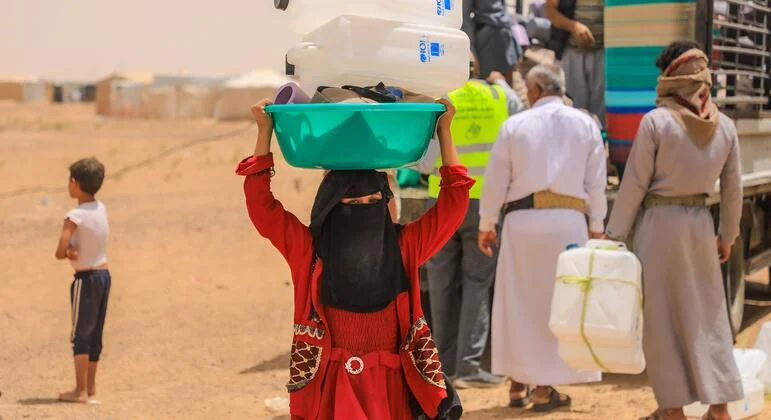
Since the dawn of September, the escalation of violence has forced more than 130,000 individuals to abandon their homes in a desperate bid for survival. This latest surge in displacement is not merely a statistical anomaly; it is the human manifestation of a protracted conflict that shows no signs of abating, despite years of international mediation efforts.
The Anatomy of a Growing Crisis: Main Facts
The current escalation is driven by a series of rapid military maneuvers. Following the advancement of Iran-backed Houthi fighters down Yemen’s western coastline toward the strategically vital Bab el-Mandeb Strait, clashes with Saudi-backed Yemeni Government forces have intensified. These military engagements have turned residential areas into active battlegrounds, leaving civilians trapped in the crossfire.
UNHCR spokesperson Babar Baloch, speaking from Geneva, highlighted the grim reality of the current situation. “Fighting in Yemen is expanding across multiple front lines, triggering a rapidly growing displacement crisis,” Baloch stated. The epicentre of this turmoil is the city of Taiz in south-western Yemen, which currently accounts for more than 60 percent of the total displacement recorded this month.
The displacement is not localized to a single region. Significant outflows of people have been documented in the governorates of Al Jawf, Marib, and Hudaydah. Perhaps most tragic is the demographic composition of those fleeing: the vast majority are women and children. For many of these families, this is not their first experience of forced migration; they are "serial displacees," having been uprooted multiple times over the course of the decade-long conflict.
Chronology of Escalation: From Stagnation to Surge
To understand the current crisis, one must look at the timeline of the conflict’s evolution in 2026:
- Early 2026: Yemen entered the year already suffering from a decade of economic collapse and structural decay. The baseline for humanitarian need was already catastrophic, with 5.2 million people internally displaced.
- Late Summer 2026: Tensions along the western coast began to boil over as military posturing increased around the Bab el-Mandeb Strait, a critical maritime chokepoint.
- September 1–15, 2026: Houthi forces initiated a swift southward advance. Government forces responded with defensive operations, leading to heavy artillery exchanges in densely populated areas.
- September 22, 2026: The UNHCR formally declared a new, acute emergency phase, citing the 130,000 newly displaced persons and the emerging refugee crisis across the Gulf of Aden.
Supporting Data: The Scale of Suffering
The statistics surrounding the Yemeni crisis are staggering. Before the latest September surge, the humanitarian landscape was already defined by extreme need.
The Demographic Burden
- Total Internal Displacement: Prior to the current escalation, 5.2 million Yemenis were already internally displaced.
- Humanitarian Need: Approximately 22 million people—over half of the country’s total population—are currently in urgent need of humanitarian assistance to survive.
- Refugee Hosting: Despite its own internal struggles, Yemen remains a host to approximately 65,000 refugees and asylum seekers, primarily from Ethiopia and Somalia, who now find themselves in the same precarious position as their Yemeni hosts.
The Regional Spillover
The crisis is no longer contained within Yemen’s borders. Civilians are increasingly braving the dangerous transit across the Gulf of Aden to reach Djibouti. To date, more than 3,000 Yemenis have arrived in Djibouti, a figure that has already surpassed the total number of arrivals from previous years combined. Similar, though smaller, influxes have been reported in Somaliland and Puntland. UNHCR officials warn that as sea conditions improve in mid-October, these numbers could swell to exceed 10,000 new arrivals in Djibouti alone.
Official Responses and the Funding Gap
The international community’s response to this crisis is currently hampered by a severe lack of financial backing. The UNHCR, which serves as a primary lifeline for these vulnerable populations, is facing a funding shortfall that threatens the continuity of life-saving operations.
In Djibouti, the UNHCR’s operation is currently only 15 percent funded. Within Yemen itself, the situation is similarly dire. Of the $194 million requested by the agency for 2026 to address the existing humanitarian baseline, only $34 million has been received. This represents a massive deficit that leaves millions without access to food, medical care, or emergency shelter.
"Many families remaining within the governorate itself are unable to move to safer locations due to fighting, blocked roads, or lack of transportation fuel," Mr. Baloch explained. The inability of humanitarian aid to reach these "trapped" populations due to active combat and infrastructure failure remains one of the most significant challenges for UN agencies on the ground.
The Broader Implications: A Future in Jeopardy
The humanitarian implications of this escalating conflict are profound and long-lasting.
1. The Death of Infrastructure
The physical destruction of Yemen’s roads, coupled with the systemic lack of fuel, has turned the simple act of fleeing into a death trap. Families are forced to remain in conflict zones not out of choice, but out of a lack of mobility. This creates a "bottleneck" effect where civilians are hemmed in by active hostilities.
2. The Economic Collapse
The economic fabric of the country has been shredded. With the collapse of the Yemeni currency and the destruction of trade routes, the cost of basic necessities—when they are available—has skyrocketed beyond the reach of the average citizen. This economic despair is a primary driver of the current displacement, as families can no longer afford to live in urban centers where the cost of living has become unsustainable.
3. The Refugee Crisis
The shift from internal displacement to international refugee flight is a critical inflection point. When populations begin to cross the sea to Djibouti and the Horn of Africa, it signals a complete loss of faith in the safety of the homeland. The international community is now forced to contend with the potential for a regional migration crisis that could destabilize neighboring countries, which themselves have limited resources to handle a large influx of refugees.
4. The Moral Failure of Mediation
The fact that this conflict has dragged on for more than a decade is a testament to the failure of diplomatic efforts. The "rapid advance" of military factions suggests that local and regional actors are prioritizing territorial gains over the lives of millions of civilians. As the front lines shift, the humanitarian mandate—which relies on neutral access—is increasingly squeezed by political actors who view aid as a secondary concern to military victory.
Conclusion: A Call for Urgent Intervention
As of late September 2026, Yemen stands at a precipice. The combination of military escalation, extreme funding shortfalls, and a lack of safe passage for civilians paints a bleak picture for the coming winter months. Unless there is an immediate cessation of hostilities and a surge in international funding, the humanitarian community will be unable to prevent a further, larger-scale loss of life.
The world’s attention may be fragmented, but the crisis in Yemen is clear: it is a man-made catastrophe that requires not only sympathy, but the political will to end the fighting and the financial commitment to save those who have lost everything. For the 130,000 people who have fled their homes this month, the time for diplomatic maneuvering has long since passed; for them, the crisis is not a statistic, but a daily, desperate struggle for survival.
 Nana Muazin
 Azzam Bilal Chamdy
 Layla Zulfa
