

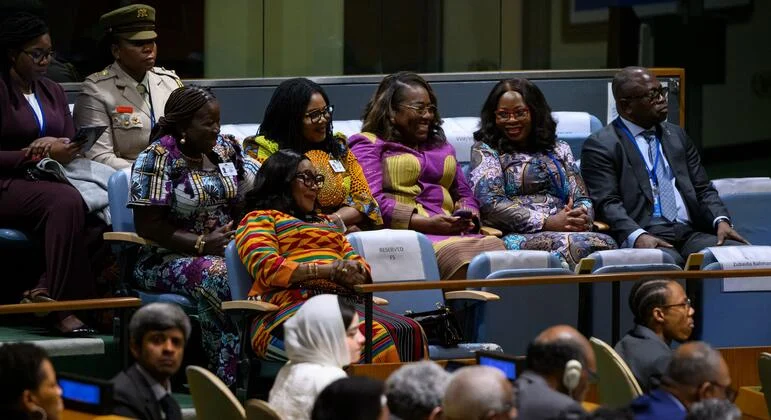
Date: 26 September 2026
Location: United Nations Headquarters, New York
As the 81st session of the United Nations General Assembly (UNGA) entered its fourth day, the center of gravity shifted decisively toward the global periphery. Leaders from Small Island Developing States (SIDS)—stretching from the turquoise expanses of the Caribbean to the vast, vulnerable archipelagos of the Pacific—delivered a collective, impassioned ultimatum to the international community: the time for incremental climate policy has passed. For these nations, the climate crisis is not a future projection, but a present-day reality that is redrawing maps, destroying economies, and challenging the very sovereignty of their states.
The Main Facts: A Call for Existential Justice
The rhetoric on Friday was defined by a shift in tone from "pleading" to "demanding." Small island leaders utilized the General Assembly podium to dismantle the narrative that climate change is merely an environmental issue. Instead, they framed it as a fundamental failure of global equity.
The core of their argument rests on three pillars:
- Sovereignty and Geography: With rising sea levels already breaching coastal defenses and contaminating freshwater lenses, several leaders noted that their national boundaries are effectively being erased.
- Economic Inequity: The current international financial architecture, they argued, treats climate assistance as a form of "charity," when it should be viewed as a debt-based obligation or, at the very least, a matter of reparative justice.
- The Ripple Effect: Global instability, particularly in far-off war zones, is acting as a force multiplier for economic hardship in the islands, causing spikes in the prices of imported food and fuel.
Chronology of the Debate: A Day of Reckoning
The fourth day of the high-level debate began with a morning session dominated by Pacific Island leaders, who spoke with a unified voice regarding the "unfinished business" of the 20th century.
- Morning Session (10:00 AM – 1:00 PM): The focus was on the legacy of nuclear testing in the Pacific. Leaders detailed the ongoing struggle with radioactive contamination, which continues to cause health crises and forced displacement. They argued that the historical trauma of nuclear weapon testing is being compounded by the modern trauma of climate-induced displacement.
- Afternoon Session (3:00 PM – 6:00 PM): The debate shifted to the Caribbean and Indian Ocean, where the focus turned to "Ocean Protection as National Protection." Delegates emphasized that for island nations, the Exclusive Economic Zone (EEZ) is not just a commercial resource but the bedrock of national identity and security.
- Evening Session (6:00 PM – 9:00 PM): The session concluded with a stern warning regarding geopolitical tensions. Leaders expressed profound concern that the "great power" competition in the Pacific is diverting attention—and funds—away from the sustainable development goals (SDGs) that keep their nations afloat.
Supporting Data: The Reality of the Crisis
While the speeches were emotional, the underlying data presented by these delegations was stark and chilling.
According to reports referenced during the assembly, small island States are facing a "triple threat":
- The Debt Trap: Many SIDS are paying interest rates on climate-resilient infrastructure loans that are significantly higher than those available to developed economies, despite having contributed the least to global carbon emissions.
- Military vs. Climate Spending: Speakers highlighted a glaring disparity: global military expenditure continues to soar toward record levels, often cited in trillions, while the "Loss and Damage" funds promised to help vulnerable nations adapt to climate change remain chronically underfunded and mired in bureaucratic delay.
- Water Security: Data provided by scientific agencies during the side-events suggested that the salinity of groundwater in atolls has increased by nearly 15% in the last decade, directly threatening the agricultural viability of these nations.
Official Responses and Diplomatic Friction
The reaction from larger, industrialized nations was varied. Representatives from the G7 and other major emitters acknowledged the validity of the island nations’ concerns, often citing "ongoing commitments" to the Paris Agreement and pledges for green energy transitions.
However, this was met with skepticism by the SIDS bloc. One Prime Minister from the Pacific remarked, "We have heard the commitments before. We are tired of the promises; we are here for the policy."
The diplomatic friction was most evident during the discussion on "transboundary water governance." As water scarcity becomes a global security issue, the SIDS reminded the assembly that water is not just a commodity to be traded but a fundamental human right. They demanded a greater role in the global management of transboundary aquifers and oceanic resources, asserting that the status quo—where large maritime powers dictate the rules—is inherently exclusionary.
Implications for Global Security
The implications of the fourth day of the UNGA are profound. The debate underscored that "security" is no longer defined solely by the absence of war, but by the presence of stability—environmental, economic, and social.
1. Geopolitical Competition in the Pacific
The warnings issued regarding the disruption of major waterways hit a nerve. As geopolitical tensions rise, the supply chains that island nations rely on for 90% of their essential goods are becoming increasingly volatile. A conflict thousands of miles away can lead to a starvation crisis in a remote archipelago, a vulnerability that is now being explicitly linked to the broader UN security agenda.
2. The Nuclear Legacy
By bringing the issue of nuclear testing back to the center of the debate, Pacific leaders have forced the international community to confront the long-term, intergenerational costs of past military actions. This has created a new framework for "Climate Justice"—one that links the damage done by the nuclear age to the damage being done by the fossil fuel age.
3. A New Financial Architecture
The call to reform the global financial system is gaining momentum. The "Bridgetown Initiative" and other similar frameworks were frequently invoked as the only viable path forward. If the international community fails to reform how climate finance is disbursed, the SIDS warned that the result would be a wave of "climate refugees" that no nation, regardless of its wealth or border security, would be able to ignore.
Conclusion: The Path Ahead
As the sun set on the fourth day of the UN General Assembly, the message from the small island States remained clear: they are the "canaries in the coal mine" of the global order. Their struggle is a litmus test for the effectiveness of the United Nations itself.
If the organization cannot protect the most vulnerable members of its community from the existential threats of climate change and economic exploitation, then its credibility as a global governing body is in jeopardy. As one delegate succinctly put it, "We are not asking for a favor. We are asking for the international community to respect the basic right to exist. If our islands sink, the world’s moral standing sinks with us."
As the Assembly moves into its final days, the pressure is now on the major powers to pivot from rhetoric to action, providing not just words of empathy, but the tangible, large-scale financial and technical support required to keep these nations above the rising tide. The world is watching, but for those on the frontlines, waiting is no longer an option.
 Nana Muazin
 Azzam Bilal Chamdy
 Layla Zulfa
