

Main Facts
In the heart of Bristol, a city internationally celebrated for its rich counter-cultural heritage and vibrant street art scene, a newly installed vinyl mural has triggered a fierce backlash. Mounted on the exterior wall of the Jolly Colliers Pub in the Bedminster district, the artwork was generated entirely by artificial intelligence. Far from celebrating the city’s unique visual culture, the piece has been widely condemned not only for its reliance on synthetic media rather than human labor, but also for its staggering array of geographical and art-historical blunders.
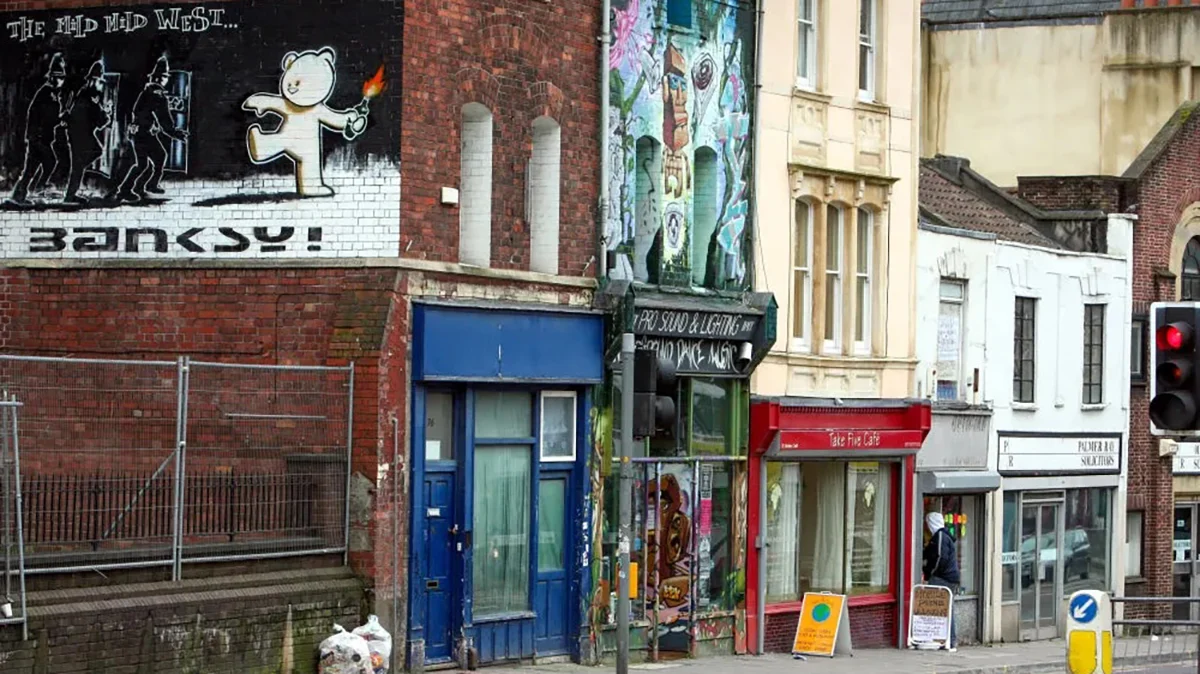
The botched AI creation attempts to pay homage to Bristol’s storied urban landscape, yet it fundamentally misunderstands the subjects it seeks to portray. Most notably, the mural features a deeply flawed interpretation of Mild Mild West (1999), one of the most famous early works by Bristol’s most infamous anonymous export, Banksy. Instead of depicting the original piece’s iconic oversized teddy bear aggressively hurling a Molotov cocktail at a line of riot police officers, the AI-generated version renders a bizarre, one-legged figure pointing vacuously into space.
Furthermore, the mural botches local landmarks. It presents an inaccurate, warped iteration of Cabot Tower—a historic landmark perched on Brandon Hill—and reduces the SS Great Britain, Isambard Kingdom Brunel’s legendary maritime engineering marvel, to a dwarfed, unrecognizable afterthought.
The installation has ignited a firestorm of protest from Bristol’s tight-knit creative community. Local artists, collectives, and heritage advocates view the mural not merely as an aesthetic failure, but as an existential threat to authentic creativity, a blatant dismissal of local talent, and a symptom of a broader corporate apathy toward the livelihoods of working artists.
Chronology of the Controversy
The unfolding saga of the Jolly Colliers Pub mural highlights the rapid friction that occurs when automated technology intrudes upon spaces traditionally reserved for human expression.
- The Installation: Punch Pubs & Co, the corporate entity that owns the Jolly Colliers Pub in Bedminster, opted to spruce up the building’s exterior. Citing upcoming structural maintenance that precluded the creation of a permanent hand-painted mural, the company bypassed local human creators entirely. Instead, they commissioned or generated an AI-designed image, printed it onto vinyl, and pasted it directly onto the side of the building.
- Immediate Discovery and Local Reaction: Passersby and local residents quickly noticed the jarring errors embedded within the vinyl print. The botched rendering of Mild Mild West and the geographically confused landmarks immediately circulated within local art circles, generating swift indignation.
- Tuesday—The Anonymous Protest Letter: The mounting tension manifested physically when an unidentified local artist posted a printed manifesto directly beneath the mural. The scathing letter rebuked the pub’s management for choosing an algorithm over community talent, denouncing the artwork as "a disrespectful affront to this city." Although the letter was swiftly removed from the premises, its contents had already been captured and shared widely across local media and social platforms.
- Media Spotlight and Collective Condorsements: Local independent media outlet Bristol 24/7 brought the controversy to a broader public audience, interviewing prominent figures from the Bristol Mural Collective (BMC). Representatives such as Caroline Maggs and Emily Tuffen vocalized the community’s deep-seated anger, framing the installation as an active assault on the local creative economy.
- Corporate Damage Control: Facing mounting public pressure, negative press, and accusations of intellectual property exploitation, a spokesperson for Punch Pubs & Co issued a public statement attempting to justify the temporary nature of the installation while dangling the prospect of a future collaboration with human artists.
Supporting Data and Context: Bristol’s Street Art Ecosystem
To understand why the Jolly Colliers Pub mural provoked such an explosive reaction, one must examine Bristol’s unique position within the global art landscape. Long before street art was commodified by major auction houses and international galleries, Bristol served as a crucible for underground expression. During the late 1980s and 1990s, the city’s burgeoning trip-hop music scene—pioneered by acts like Massive Attack and Portishead—collided with graffiti subculture, giving rise to a distinct aesthetic.
Most famously, this environment birthed Banksy, whose satirical, stencil-based works transformed the city’s walls into global tourist attractions. Today, Bristol boasts hundreds of professionally executed murals, legal graffiti walls, and community-led art projects. Events like Upfest, Europe’s largest annual street art festival, draw tens of thousands of visitors to South Bristol—including Bedminster itself—generating substantial revenue and cultural capital for the region.
The economic reality of this ecosystem stands in stark contrast to the decision made by Punch Pubs & Co. Bristol is home to hundreds of freelance muralists, illustrators, and fine artists who rely on local commissions to sustain their livelihoods. In an era marked by economic uncertainty, inflation, and the rapid, unchecked commercial encroachment of generative AI tools, the choice to use an algorithm to bypass human labor is viewed by trade groups not as a cost-saving measure, but as an act of economic displacement.
Furthermore, generative AI models are fundamentally trained on vast datasets containing billions of images scraped from the internet without the consent or compensation of the original creators—including countless photographs of Bristol’s actual street art. Consequently, by opting for an AI-generated vinyl print, the pub inadvertently became a participant in the digital harvesting and watering down of the very culture it attempted to exploit for decorative purposes.
Official Responses and Community Outcry
The backlash from Bristol’s artistic community has been articulate, unyielding, and deeply critical of the corporate rationale behind the mural.
Caroline Maggs of the Bristol Mural Collective (BMC) did not mince words when speaking to Bristol 24/7. "AI designs not only devalue but undermine the work of artists," Maggs stated, expressing the collective’s profound dismay that a local business establishment chose to bypass human hands. "We are saddened and angered by the Jolly Colliers not choosing to support handmade work."
Maggs further contextualized the decision within the broader sociopolitical landscape of the modern creative industries. "We are small businesses, and as a small business themselves, they should have chosen better," she argued. "In a climate where humans are being replaced by AI at an alarming rate, choosing art like this is not only an aesthetic choice but a political one."
The anonymous open letter posted beneath the mural further crystallized these sentiments, excoriating the pub’s management for displaying a fundamental misunderstanding of what makes Bristol culturally unique:
"By choosing to ‘create’ (though that word gives more credit than is due) an AI-generated image, produce it in vinyl and stick it to the side of your building, you are actively damaging the livelihoods of artists, disrespecting and contributing to the theft of their work, and making a mockery of what makes Bristol the city it is. You have watered down the spirit, the originality and the very essence of the visual aesthetic you have tried, and failed, to recreate."
In response to the escalating criticism, Punch Pubs & Co attempted to downplay the permanence of the installation while offering a logistical defense for their methods. A company spokesperson explained: "The external wall requires some minor works which would make a permanent mural at this time difficult, so we have opted for a temporary solution." Attempting to smooth over the relations with the local community, the spokesperson added that the company was already looking forward to collaborating with local artists for a genuine, permanent piece once the structural repairs are finalized.
However, local artists remain skeptical of corporate promises made only after public shaming occurs. Injecting a dose of satirical wit characteristic of Bristol’s artistic lineage, BMC artist Emily Tuffen suggested a creative alternative for the current eyesore: "On a personal level, I would be so happy if someone circled all the mistakes in red paint like a teacher or a spot the difference puzzle. That would make it actually a good street art piece and a clear statement."
Tuffen concluded with a warning to commercial entities seeking to cut corners at the expense of authentic culture: "Bristol loves authentic creativity and won’t stand for intellectual property theft! It wouldn’t cost the proprietors too much if they wanted THAT commissioned!"
Broader Implications for Art, AI, and Urban Spaces
The controversy surrounding the Jolly Colliers Pub mural extends far beyond a single building in Bedminster. It serves as a micro-cosmic battleground for a global war currently being waged between automated technology and human craftsmanship across all creative sectors.
As generative AI tools become cheaper, faster, and more accessible to corporate entities looking for quick decorative solutions, incidents of cultural appropriation by algorithms are bound to rise. Pubs, retail chains, and municipal bodies frequently look to capitalize on the authentic "gritty" charm of street art cultures without understanding the socio-political roots, labor, and community trust required to produce them. When algorithms attempt to synthesize culture, they inevitably fail because they lack lived experience. The substitution of Banksy’s anti-authoritarian teddy bear with a nonsensical, one-legged pointer is a textbook example of AI’s inability to grasp human context, irony, and historical nuance.
Moreover, the Bristol incident establishes a precedent for how local communities can—and likely will—push back against corporate laziness. The swift mobilization of artists, the generation of independent critique letters, the widespread media pickup, and the ultimate forcing of a corporate response demonstrate that grassroots solidarity remains a formidable defense against corporate technocracy.
For property owners and commercial landlords everywhere, the lesson from Bristol is clear: attempting to artificially manufacture a sense of place using stolen data and synthetic images will no longer pass unnoticed. In cities with deep cultural roots, communities possess the historical awareness, the critical eye, and the collective voice to spot the artificial, reject the derivative, and demand the authentic human touch. Whether Punch Pubs & Co will successfully mend fences by commissioning genuine local talent remains to be seen, but the wall at the Jolly Colliers Pub will long be remembered as the site where Bristol firmly drew a line in the digital sand.
 Sagoh
Sagoh
 Reynand Wu
 Siti Muinah
