

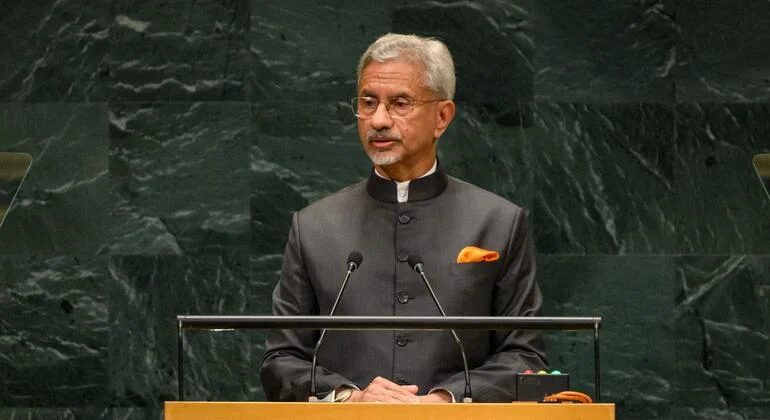
NEW YORK — As the 81st session of the United Nations General Assembly (UNGA) convened under the weight of mounting global crises, Indian External Affairs Minister Dr. S. Jaishankar delivered a sobering assessment of the international order. Standing before the world’s gathered leaders, he argued that the systemic inability to maintain peace is no longer just a failure of diplomacy—it is an existential threat to development and global security.
In a wide-ranging address, Dr. Jaishankar highlighted that countries far removed from the physical theaters of conflict are being forced to pay the price for wars they did not ignite. From the weaponization of trade to the persistent shadow of cross-border terrorism, India’s representative articulated a vision of a world “on the brink of the abyss,” calling for a radical shift toward stability and a more inclusive, multipolar international framework.
The Costs of Conflict: A Globalized Burden
The central thesis of Minister Jaishankar’s address was the interconnectedness of modern suffering. While conflicts in the Middle East and Eastern Europe may be geographically localized, their economic and social ripples are universal.
“The inability to maintain peace is not only weakening security, but is also threatening progress, slowing the pace of development in a globalized world,” Dr. Jaishankar stated. He emphasized that the Global South, in particular, has become the collateral damage of geopolitical maneuvers. The disruption of supply chains, the volatility in energy markets, and the crises involving food, fuel, and fertilizers have disproportionately impacted nations that have no stake in these wars.
Chronology of Crisis
To understand the urgency of India’s position, one must look at the recent timeline of instability:
- The Ukraine Conflict (Year 5): Entering its fifth year, the war continues to strain global food security and energy prices. India has consistently advocated for a shift from “an endless war” to “ending the war,” signaling a departure from the rhetoric of escalation toward a policy of diplomatic resolution.
- Gulf Instability: The recent increase in threats to commercial shipping and maritime crews in international waters has exacerbated already volatile West Asian tensions. India has demanded an immediate cessation of these actions, viewing them as unacceptable violations of international law.
- The Middle East Conundrum: Regarding the broader regional strife, India has reaffirmed its long-standing support for a two-State solution, urging all parties to prioritize the protection of civilians and the restoration of commerce.
Everything is Being Weaponized: The New Normal
Perhaps the most striking element of the Minister’s address was his critique of the contemporary global mindset. He argued that the institutional safeguards built in the post-1945 era have been eroded by a culture of “hyper-competition.”
“We are witnessing circumstances in which everything is being weaponized,” Dr. Jaishankar warned. He pointed to a growing trend where finance, market access, supply chains, and even technological advancements are used as tools of coercion rather than cooperation. This shift has forced nations to prioritize “de-risking” and diversification over global integration, a trend that threatens to fracture the global economy into isolated, competing blocs.
Supporting Data and Institutional Decay
The Minister’s concerns reflect a broader data-driven anxiety regarding international institutions. With the UN now eight decades old, the promise of a rules-based order remains unfulfilled. Instead of the predictability promised by the UN Charter, the world is experiencing:
- Supply Chain Volatility: The focus on “de-risking” has led to a 15% increase in trade fragmentation over the last three years, according to various global economic indicators.
- Financial Instability: The weaponization of financial clearing systems has left emerging economies vulnerable to currency shocks and debt distress.
- Institutional Marginalization: The perceived inability of the UN Security Council to resolve major conflicts has led to a loss of faith in multilateralism, prompting countries to seek regional or bilateral alliances that often bypass international norms.
Terrorism as a Direct Affront
India’s stance on terrorism remained, as always, uncompromising. Minister Jaishankar characterized the phenomenon as a “scourge” that continues to undermine the global order. He was particularly vocal about the threat of state-sponsored, cross-border terrorism.
Without naming the nation directly, the Minister issued a sharp rebuke to a “serial practitioner of terrorism” that had addressed the General Assembly earlier in the week. He accused the unnamed state of misrepresenting facts and attempting to normalize terrorist activities as legitimate political struggle.
“It is for the perpetrator of terrorism to mend its ways,” he stated, emphasizing that there can be no weakening of the “zero tolerance” policy toward terror. For India, terrorism is not merely a security issue but a fundamental barrier to the democratic and developmental progress of the entire region.
Development in a Multipolar World
Amidst the gloom of conflict, Minister Jaishankar provided a roadmap for a more optimistic future, anchored by India’s own developmental trajectory. India’s success, he noted, has served as a lighthouse for one-sixth of humanity.
The Role of Digital Public Infrastructure (DPI)
India’s deployment of DPI has revolutionized governance, allowing for the direct and efficient delivery of socioeconomic benefits to millions. This model, the Minister argued, is a exportable success story. India’s commitment to the Global South is evidenced by its support for over 600 development projects in 78 countries, focusing on:
- Clean Energy: Transitioning to sustainable power grids.
- Infrastructure: Building resilient, climate-proof connectivity.
- Sustainable Agriculture: Ensuring food security through technological innovation.
- Information Technology: Bridging the digital divide in underserved regions.
The Inevitability of Multipolarity
The international order established in 1945 is currently confronting realities that its founders could never have envisioned. As the world moves toward a multipolar arrangement, the Minister warned that the transition would not be easy.
He cautioned that power cannot remain concentrated in the hands of a few legacy institutions. “Civilized dialogue is essential,” he argued, noting that a large part of humanity—specifically the Global South—can no longer be excluded from the decision-making processes that determine their future.
Implications: The Path Forward
The implications of India’s address are clear: the world is at a crossroads. The current trend of weaponizing every facet of international interaction is unsustainable.
If the UN is to remain relevant in its ninth decade, it must undergo a profound transformation. This includes:
- Structural Reform: A more inclusive Security Council that reflects the realities of the 21st century rather than the 20th.
- Diplomatic Restraint: A collective commitment to de-escalation in active war zones.
- Economic Cooperation: Reversing the trend of hyper-competition in favor of a shared, stable global market.
As he concluded his speech, Dr. Jaishankar invoked the timeless wisdom of Mahatma Gandhi, whose statue stands as a sentinel at the UN headquarters. By quoting the mantra, "There is no path to peace. Peace is the path," the Minister reminded the international community that peace is not merely the absence of war, but a constant, active process of engagement, dialogue, and mutual respect.
For the international community, the message from New Delhi is unambiguous: the time for transactional politics is over. The era of global responsibility must begin, or the world risks falling from the precipice it currently inhabits. As the 81st UNGA continues, the question remains whether the major powers of the world are prepared to heed this warning or if they will continue to prioritize narrow, short-term interests over the long-term survival of the global order.
 Nana Muazin
 Azzam Bilal Chamdy
 Layla Zulfa
