

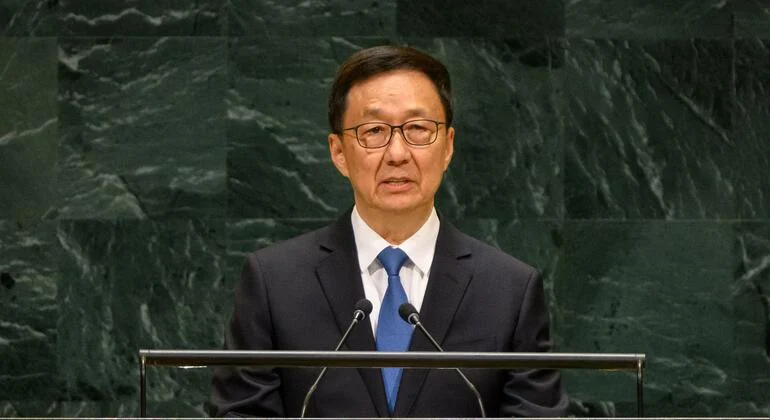
UNITED NATIONS, New York — In a wide-ranging address to the 81st session of the United Nations General Assembly, Chinese representative Han Zheng delivered a stern defense of the international order established in the wake of World War II. Amidst a backdrop of escalating geopolitical tensions, fragmented global trade, and the rapid, often volatile evolution of artificial intelligence, China signaled its intent to position itself as a stabilizing anchor for multilateralism and a vocal champion for the nations of the Global South.
The address, which spanned topics from the conflicts in Ukraine and the Middle East to the ethical development of emerging technologies, underscored a pivotal moment in international diplomacy. As the UN approaches its ninth decade, Beijing’s message was clear: the existing international system, anchored by the UN Charter and international law, is not merely a historical relic but the essential foundation for contemporary global peace.
Main Facts: A Call to Return to Multilateralism
The central theme of Mr. Han’s speech was the necessity of preserving the "postwar order." He argued that the global community is currently at a crossroads, facing a proliferation of unilateral actions that undermine the established framework of collective security.
"The world wants peace, not war," Mr. Han declared, setting the tone for his remarks. He articulated a vision where international disputes are resolved exclusively through dialogue and consensus, rather than the "unilateral military actions" that he suggested violate the UN Charter and circumvent the authority of the Security Council.
For Beijing, the path forward requires a re-commitment to the rule of law. Mr. Han emphasized that major powers bear a special burden in this regard. He called for a global environment where the rule of law is not selectively applied but is instead treated as a universal obligation. This, he suggested, is the only mechanism capable of preventing the world from sliding into a state of chaotic competition.
Chronology: From 1971 to the Present Day
To understand the weight of China’s current diplomatic stance, one must look at the historical trajectory of its relationship with the United Nations. Mr. Han’s address coincided with the 55th anniversary of General Assembly Resolution 2758, adopted on October 25, 1971.
- 1971: The UN General Assembly passes Resolution 2758, recognizing the Government of the People’s Republic of China as the sole legitimate representative of China at the UN. This marked the beginning of China’s active participation in the international system.
- 1971–2026: Over the subsequent five and a half decades, China transitioned from a peripheral actor to one of the most significant contributors to the UN’s peacekeeping missions, humanitarian efforts, and global development initiatives.
- 2024–2026: As the UN prepares for a leadership transition with Secretary-General António Guterres set to step down at the end of 2026, China has begun to outline the criteria it believes are essential for his successor. Beijing is seeking a leader who possesses "exceptional capability, integrity, and fairness," and who demonstrates the courage to uphold the UN Charter in an increasingly polarized world.
Supporting Data: China’s Economic and Diplomatic Footprint
China’s influence at the UN is underpinned by significant statistical evidence regarding its role in global development and peace efforts. According to the data presented by Mr. Han, China has sought to distinguish itself from other major powers through a proactive approach to international aid and economic integration.
- Economic Impact: China has accounted for approximately 30% of global economic growth in recent years, a statistic it cites to emphasize its role as a "stabilizing force" in the global economy.
- Development Financing: Through the Global Development Initiative (GDI), China has mobilized more than $23 billion to support projects in developing nations, focusing on infrastructure, poverty reduction, and digital connectivity.
- Trade Accessibility: In a move designed to strengthen ties with the Global South, China has granted zero-tariff access to all African countries and least-developed nations with which it maintains formal diplomatic relations.
- Peacekeeping: China remains the largest contributor to peacekeeping operations among the five permanent members of the UN Security Council, a point of pride that Mr. Han used to highlight China’s commitment to the UN’s core mission of security.
Official Responses and Strategic Positions
The Chinese address outlined specific, and at times controversial, positions on the most pressing security crises of the day.
The Middle East and Ukraine
On the ongoing humanitarian crisis in Gaza, Mr. Han called for a reconstruction process that adheres to the principle of "Palestinians governing Palestine," while reaffirming support for a two-state solution. Regarding the conflict in Ukraine, he reiterated President Xi Jinping’s "four points" as the foundational guidance for Beijing’s diplomacy. These points advocate for a political settlement that respects the security concerns of all parties involved, positioning China as a potential, albeit cautious, mediator.
Trade and Technology
Beyond security, Mr. Han addressed the threat of economic protectionism. He argued that the World Trade Organization (WTO)-centered system is vital for global prosperity and that "protectionism produces no winners." On the issue of artificial intelligence, he advocated for a "people-centered" approach. He argued that the digital divide must be narrowed, and AI development must be directed toward universally beneficial outcomes rather than serving the strategic interests of a few technologically advanced nations.
Cultural Exchange
In a nod to the diversity of the international community, Mr. Han warned against a "condescending and self-centered mindset" in cross-cultural interactions. He asserted that diversity is the source of the world’s splendor and that international relations should be built on mutual respect rather than the imposition of one culture’s values over others.
Implications: A New Era for the Global South
The most significant implication of Mr. Han’s speech is China’s explicit push for UN reform. While Beijing supports the idea of reforming the organization, it has drawn a firm line regarding the nature of that reform. China opposes "merely cutting" the organization’s bodies or mandates. Instead, it advocates for a strengthening of the UN’s infrastructure, with a particular focus on amplifying the voices of the "Global South."
The Rise of the Global South
For many nations in Africa, Asia, and Latin America, China’s message resonated as a challenge to the traditional dominance of Western powers within the UN framework. By framing itself as the primary advocate for the developing world, China is attempting to reshape the power dynamics of the General Assembly.
The Challenge of Leadership
The call for a strong, independent successor to Secretary-General Guterres suggests that China is preparing to play a more assertive role in the administrative and strategic direction of the UN. Beijing is clearly signaling that it will no longer settle for a passive seat at the table; it intends to be a primary architect of the UN’s future agenda.
Multilateralism as a Necessity
Ultimately, the Chinese address serves as a stark reminder of the fragile state of the postwar order. By framing multilateralism as "a choice made by humanity after going through the scourges of war," Mr. Han underscored that the alternative to the current UN-centered system is not a new order, but the potential collapse into isolationism and conflict.
As the international community navigates the remainder of the 81st session, the impact of China’s intervention will likely be felt in the corridors of the Security Council and the development committees. Whether Beijing’s vision for a "community with a shared future for humanity" can bridge the deep ideological and strategic divides currently paralyzing the UN remains the most significant question of this diplomatic era. For now, China has set a high bar for what it expects from the international system, and it has made clear that it intends to use its economic and diplomatic weight to ensure that the voice of the Global South remains central to the evolution of global governance.
 Lina Hope
 Asro
Asro
 Layla Zulfa
