

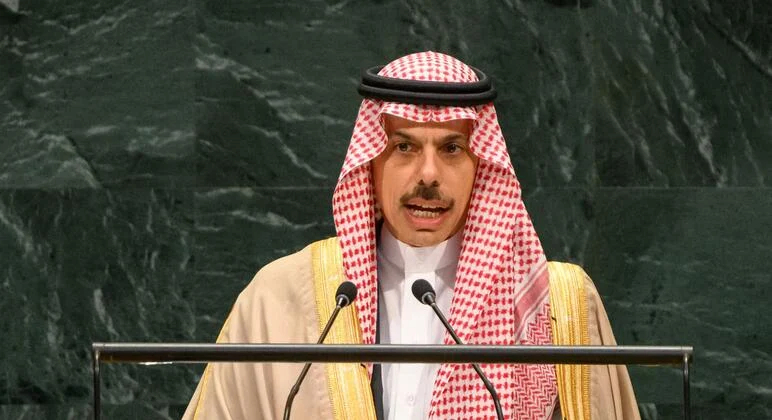
UNITED NATIONS, New York — In a wide-ranging address to the 79th session of the United Nations General Assembly, Saudi Arabia’s Foreign Minister, Prince Faisal bin Farhan, articulated a vision of international security that places the stability of the Gulf region at the heart of global economic and geopolitical health. His remarks served as a stern warning against regional belligerence, a plea for maritime sovereignty, and a blueprint for a future defined by technological ethics and sustainable energy transitions.
As tensions across the Middle East threaten to spill over into wider conflict, the Kingdom’s top diplomat utilized the world stage to reinforce its commitment to international law while simultaneously asserting its sovereign right to defend its territory against what he characterized as “flagrant” external aggression.
The Core Mandate: Security as an Indivisible Global Asset
At the center of Prince Faisal’s address was the assertion that the security of the Gulf is not a regional silo, but a pillar of global stability. Addressing the General Assembly, the Foreign Minister emphasized that the Gulf region’s role in global energy markets and international trade routes makes its instability a systemic threat to every nation.
"The security of the Gulf region is part and parcel of the security of the region and the world at large," Prince Faisal stated. By framing Gulf security as a global public good, Riyadh signaled to the international community that the containment of regional threats—specifically those emanating from Iranian-backed proxies and direct state-level incursions—is a responsibility that transcends borders.
The Kingdom’s stance is rooted in a reality where economic disruption in the Middle East has immediate, visceral consequences for global inflation, supply chain logistics, and energy price volatility. By highlighting these interdependencies, Saudi Arabia is positioning itself as a central guarantor of the global status quo.
Chronology of Tensions and Regional Escalation
To understand the urgency of Prince Faisal’s message, one must look at the recent timeline of instability that has defined the Gulf and the broader Middle East:
- Pre-February 2024: A period marked by growing friction in the Strait of Hormuz, characterized by increasing efforts to impose restrictive controls on commercial vessels.
- Ongoing Houthi Aggression: Throughout the past year, the Houthi movement in Yemen has persisted in its campaign of drone and missile strikes, targeting both Saudi infrastructure and international commercial shipping in the Red Sea and the Bab el-Mandeb Strait.
- The Gaza Conflict (October 2023–Present): The outbreak of war in Gaza has served as a catalyst for increased regional volatility, complicating diplomatic normalization efforts and providing a pretext for non-state actors to escalate attacks against regional security assets.
- Diplomatic Re-engagement: Despite these pressures, the Kingdom has actively supported de-escalation initiatives mediated by Qatar, Pakistan, and other neutral partners, signaling a preference for long-term political arrangements over perpetual military engagement.
Maritime Sovereignty and Vital Waterways
A significant portion of the Foreign Minister’s speech was dedicated to the protection of international waterways. The Strait of Hormuz, the Bab el-Mandeb, the Red Sea, and the Gulf of Aden are the jugular veins of global commerce. Prince Faisal categorically rejected the use of these waters as instruments of political leverage or extortion.
"We call for the situation in the Strait of Hormuz to return to its status before 28 February, without the imposition of any fees or restrictions," the Foreign Minister declared. His call for a return to the status quo ante is a direct challenge to attempts by any regional actor to exercise unilateral control over international transit routes.
For the international community, this is a clarion call. The freedom of navigation is not merely a regional preference but a fundamental tenet of the UN Charter and international maritime law. By emphasizing the vulnerability of these chokepoints, Saudi Arabia is pressing for a more robust, collective naval and diplomatic presence to ensure that global trade remains unencumbered by regional power plays.
Humanitarian Crises: Gaza and Yemen
The Foreign Minister’s remarks on the Occupied Palestinian Territory were uncompromising. He condemned the targeting of civilians, the obstruction of humanitarian corridors, and the expansion of illegal settlements, which he identified as major impediments to a lasting peace.
Riyadh’s position remains anchored in the Arab Peace Initiative, advocating for a two-state solution with East Jerusalem as the capital of an independent Palestinian state. Prince Faisal argued that without such a political horizon, the cycle of violence will continue to destabilize the broader Levant and the Arabian Peninsula.
In parallel, the situation in Yemen remains a primary concern for the Kingdom. Having provided more than $29 billion in humanitarian and development aid to the war-torn nation, Saudi Arabia continues to advocate for a comprehensive political solution. However, the Foreign Minister was clear: stability in Yemen cannot be achieved so long as Houthi forces continue to threaten regional infrastructure and global shipping lanes. He urged the international community to take a unified stance against those who threaten maritime security, emphasizing that such acts are violations of international law that affect the livelihood of nations far beyond the Middle East.
Energy Security and the Saudi Vision 2030
Beyond the immediate theater of conflict, Prince Faisal highlighted the Kingdom’s internal transformation through "Vision 2030." A key theme of this vision is the decoupling of economic growth from environmental degradation.
"Energy security and climate action should be mutually reinforcing," he argued. The Kingdom is positioning itself not just as a traditional energy exporter, but as a leader in clean hydrogen, carbon capture, and renewable energy infrastructure. By advocating for a "realistic energy transition," Riyadh is cautioning the West against policies that prematurely exclude traditional energy sources, which could lead to supply shocks and global economic instability. Instead, Saudi Arabia is promoting a diversified energy portfolio that prioritizes both sustainability and reliability.
The Frontier of Artificial Intelligence
In a forward-looking segment of his address, the Foreign Minister turned his attention to the rapid evolution of Artificial Intelligence (AI). Recognizing the dual-use nature of the technology, Prince Faisal urged the UN to take a proactive role in setting ethical guardrails.
"We must ensure this technology is used in the service of development and human flourishing," he noted. The Kingdom has already begun launching initiatives focused on AI capacity-building, particularly for the Global South. By framing AI as a tool for development, Saudi Arabia is attempting to bridge the digital divide, ensuring that the benefits of the Fourth Industrial Revolution are shared equitably rather than concentrated in a few technological hubs.
Implications: The Path Forward
The implications of Prince Faisal’s address are profound. By weaving together the disparate threads of maritime security, regional conflict, energy transitions, and AI ethics, Saudi Arabia is asserting its role as a "middle power" with global responsibilities.
- A Demand for Multilateralism: The Foreign Minister’s constant references to the UN Charter signal a preference for institutionalized, rule-based conflict resolution. However, it also serves as a warning: if the international system fails to protect the security of its members, individual nations will have no choice but to exercise their sovereign right to self-defense.
- Strategic Autonomy: While reaffirming its alliances, the Kingdom is demonstrating a high degree of strategic autonomy, choosing to engage with regional rivals while maintaining a firm line on core security interests.
- The New Security Architecture: The call for a region free of weapons of mass destruction and the push for international safeguards on nuclear programs suggest that Riyadh is looking to establish a new, transparent security architecture that moves beyond the current, often volatile, status quo.
Conclusion: A Call for Collective Responsibility
Concluding his address, Prince Faisal bin Farhan reminded the delegates that no country, no matter how powerful, can face the challenges of the 21st century in isolation. Whether it is the threat of conflict, the volatility of energy markets, or the risks inherent in emerging technologies, the solutions are inherently collective.
"Security," he concluded, "can only be sustained through adherence to the UN Charter, respect for international law, and cooperation aimed at peaceful solutions."
For the global community, the message from Riyadh is clear: Saudi Arabia is prepared to lead, to invest in stability, and to defend its interests. But it is also inviting the world to participate in a more stable, secure, and prosperous regional order—provided that the international community is willing to stand behind the principles of sovereignty, navigation, and the rule of law. The coming months will determine whether this diplomatic overture leads to a cooling of regional tensions or if the Kingdom’s warnings will serve as a prelude to a more fortified and defensive posture in the Gulf.
 Nana Muazin
 Azzam Bilal Chamdy
 Layla Zulfa
