

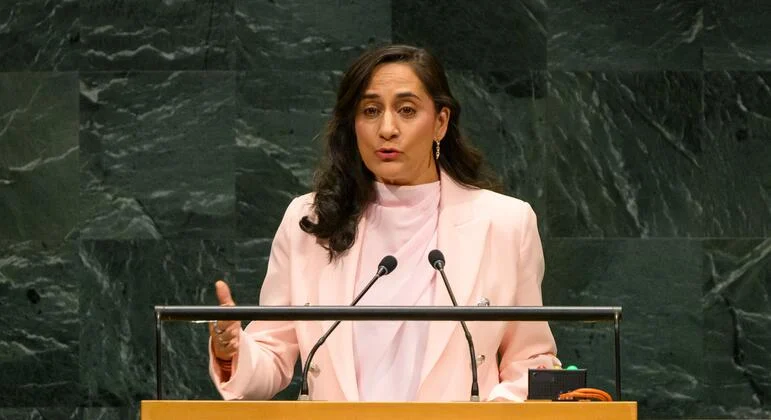
In a rapidly shifting geopolitical landscape defined by volatility and the erosion of post-Cold War norms, Canada has signaled a definitive pivot in its foreign policy. Addressing the global community, Canadian Foreign Minister Anita Anand characterized the current international environment not as a period of gradual transition, but as a "rupture"—a fundamental break in the established order that demands a more assertive, agile, and diversified approach to diplomacy and statecraft.
Drawing on her roots in Nova Scotia, Ms. Anand utilized a maritime metaphor to frame the challenge: "The tide does not wait. You must move with it." As great powers increasingly retreat from long-standing economic cooperation and the foundational principles of the UN Charter—particularly state sovereignty—are met with rising disdain, Canada is preparing to navigate these turbulent waters by prioritizing "strategic autonomy" and "values-based realism."
The Genesis of the Pivot: A World in Disarray
The current global climate is marked by a retreat from multilateralism. For decades, the international system relied on the assumption that economic integration would inevitably lead to political stability. Today, that assumption has been shattered. The "rupture" Ms. Anand describes is evidenced by the weaponization of supply chains, the resurgence of bloc-based competition, and a blatant disregard for international law in conflict zones spanning from Eastern Europe to the Middle East.
Chronology of Recent Geopolitical Shifts
- 2022: The Russian invasion of Ukraine fundamentally altered the security architecture of Europe, forcing Canada to re-evaluate its defense commitments and its reliance on traditional supply chains.
- 2023: The intensification of competition between the United States and China led to widespread "de-risking" strategies, a trend that Ottawa has begun to mirror to ensure its own economic security.
- 2024: The escalation of conflicts in the Middle East and the humanitarian crises in Haiti and Sudan underscored the limitations of the current UN-led crisis management frameworks, prompting Canada to launch the "Partners for Multilateralism" initiative.
Strategic Autonomy and the New Coalition Model
Canada’s response to this fragmentation is not isolationism, but a sophisticated, multi-layered engagement strategy. Recognizing that the era of relying solely on a singular, dominant superpower partner is fading, Ottawa is moving toward "strategic autonomy." This policy involves a deliberate diversification of economic and diplomatic relationships to insulate the Canadian economy from regional shocks.
Building Issue-Based Coalitions
Rather than relying exclusively on rigid, monolithic alliances, Canada is pioneering an "issue-based coalition" model. This approach allows Ottawa to partner with a flexible array of small states, middle powers, and major global players depending on the specific challenge.
- Security and the Arctic: With the melting of polar ice caps opening new maritime routes, the Arctic has shifted from a peripheral concern to a central pillar of Canadian identity and national security. Canada is strengthening its collaborative efforts with Indigenous peoples and Arctic partners to maintain regional stability.
- The "Partners for Multilateralism" Initiative: Recognizing that institutions like the United Nations require modernization, Canada has spearheaded a new initiative aimed at making international governance more representative, effective, and trustworthy. The goal is to reinforce the multilateral system, ensuring it acts as a safeguard against disorder rather than a bystander to it.
Values-Based Realism: Beyond Ideology
At the heart of the Canadian strategy is the concept of "values-based realism." This framework acknowledges that while Canada must operate within the harsh realities of power politics, its actions will remain tethered to core liberal democratic principles.
This realism is applied through tangible economic and security initiatives:
- Critical Minerals and Energy: In an age of technological competition, Canada is securing its position in the global supply chain for critical minerals, which are essential for the green transition and the manufacturing of advanced defense technologies.
- Trade Diversification: Canada is actively deepening its footprint in the Indo-Pacific, the Gulf region, Latin America, and Africa. By strengthening ties with emerging hubs of growth, Ottawa aims to reduce the "over-reliance" that has historically left it vulnerable to the volatility of its primary trading partners.
- Responsible Technology: Canada is leading international discussions on the governance of Artificial Intelligence, advocating for frameworks that ensure security and ethical standards are built into the backbone of technological innovation.
Regional Security: From Ukraine to the Middle East
The breadth of Canada’s foreign policy commitment is perhaps best illustrated by its firm stances on the world’s most intractable conflicts.
Ukraine and European Security
Canada remains a steadfast supporter of Ukraine, calling for a "comprehensive, just and lasting peace." Minister Anand emphasized that any resolution must respect Ukraine’s territorial integrity and sovereignty. This support is not merely humanitarian; it is viewed as a defense of the principle that borders cannot be redrawn by force.
The Middle East: A Two-Pronged Approach
Regarding the Israeli-Palestinian conflict, Canada’s stance remains one of unwavering commitment to a negotiated two-state solution. Minister Anand articulated a clear boundary: "Israel’s right to exist is not up for debate, and the right of the Palestinian people to self-determination in a state of their own is also not up for debate."
Simultaneously, Canada has adopted a firm stance on Iran, characterizing the regime as the "principal threat to peace and security in its region." Ottawa has condemned Tehran’s destabilizing actions and has been clear in its position that Iran must never be permitted to acquire a nuclear weapon.
Implications for the Global Order
The shift in Canada’s diplomatic posture has significant implications for the international community. By championing reform while simultaneously building ad-hoc coalitions, Canada is attempting to bridge the gap between the "old world" of established institutions and the "new world" of fragmented power.
Challenges to Implementation
Critics argue that balancing "values-based realism" with the necessity of engaging with regimes that do not share Canadian values will be difficult. Renewed partnerships with countries like India and China, while economically necessary for diversification, will require delicate management to avoid compromising Canada’s commitment to human rights and international law.
Furthermore, the effectiveness of the "Partners for Multilateralism" initiative will depend on whether Canada can convince other influential middle powers—such as Brazil, South Africa, and Indonesia—that reform is still possible within existing structures.
A Call to Confidence
Despite the "rupture" in the global order, Minister Anand rejected the temptation of nostalgia or despair. "That’s not an option," she stated, noting that Canada must instead "move with confidence and strength."
This confidence is grounded in the belief that while the tide of history is changing, the principles of the UN Charter and the rule of law remain the only viable foundation for a stable future. As Canada charts this new course, it is extending an invitation to its allies and partners to join in a collective effort to stabilize the international landscape.
The success of this strategy will not be measured by the rhetoric of summits, but by the tangible outcomes of these new coalitions: the stabilization of trade routes, the successful navigation of technological shifts, and the continued protection of sovereignty in an era where it is increasingly under threat. Canada’s message to the world is clear: the transition is over, the rupture is here, and the work of rebuilding a functional, equitable, and secure global order must begin in earnest.
 Nana Muazin
 Azzam Bilal Chamdy
 Layla Zulfa
