

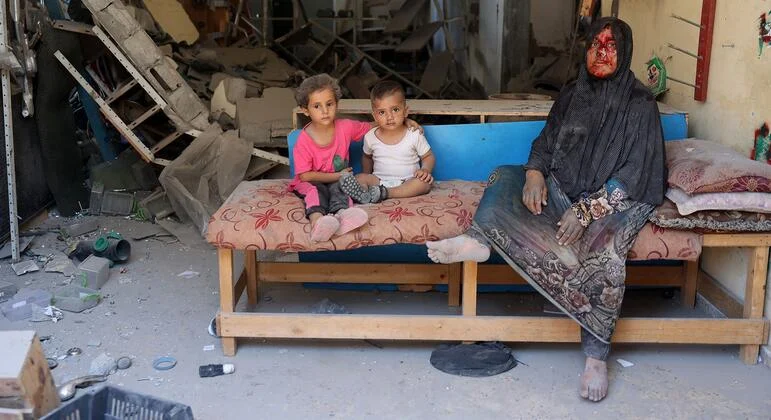
NEW YORK – The United Nations Security Council held a high-stakes emergency session on Monday, September 28, 2026, as the international community grapples with the accelerating deterioration of stability in the Middle East. With the long-sought peace plan for the Gaza Strip effectively paralyzed and a volatile surge of violence gripping the West Bank, the 15-member body faced stark warnings that the window for a viable two-State solution is closing rapidly.
The meeting underscored a dual-front crisis: the humanitarian catastrophe in Gaza, where the remnants of a year-old ceasefire roadmap remain unimplemented, and the escalating cycle of settler violence and settlement expansion in the West Bank, which observers describe as an existential threat to future Palestinian statehood.
The Core Impasse: A Stalled Peace Roadmap
At the heart of Monday’s discussions was the stagnation of the multi-phase peace roadmap initiated last year. The plan, which was designed to bring a definitive end to hostilities, remains trapped in its preliminary stages.
The primary points of contention continue to be the disarmament of Hamas and the reciprocal demand for a full, phased withdrawal of Israeli Defense Forces (IDF) from the Gaza Strip. As of late September 2026, neither condition has been met, leading to a humanitarian paralysis that has left millions of civilians in the enclave trapped in a cycle of displacement, food insecurity, and crumbling infrastructure.
Diplomatic sources indicate that the Council is deeply divided on how to incentivize the parties back to the negotiating table. While some member states advocate for increased pressure on regional stakeholders, others emphasize that the lack of political will—on both sides—has rendered the current framework nearly obsolete.
Chronology of the 2025–2026 Crisis
To understand the urgency of the current Security Council session, one must look back at the trajectory of the conflict over the last 18 months:
- September 2025: The initial "Roadmap to Restoration" is unveiled, outlining a three-phase process involving prisoner exchanges, humanitarian relief, and a transition to civilian governance.
- December 2025: Phase One begins with limited success, but stalled negotiations over the scope of the permanent ceasefire lead to the first major breach of the agreement.
- March 2026: Violence flares in the West Bank to levels not seen in two decades, diverting international attention and resources away from the Gaza peace efforts.
- June 2026: International mediators confirm that the second phase of the peace plan—the disarmament protocols—has been suspended indefinitely.
- August 2026: A series of major settlement expansion announcements in the West Bank sparks widespread protests and international condemnation, further eroding trust between the Palestinian Authority and the Israeli government.
- September 28, 2026: The Security Council convenes in New York to address the failure of the peace plan and the rising regional instability.
Supporting Data: The Cost of Stagnation
The human and geopolitical cost of the current stalemate is quantified in alarming data points that were circulated during the briefing:
The Humanitarian Toll in Gaza
According to the latest UN OCHA reports, over 80% of Gaza’s infrastructure remains either destroyed or severely damaged. The "mattress-and-rubble" reality captured in the latest imagery from Burij has become a symbol of the broader humanitarian failure. With health services operating at less than 15% capacity, preventable diseases are rising, and childhood malnutrition has reached record levels in the territory’s northern sectors.
West Bank Expansionism
Satellite imagery and data from UN monitoring groups indicate that settlement activity in the West Bank has reached a ten-year high in 2026. The construction of new outposts and the expansion of existing ones have effectively fractured the geographical continuity of the West Bank, making the physical requirements of a sovereign Palestinian state increasingly difficult to achieve.
Security Metrics
Data presented to the Council highlighted a 40% increase in incidents involving settler-on-Palestinian violence compared to the same period in 2025. Simultaneously, rocket fire from isolated cells and retaliatory military operations have created a permanent state of emergency across the region.
Official Responses and Diplomatic Posturing
The floor of the Security Council was characterized by sharp exchanges and, at times, weary calls for pragmatism.
The Palestinian Perspective
The representative for the State of Palestine urged the Council to move beyond "rhetorical concern." In a pointed address, they stated, "We are witnessing the annexation of our future through the expansion of settlements while our people in Gaza are being systematically starved of the hope of a ceasefire. The Council’s failure to enforce its own resolutions is interpreted as a green light for the status quo."
The Israeli Perspective
The Israeli representative maintained that the security of its citizens remains the primary driver of its policy. "We are committed to peace," they asserted, "but we cannot negotiate with entities committed to our destruction. The implementation of the peace plan requires a security guarantee that currently does not exist. We will continue to defend our borders and our historical presence in the land against those who seek to use diplomacy as a cover for terrorism."
The Global Powers
The United States and European members of the Council pushed for a revitalized, time-bound framework, suggesting that a lack of clear consequences for either side has allowed for the current inertia. Meanwhile, China and the Russian Federation criticized what they termed "Western bias," calling for a broader multilateral approach that includes regional Arab states as primary guarantors of any future deal.
Implications for Regional and Global Security
The failure of the current peace process carries significant implications that extend far beyond the borders of Israel and Palestine.
1. The Risk of Regional Contradiction
The continued instability provides a pretext for non-state actors and regional proxies to escalate their own agendas. Experts at the briefing warned that the "Lebanon-Gaza-West Bank" nexus is more interconnected than ever, and a single miscalculation could trigger a regional war that would involve major global powers.
2. The Erosion of International Law
The persistent illegality of settlement expansion, recognized as such by the International Court of Justice and the vast majority of the UN membership, threatens to undermine the credibility of the entire UN Charter. If the Security Council cannot enforce its own resolutions regarding the territorial integrity of the occupied territories, member states fear a "normative collapse" where power, rather than law, dictates international boundaries.
3. The Humanitarian Precedent
The world is witnessing a normalization of "permanent crisis." As global attention shifts toward other conflicts, the Gaza and West Bank situations risk being relegated to a secondary status, where aid is provided just enough to prevent total collapse, but never enough to foster development or peace. This creates a generation of Palestinians and Israelis living under the shadow of permanent conflict.
Conclusion: A Call for Renewed Engagement
As the meeting concluded, there was no breakthrough in sight, yet the consensus remained that the current path is unsustainable. UN Secretary-General Antonio Guterres has called for an "immediate, unconditional, and comprehensive" review of the mediation process.
The Security Council is now under intense pressure to move from monitoring to mediating. Without a fundamental shift in the approach to the peace plan—one that addresses the core security concerns of Israel and the fundamental rights and sovereignty of the Palestinian people—the cycle of violence is expected to intensify as the year draws to a close.
For the millions trapped in the crossfire, the words spoken in the halls of the United Nations in New York serve as a thin, fraying lifeline. The international community now faces a critical test: whether it possesses the collective will to force a resolution, or whether it will allow the region to descend further into a future defined by conflict rather than coexistence.
For ongoing updates on this developing story, subscribe to the UN News Newsletter or download the UN News application on your iOS or Android device.
 Nana Muazin
 Azzam Bilal Chamdy
 Layla Zulfa
