

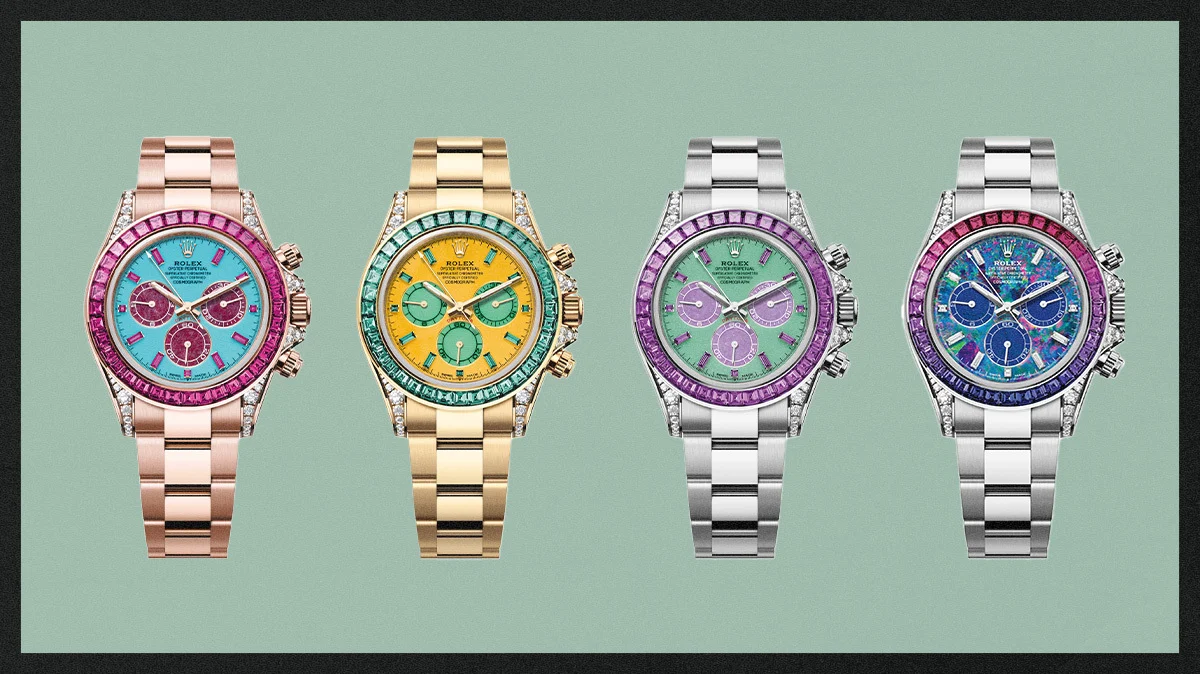
In a landmark event that has sent shockwaves through the global horological community, Rolex has orchestrated a feat of both philanthropy and prestige that will be etched into the annals of auction history. On a quiet Monday evening in London, the Swiss watchmaking titan—a brand notoriously guarded about its manufacturing processes and limited editions—offered four unique "Four Seasons" Cosmograph Daytonas at a Phillips auction. By the time the final gavel fell, the quartet had commanded a staggering $49.5 million, with every cent destined for charitable causes supported by Rolex Testimonees Roger Federer and Leonardo DiCaprio.
The auction was not merely a sale; it was a demonstration of the brand’s unparalleled market dominance. While the Rolex Daytona has long been the crown jewel of any serious collector’s cabinet, these four bespoke iterations represent a departure from the brand’s traditional design language, blending high-jewelry craftsmanship with the rugged, racing-inspired DNA of the 1960s chronograph.
The Main Facts: A Quartette of Uniqueness
The collection, thematically tied to the changing seasons, utilized a breathtaking array of precious metals and rare, natural stones. In an industry where "uniqueness" is often a marketing term, Rolex confirmed that each of these four timepieces is truly one-of-a-kind—a rarity for a house that typically prioritizes consistency and industrial perfection.
The auction results were as follows:
- The Summer Daytona: The undisputed star of the evening, this Everose gold masterpiece featured a vibrant turquoise dial accented by ruby counters and a bezel encrusted with pink sapphires. It hammered down at an eye-watering $13.65 million.
- The Autumn Daytona: Utilizing a warm yellow-gold architecture, this model featured a rare mookaite dial, chrysoprase counters, and green tourmalines. It achieved a total of $13.5 million.
- The Winter Daytona: An exercise in icy elegance, this platinum timepiece boasted a blue opal dial, lapis lazuli counters, and a shimmering array of blue sapphires. It realized a final price of $13.2 million.
- The Spring Daytona: Cased in white gold, this model showcased a refreshing chrysoprase dial, lepidolite counters, and deep purple sapphires, closing the set with a sale price of $9 million.
Chronology of a Historic Evening
The atmosphere at the Phillips London saleroom was electric, characterized by a palpable tension as collectors from across the globe vied for a piece of history. Aurel Bacs, the legendary auctioneer whose presence has become synonymous with record-breaking watch sales, presided over the proceedings.

"This is a historic moment for the world of watchmaking," Bacs remarked during the proceedings. "We are deeply honored to have played a role in this first-ever charity auction with Rolex and to support the important work of the Federer Foundation and Re:wild."
The bidding process was characterized by swift, aggressive increments, reflecting the extreme scarcity of the lots. As each watch passed the $10 million threshold, the room erupted into cheers, underscoring the communal spirit of the event. For many in attendance, the auction served as a validation of the "Daytona effect," where historical significance, scarcity, and philanthropic intent converge to drive value into the stratosphere.
Supporting Data: The Daytona’s Unrivaled Pedigree
To understand the significance of these prices, one must look at the historical performance of the Rolex Daytona. Since its introduction in 1963, the model has evolved from a tool watch for racing drivers into the ultimate symbol of horological success.
The most famous precedent is the Paul Newman Daytona, which sold for $17.8 million at a Phillips auction in 2017. While that piece owed its value to its celebrity provenance, the "Four Seasons" set has achieved similar heights through sheer artisanal complexity and the prestige of the Rolex name. By moving away from the standard dial layouts and incorporating rare materials like mookaite and lapis lazuli, Rolex has effectively redefined the limits of what a "production" watch can be, transforming the Daytona into a wearable sculpture.
Official Responses and Charitable Impact
The success of the auction is intrinsically linked to the two charities that will benefit from the proceeds. The Federer Foundation, established by the tennis icon in 2003, focuses on early childhood education and developmental support in Southern Africa and Switzerland. Conversely, Re:wild, co-founded by Academy Award-winning actor Leonardo DiCaprio, works to protect and restore biodiversity and wild ecosystems globally.

In his statement following the auction, Bacs reflected on the broader implications of the sale. "It was a privilege to stand on the rostrum and witness the energy and passion in the room, united by shared values of excellence, craftsmanship and, above all, a commitment to making a positive difference," he said. "The extraordinary amount raised will make a meaningful contribution to future generations and to the protection of our natural world."
The involvement of Federer and DiCaprio—both of whom are long-term Rolex Testimonees—provided the event with a unique narrative arc, bridging the gap between the worlds of high-stakes horology, elite sports, and global environmental advocacy.
Implications: A New Era for Watch Collecting
The sale of the "Four Seasons" Daytonas carries profound implications for the luxury watch market. First, it reaffirms that the market for "super-watches"—timepieces that transcend the boundary between jewelry and engineering—is stronger than ever. The ability of these watches to command an average price of over $12 million suggests that ultra-high-net-worth individuals are increasingly viewing rare timepieces as a primary asset class.
Second, the auction signals a potential shift in Rolex’s strategy. By embracing the "unique piece" model, the brand is engaging with a segment of the market that usually resides in the domain of Patek Philippe or Audemars Piguet’s high-jewelry commissions. If Rolex chooses to continue creating bespoke pieces for charitable initiatives, it could fundamentally alter the secondary market, creating a new tier of "Royal" provenance that sits above standard retail models.
Third, the philanthropic success of this event sets a new gold standard for corporate social responsibility in the luxury sector. Rather than simply donating corporate profits, Rolex utilized its most valuable resource—its creative and technical ingenuity—to generate funds. This approach creates a deeper emotional and financial connection between the brand, the collector, and the cause.

The Future of the Daytona
As the dust settles in London, the question remains: where do these four watches go from here? They have effectively disappeared into private collections, likely to remain unseen by the public for decades. Yet, their impact will be felt for years to come.
The "Four Seasons" Daytonas have proven that even the most established icon can be reinvented. By marrying the precision of the Cosmograph movement with the vibrant, natural textures of seasonal-inspired gemstones, Rolex has created a new mythology for the watch. They are no longer just watches; they are relics of a moment where art, charity, and engineering coalesced.
For the collector, the message is clear: the ceiling for Rolex value has been raised, and the definition of a "grail" watch has expanded. For the brand, the auction was a masterclass in reputation management, proving that even a global giant can maintain its mystery while simultaneously becoming a force for significant global change.
As the watch industry looks toward the next major auction cycle, the $49.5 million total will serve as the benchmark. It is a reminder that in a world of digital noise and mass production, the human touch—combined with the enduring allure of a stainless steel, gold, or platinum chronograph—remains the ultimate luxury. The Four Seasons Daytonas have not just changed hands; they have changed the game, ensuring that the legacy of the Daytona will continue to dominate the horological discourse for generations to come.
 Pevita Pearce
 Suro Senen
 Sagoh
Sagoh
