

The international landscape remains fraught with complex challenges as the United Nations reports on a series of critical developments. From the looming collapse of essential services in Syrian refugee camps to the moral dilemmas posed by externalized migration policies and the urgent ecological imperative to restore the world’s forests, the global community stands at a crossroads. Meanwhile, in Colombia, a pioneering approach to transitional justice offers a glimmer of hope for reconciliation.
1. The Looming Humanitarian Crisis: Zaatari Camp at a Breaking Point
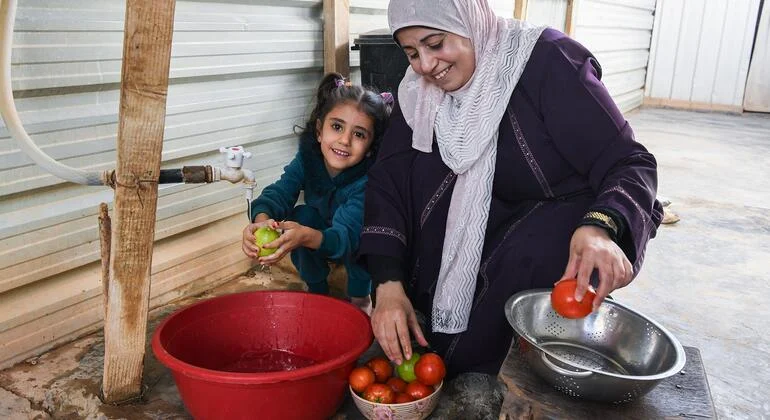
The Zaatari refugee camp, currently home to over 80,000 Syrians, is facing a silent but devastating emergency. With more than half of its population comprised of children—many of whom have never known a life outside the confines of the camp—the situation has reached a critical threshold.
The Lifeline Under Threat
UNICEF has issued a desperate warning: without an immediate infusion of funding, the camp’s water and sanitation services could cease operations within months. Louise Wateridge, a regional spokesperson for UNICEF, emphasized that the infrastructure is essentially a "lifeline" for those displaced by the protracted Syrian conflict.
"For these children, the risk of disruption to water and sanitation services will add yet another layer of instability to lives already shaped by war and displacement," Wateridge stated. The operational pressures are mounting; declining rainfall, exhausted groundwater reserves, and a surge in population demand have forced engineers to bore deeper wells every year—between seven and 10 meters annually—to reach the receding water table. With the current program facing a 90 percent funding deficit, the agency is forced to manage water at a granular, cubic-meter level, a strategy that is increasingly unsustainable.
2. Migration Policy: The Human Cost of Externalization
Independent UN human rights experts have sounded the alarm regarding the United States’ evolving migration policies. By shifting the responsibility of processing asylum seekers to third countries, the U.S. government is being accused of creating a "cascade" of human rights violations that extend far beyond its borders.
The Mechanism of Exclusion
The data is staggering: at least 23,000 individuals have been transferred to 29 different countries and territories under these externalization agreements, with 35 such arrangements now in effect. Experts note that new agreements are being finalized with alarming frequency.
"The harms caused by this U.S. Government scheme are no longer hypothetical," the experts warned in a joint statement. The policy effectively traps migrants in a state of perpetual limbo. Many are sent to nations where they possess no social, cultural, or familial ties, and which themselves struggle with poverty, conflict, or institutional instability.
Implications for Vulnerable Populations
The risks are disproportionately high for women, children, persons with disabilities, victims of human trafficking, and LGBTQ+ individuals. Furthermore, the experts challenged the notion of "voluntary" return, noting that migrants trapped in detention without legal counsel or financial resources are essentially being coerced into returning to the very dangers they fled. The experts were categorical: "States cannot contract out of their international legal obligations." They urged an immediate halt to these arrangements, insisting that human rights must remain the bedrock of migration governance rather than a casualty of deterrence.
3. Ecological Restoration: Forests as a Global Imperative
The Food and Agriculture Organization (FAO) of the United Nations has released a clarion call for the protection and restoration of the world’s forests. As climate change accelerates and food insecurity spreads, the FAO argues that forestry is not just an environmental issue, but a cornerstone of economic and social stability.
The Scale of the Deforestation Crisis
The statistics provided in the latest State of the World’s Forests (SOFO) 2026 report are sobering. Between 1990 and 2025, the world lost an estimated 489 million hectares of forest. Additionally, 460 million hectares are now categorized as "degraded." This degradation is primarily driven by rapid population growth, unsustainable land-use changes, and the relentless demand for natural resources.
The Economic Case for Restoration
The FAO’s report highlights a transformative opportunity: the restoration of over one billion hectares of degraded land could generate approximately $1.8 trillion in annual economic benefits. These benefits are not merely financial; they include the preservation of biodiversity, the stabilization of water courses, and the revitalization of soil health. With one-third of the global population relying on forests for food and livelihoods, the agency stresses that success depends on sustained political commitment and massive, scaled-up investment.
4. Colombia: A Landmark in Restorative Justice
Amidst the backdrop of global turbulence, Colombia provides a model for how nations can address a violent past. UN High Commissioner for Human Rights Volker Türk recently praised the country’s "landmark" efforts to implement restorative justice.
A Collaborative Path to Truth
In a move that would have been unthinkable during the height of the armed conflict, former FARC-EP leaders and army officers are working side-by-side at a cemetery in Pitalito, Huila. Their mission is to locate the remains of the "disappeared," allowing grieving families to finally find closure.
This work is part of the Special Jurisdiction for Peace (JEP), which allows for restorative measures—such as community service and truth-telling—to replace traditional prison sentences. Mr. Türk described this cooperation as a "global achievement for transitional justice," emphasizing that it represents a powerful contribution to collective healing.
The Need for Sustained Support
While celebrating these strides, Mr. Türk warned that the peace process is not a "one-off" event. He urged the international community to maintain funding for the Comprehensive System for Peace. Since the 2016 peace agreement, the UN has played a pivotal role in providing technical assistance and ensuring that the rights of victims remain the central focus of the judicial process.
Chronology of Key Events (September 2026)
- September 1st: FAO releases the State of the World’s Forests 2026 report, urging a global shift toward reforestation as a climate mitigation strategy.
- September 2nd: UNICEF issues an urgent appeal for the Zaatari refugee camp, citing a 90% funding gap for water and sanitation services.
- September 7th: UN independent human rights experts issue a scathing report on U.S. migration externalization policies, citing 23,000 people displaced to 29 countries.
- September 10th: UN Human Rights Chief Volker Türk visits Colombia to highlight the restorative justice initiatives between former combatants.
Official Responses and Implications
On Migration
The U.S. administration has defended its policies as necessary for border security. However, the UN’s stance remains firm: deterrence cannot supersede international law. The implications for the international legal order are significant; if major powers continue to "contract out" their asylum responsibilities, the global refugee protection framework risks total erosion.
On Environmental Sustainability
The FAO’s findings suggest that we are currently under-investing in the most cost-effective solution to climate change. The $1.8 trillion potential return on investment is a figure intended to catch the attention of private sector investors and finance ministers alike, suggesting that the "Green Economy" is not merely an abstract concept but a measurable necessity.
On Transitional Justice
Colombia serves as a proof-of-concept that restorative justice can work even in the most hardened, post-conflict societies. However, the UN’s plea for funding underscores a recurring theme in modern diplomacy: the transition from "conflict" to "peace" is a decades-long process that requires as much financial and political commitment as the war that preceded it.
As these four distinct issues unfold, they reveal a common thread: the fragility of current international systems. Whether it is the infrastructure of a refugee camp, the integrity of asylum law, the resilience of our forests, or the depth of a nation’s commitment to peace, all require urgent, collective, and well-funded action to prevent further deterioration.
 Nana Muazin
 Azzam Bilal Chamdy
 Layla Zulfa
