

WASHINGTON, DC — To walk through Water’s Edge: The Art of Truman Lowe at the Smithsonian’s National Museum of the American Indian is to enter a fluid ecosystem where rigid timber bends to the will of imagination, and static materials take on the relentless, flowing motion of rivers.
Marking the first major retrospective for the celebrated Hoocąk (Ho-Chunk) artist, the exhibition captures a lifetime of artistic exploration. Lowe, who passed away in 2019, spent decades dissolving the boundary between sculpture and nature. Through his hands, wood became water—a medium capable of carrying the deep histories of place, ancestry, and cultural survival.
Main Facts: Capturing the Fluidity of Wood and Water
At the heart of the retrospective is Lowe’s foundational artistic philosophy: wood is water. This ethos is immediately established upon entering the exhibition space, which opens with “Ottawa” (1992). A breathtaking, billowing sculpture constructed from pine and peeled wood saplings, the piece visually merges the tributary currents of the waterways that defined Lowe’s childhood landscape in Wisconsin. Rather than treating wood as a rigid, static medium, Lowe bends, twists, and undulates the saplings with an audacious disregard for their natural state, transforming them into ripples, currents, and waves.
Curated around four distinct themes of moving water—Landscape and Place, Woodland Structures, Memory, and Shared Knowledge—the retrospective brings together sculptures spanning decades of Lowe’s career. Throughout the galleries, the exhibition resonates deeply with a famous sentiment by author Toni Morrison: "All water has a perfect memory and is forever trying to get back to where it was."
Lowe’s sculptures function similarly. They are vessels of memory, reaching back to ancestral landscapes, traditional Indigenous architecture, and the natural rhythms of the rivers that shaped Hoocąk territory.
Chronology: Tracing the Evolution of a Master Sculptor
Truman Lowe’s journey as an artist is deeply rooted in his upbringing within the Ho-Chunk community, where natural elements were viewed not merely as resources, but as living relatives and spiritual teachers. Born in 1944 on a farm near Black River Falls, Wisconsin, Lowe’s early life was intimately tied to the wooded terrain and river systems of his ancestral homelands.
Early Foundations and Education
Lowe pursued formal training in the arts during a time of profound transformation in contemporary Native American art. He earned a Bachelor of Science degree from the University of Wisconsin-La Crosse in 1967 and later received his Master of Fine Arts from the University of Wisconsin-Madison in 1973. During his graduate studies and early career, Lowe began experimenting with organic materials, moving away from conventional canvas painting and casting techniques to embrace the tactile qualities of wood, willow, and stone.
The 1970s and 1980s: The Birth of the Woodland Structures
By the late 1970s, Lowe had established a distinct sculptural vocabulary. Works from this era, such as “Mimi” (1979), demonstrate his meticulous attention to cultural symbolism and material harmony. “Mimi” incorporates four peeled willow branches, four groupings of blue jay feathers, and meticulous sequences of red beads that cocoon four strips of leather.
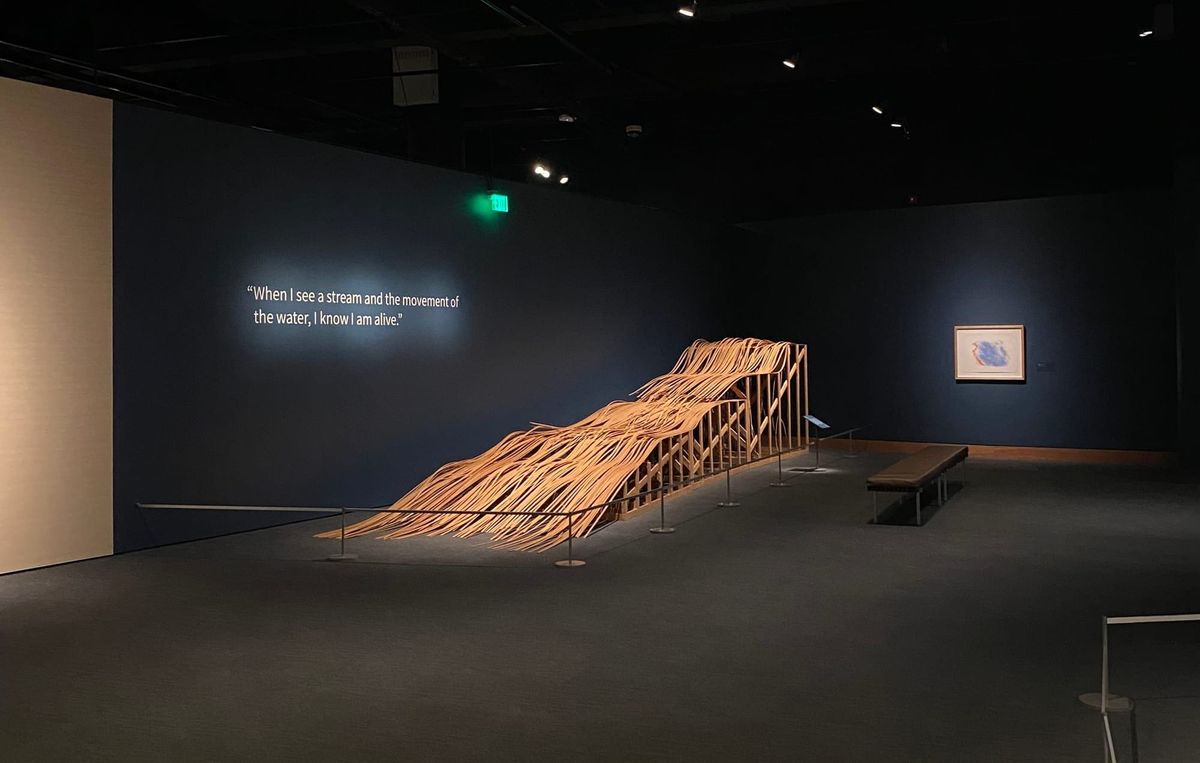
During these decades, Lowe also began creating large-scale architectural installations inspired by historical Ho-Chunk dwellings, such as traditional wigwams and bark-covered structures. These installations bridged the gap between sculpture, architecture, and environmental art, inviting viewers to step inside spaces charged with historical consciousness.
The 1990s and 2000s: Monumental Currents and Industrial Shifts
As his career progressed into the 1990s, Lowe’s sculptures grew in scale and conceptual ambition. Works like “Ottawa” (1992) cemented his reputation for capturing the ephemeral qualities of nature using raw timber.
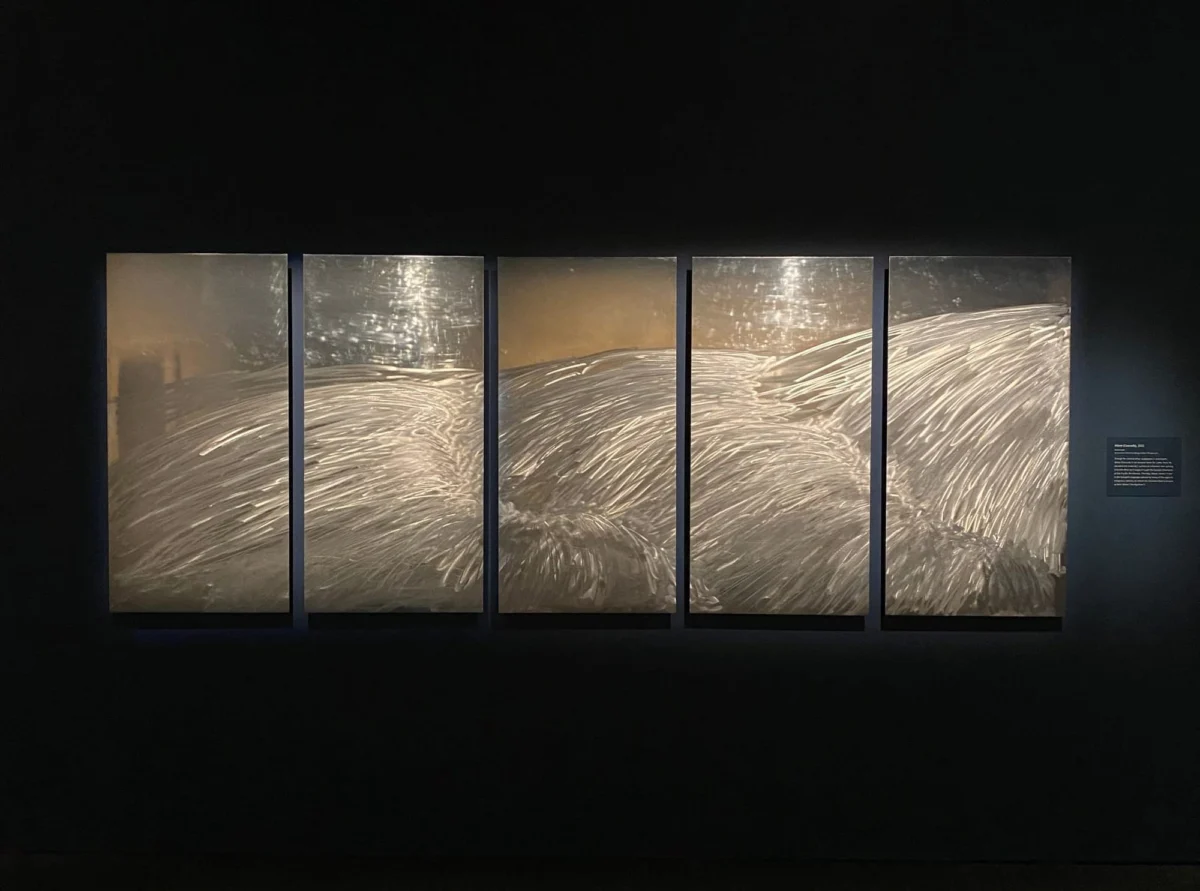
Entering the 2000s, Lowe expanded his material palette beyond organic wood, occasionally incorporating industrial metals to comment on environmental shifts and modern infrastructure. A striking example featured in the retrospective is Wána (Cascade) (2002), crafted from aluminum. Here, Lowe translates the kinetic energy of a cascading waterfall into gleaming, reflective metallic plates, proving his mastery over both organic and manufactured mediums.
Throughout his life, Lowe also dedicated himself to education and public service. He served as a professor of art at the University of Wisconsin-Madison for nearly four decades and spent several years as the curator of contemporary art at the National Museum of the American Indian, championing a generation of Indigenous artists who followed in his footsteps.
Supporting Data and Cultural Framework: The Significance of Four
In Hoocąk culture and worldview, numbers hold profound structural and spiritual weight, with the number four occupying a place of supreme reverence. It represents the four cardinal directions, the four seasons, the four stages of life, and the foundational elements of the natural world. In Lowe’s artistic practice, this numerical repetition is never accidental; it signifies permanence, balance, and historical continuity.
This cultural framework is meticulously woven into the fabric of his physical artworks. In Mimi (1979) and numerous other minimalist assemblages, elements are deliberately grouped in sets of four. This mathematical and spiritual rhythm provides a counterpoint to the fluid, chaotic movement of the water metaphors. While water flows and changes course, the sacred geometry of the four-part structure anchors the artwork, providing stability and endurance against the forces of cultural erasure and historical displacement.
Furthermore, the materials Lowe utilized carry their own empirical and ecological data. By relying heavily on native flora such as pine, peeled willow saplings, and birch, Lowe’s sculptures act as archives of regional ecosystems. Each sapling retains the grain, flexibility, and weathering of the specific riverbanks and forests from which it was gathered, offering viewers a tangible encounter with American geography.
Official Responses and Curatorial Perspectives
The opening of Water’s Edge has drawn widespread acclaim from art critics, historians, and museum leadership, who view the retrospective as a long-overdue celebration of a pivotal figure in American sculpture.

Museum directors and curators involved in organizing the exhibition have emphasized Lowe’s unique ability to transcend standard categorical boundaries. While mainstream art history often pigeonholed Native American artists into strict ethnographic categories, Lowe’s work consistently commanded space within the broader movements of Minimalism, Process Art, and Environmental Sculpture.
"Truman Lowe did not just represent nature; he spoke its language," noted one of the exhibition’s coordinating curators during the opening remarks in Washington, DC. "He understood that wood remembers the forest, and that water remembers its course. By bringing these elements into the gallery space, he forced modern audiences to confront their own separation from the natural world."
Art critics have similarly praised the exhibition’s layout, noting how the division into four distinct thematic sections allows viewers to trace the intellectual and emotional depth of Lowe’s career. Reviews highlight how the transition from organic wood sculptures to sleek aluminum installations like Wána (Cascade) demonstrates an artist who was never complacent, constantly seeking new ways to articulate the timeless motion of the earth.
Implications: The Enduring Legacy of Truman Lowe
The retrospective at the National Museum of the American Indian arrives at a critical juncture in contemporary art history, where institutions are increasingly reckoning with the historical marginalization of Indigenous creators. Water’s Edge does more than celebrate an individual master; it repositions Native American art as a central driver of conceptual and environmental discourse in the late 20th and early 21st centuries.
Bridging Environmental Consciousness and Art
Lowe’s work carries profound implications for contemporary conversations surrounding climate change, ecological degradation, and land stewardship. Long before "eco-art" became a dominant genre in contemporary galleries, Lowe was engaging directly with the landscape, using sustainably gathered materials to comment on the fragility and resilience of natural waterways. His sculptures serve as visual reminders of the interconnectedness of human communities and river ecosystems—an urgent message in an era of unprecedented environmental crisis.
Inspiring Future Generations of Indigenous Artists
As an educator, mentor, and institutional leader, Truman Lowe’s influence extends far beyond the physical objects he crafted. By successfully navigating the elite spaces of academic art and major museums while remaining fiercely committed to his Hoocąk identity, he paved the way for contemporary Indigenous artists to claim space on their own terms.
Water’s Edge: The Art of Truman Lowe ensures that his artistic vision will continue to ripple outward. Just as Toni Morrison noted that water is forever trying to get back to where it was, Truman Lowe’s art guides us back to the source—reminding us of the rivers of our childhood, the strength of our ancestry, and the enduring power of culture to flow across generations.
 Nana Muazin
 Neng Nana
