

Main Facts
In October 2026, the historic Veterans Room at Manhattan’s Park Avenue Armory transformed into a laboratory of sound, memory, and geographic displacement. At the center of the ornate, dimly lit chamber sat a modest table holding an eclectic array of instruments and noisemakers: sound mixers, synthesizers, effect pedals, speakers, whistles, a turkey call, and a ceramic horn.
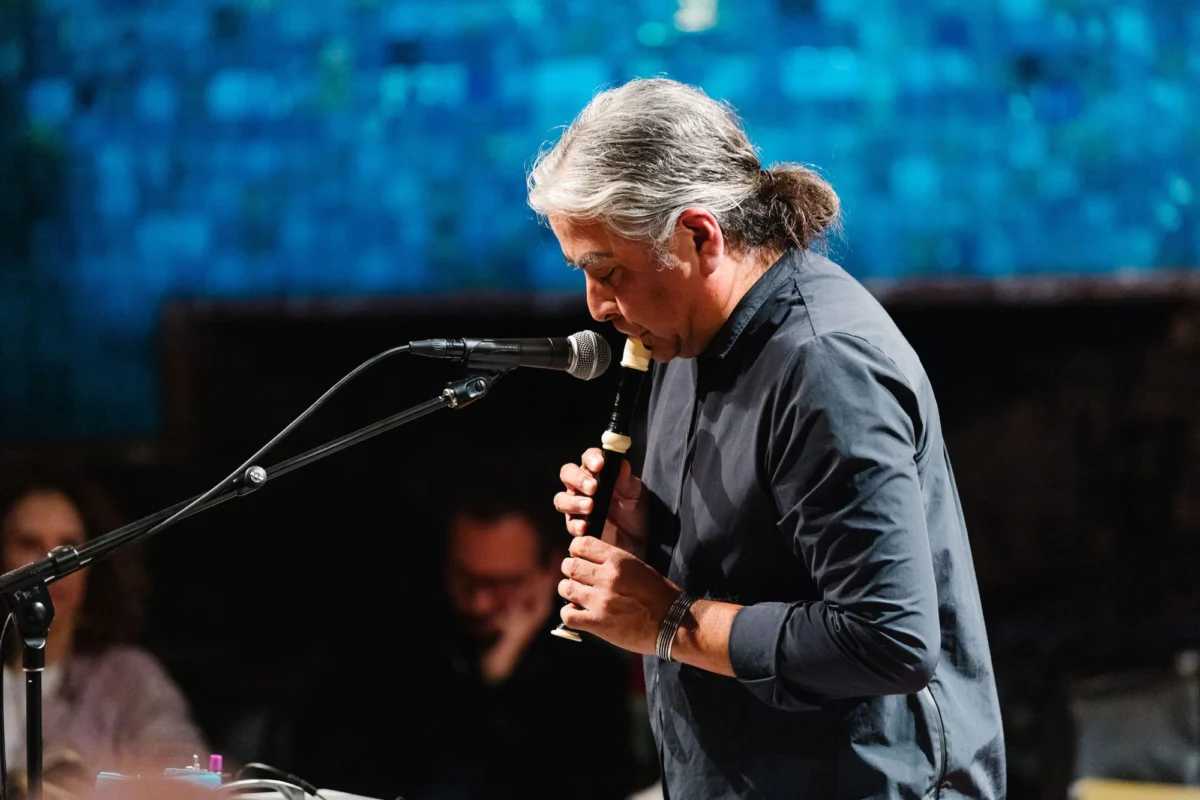
For two consecutive nights, this setup served as the staging ground for hour-long improvisation sessions by Raven Chacon, a celebrated Diné (Navajo) composer, performer, and visual artist. Chacon, who made history as the first Native American to win the Pulitzer Prize for Music in 2022, took to the stage as part of the Armory’s prestigious Artists Studio series.
Rather than relying on traditional musical scores, Chacon’s performances relied entirely on real-time improvisation. He manipulated breath, feedback, electronic drone, and field recordings to craft an immersive sonic environment. By turns meditative and disquieting, his performances bridged the gap between raw natural landscapes—specifically the open winds of New Mexico—and the claustrophobic, vehicle-choked concrete canyons of midtown Manhattan.
The performances offered audiences a rare, intimate look at a master sound artist at work, raising fundamental questions about geography, the echoes of colonial violence, and the vital practice of "deep listening" in contemporary society.
Chronology of the Performance and Interview
The October Residencies (October 7–8, 2026)
The sequence of events unfolded across two distinct evenings in the Park Avenue Armory’s Veterans Room:

- The Setup: At the center of the historic room, Chacon arranged a table laden with both high-tech electronic equipment (synthesizers, mixers, looping pedals) and primitive acoustic implements (whistles, a turkey call, a ceramic horn).
- The October 7 Opening Night: Chacon established the sonic vocabulary for the residency, blending abstract electronic feedback with stark, organic acoustic sounds.
- The October 8 Performance: During the second night’s performance, Chacon executed a masterclass in tension and release. He blew sharply into a microphone via a whistle, looping the audio to construct a rising electronic drone. He then layered recorded breaths, cutting them abruptly to highlight the raw acoustic transmission of his own breathing moments prior.
- The Sci-Fi Transition: Midway through the set, Chacon blended sharp screeches with the whistle loops, warping them into metallic, oscillating frequencies reminiscent of extraterrestrial communication signals from classic science fiction.
- The Closing Act: To conclude the session, Chacon utilized a hyperdirectional speaker. Playing recordings of wind gathered from his homeland in New Mexico, he physically rotated in a circle, sweeping the rushing sound across different quadrants of the room. This acoustic geography directly contrasted with the blaring sirens and heavy traffic of Park Avenue immediately outside the building’s thick walls.
- The Post-Performance Interview: Between his New York engagements, Chacon sat down for an exclusive telephone interview with Hyperallergic to discuss site-specificity, his upcoming projects, and the philosophy undergirding his approach to sound art.
Supporting Data and Context
To understand the weight of Chacon’s Park Avenue Armory performances, one must examine his broader artistic trajectory, institutional footprint, and technical methodology:
- The Pulitzer Milestone: In 2022, Chacon was awarded the Pulitzer Prize for Music for Voiceless Mass, a composition written for pipe organ and ensemble that explores the spaces where people have gathered—or been forced to gather—throughout history.
- A Multidisciplinary Practice: Based in Albuquerque, New Mexico, Chacon works across chamber music, orchestrations, fine art installations, and noise performances. He is also a founding member of the Indigenous performance art collective Postcommodity.
- The Instrumentarium: Chacon’s choice of tools is deliberately heterogeneous. By pairing high-end synthesizers and looping pedals with historical or vernacular noisemakers—such as the turkey call and ceramic horns—he collapses the hierarchy between traditional Western classical music and folk or survivalist implements.
- Spatial Resonance: Chacon’s work is acutely responsive to where it is exhibited. Critics have frequently noted how his installations adapt to their architectural and geographical hosts. For instance, a recent sound installation at the Hammer Museum in Los Angeles was described by critics as evoking a "California earthquake," engaging directly with the unstable geological fault lines of the West Coast. In contrast, his New York engagements must contend with the dense urban white noise of the metropolis.
Official Responses and Dialogue
The discourse surrounding Chacon’s residency highlights the complex interplay between artist, location, and audience. In his conversation with Hyperallergic, Chacon addressed the challenges of bringing site-specificity to improvised performance, the acoustic weight of urban environments, and his integration of naturalist histories.
On Improvisation vs. Site-Specificity
When asked how he incorporates local histories—such as Lenape culture or New York’s naturalist past—into an entirely improvised set, Chacon offered a candid reflection on the realities of live performance:
"I wish I could say I was responding to the Armory [laughs]. When I’m playing in the city, I tend to bring in more field recordings of the outdoors, of wind and other sounds from other places. A lot of these were gathered where I’m from in New Mexico. While not site-specific to the Armory in this case, I find myself incorporating those more indoors, amongst the other things that encroach upon the interior of the space. It’s unavoidable that we might hear sirens and traffic outside, and those usually become part of the soundtrack of what I’m working with."
On Geological Resonance and Context
Comparing his New York residency to his recent exhibition at the Hammer Museum in Los Angeles, Chacon noted how the surrounding visual art influences how his sound pieces are experienced by the public:
"That was certainly a consideration. Also, with that show, there were a lot of works about the actual ground. That installation was situated at the entry, but immediately, you have works by Edgar Calel, Ana Mendieta, these works that involve soil and dirt. I wanted to reference that with that piece. And as you move through, you have these different interactions with different materials and visual concepts happening throughout the show."
Implications
Raven Chacon’s residency at the Park Avenue Armory carries profound implications for contemporary sound art, Indigenous visibility in elite cultural institutions, and the socio-political power of listening.
1. Disrupting Elite Architectural Spaces
The Park Avenue Armory, a monument to Gilded Age wealth and military history in Manhattan, is traditionally a site associated with elite European classical traditions and historical preservation. By filling the ornate Veterans Room with industrial noise, electronic feedback, and field recordings of New Mexico winds, Chacon subtly subverts the colonial and institutional architecture. He forces a collision between the hyper-gentrified interior of the Armory and the broader, unceded landscapes of North America.
2. The Politics of "Deep Listening"
In an era dominated by constant sensory overload—symbolized by the screaming police sirens and roaring engines just outside the Armory doors—Chacon’s work demands a radical slowing down. By manipulating hyperdirectional speakers to pan the sound of the wind across the room, he creates an alternative reality. This geography, as reviewers noted, is "much less violent than those sounded by the cars blaring up and down Park Avenue." Yet, Chacon reminds his audience that the survival of these alternative spaces depends entirely on human agency: we must actively choose to listen.
3. Expanding the Boundaries of Native Modernism
As an Indigenous artist working in experimental electronic music, noise, and conceptual art, Chacon consistently resists reductive categorization. He does not produce "folkloric" or easily digestible representations of Diné culture; rather, he deploys cutting-edge sound engineering, noise theory, and science fiction to critique historical trauma and imagine futures beyond colonial frameworks. His ongoing evolution—including upcoming projects with the San Francisco Museum of Modern Art (SFMOMA)—cements his status as one of the most vital and provocative sonic architects of the twenty-first century.
 Layla Zulfa
 Neng Nana
