

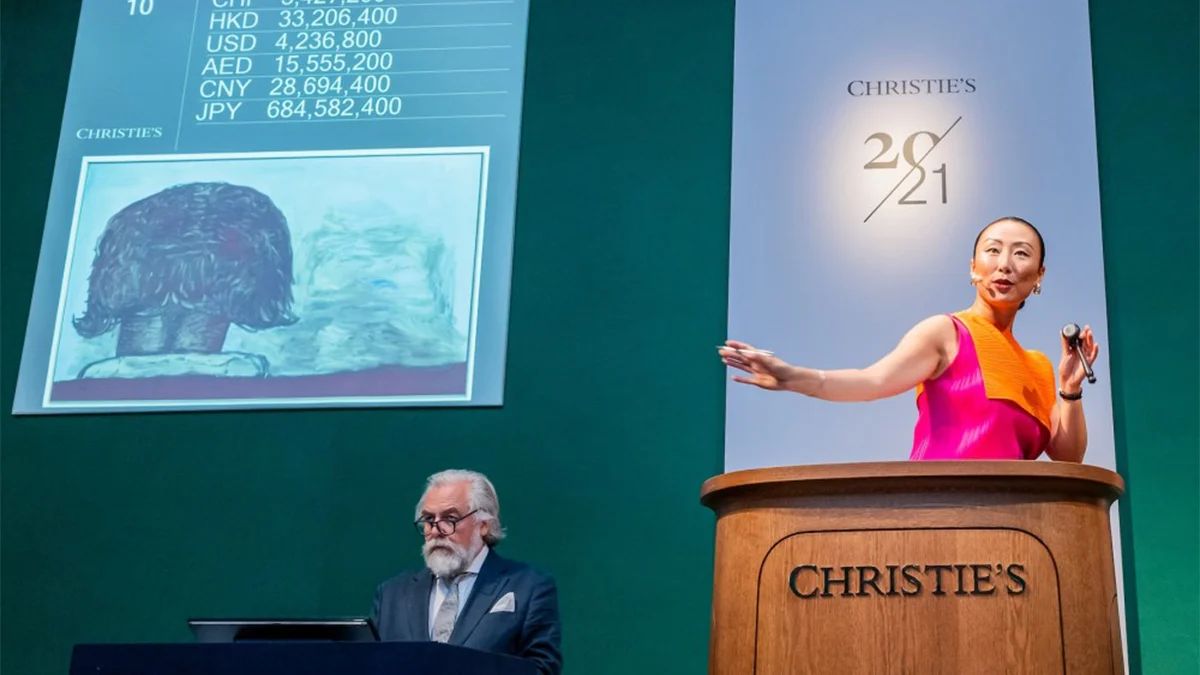
The global art market, often viewed as a bellwether for the health of the high-end luxury economy, is demonstrating renewed vigor. In a comprehensive midyear performance update, auction powerhouse Christie’s announced an impressive $4.5 billion in total revenue for the first half of the year. This figure, which combines $3.5 billion in auction sales and over $1 billion in private sales, represents the house’s most successful six-month start since 2021.
More significantly, the data suggests that the art market is not merely relying on the occasional "trophy" sale to sustain its momentum. Instead, Christie’s results point to a broader, more systemic recovery characterized by deepened buyer participation, increased sell-through rates, and a healthy appetite for works across diverse price brackets.
Main Facts: A Strong Rebound
The headline figure—a 71 percent year-over-year increase in auction sales—initially suggests a market fueled by extreme volatility and major estate sales. While blockbuster consignments undoubtedly provided a strong tailwind, the underlying metrics reveal a more nuanced story of sustained demand.

The $630.8 million sale of the S.I. Newhouse collection served as the primary engine for the headline numbers. However, the internal data provided by Christie’s highlights that the firm achieved growth across every department, region, and price point. By moving the conversation away from total volume and toward market health, Christie’s is making a concerted effort to assure investors and collectors alike that the current momentum is sustainable rather than ephemeral.
Chronology of Growth
To understand the current state of the art market, one must look at the trajectory Christie’s has navigated since the post-pandemic reset.
- 2021–2022: The market experienced a "revenge spending" boom as collectors returned to in-person events, though economic headwinds soon cooled enthusiasm in certain sectors.
- Early 2023: Christie’s faced a more cautious environment, marked by economic uncertainty and rising interest rates that prompted a more selective approach from high-net-worth individuals.
- Q1 2024: The first quarter saw the stabilization of interest rates and a return of confidence, with Christie’s pivoting its strategy toward broader international outreach.
- H1 2024 (Present): The current reporting period shows a robust recovery, punctuated by record-breaking auctions of modern masterpieces and a surge in the middle-market sector.
Supporting Data: The Metrics of Health
Christie’s midyear report emphasizes qualitative data that goes beyond gross revenue to prove market depth. The firm’s sell-through rate, a key indicator of bidder interest, climbed to 91 percent from 87 percent in the previous year.

Furthermore, the average performance against low estimates has improved significantly. While in the past year, works were selling at roughly 112 percent of their low estimates, that figure has now risen to 124 percent. Perhaps most revealing is the "middle-market" performance: works estimated between $20,000 and $100,000 achieved 148 percent of their low estimates—a 21 percent improvement over the previous year. This confirms that the appetite for art is not confined to the ultra-wealthy seeking blue-chip masterpieces; rather, it is a sign of a vibrant, competitive ecosystem across all tiers of the market.
Breakdown of Categories
- 20th- and 21st-Century Art: This remains the crown jewel, climbing 79 percent to $2.3 billion.
- Old Masters: In a surprising surge, sales in this category grew by 232 percent, suggesting a renewed interest in historical provenance.
- Luxury Goods: While often a primary driver of volume, luxury saw a more modest increase of 15 percent, reaching $539 million. This indicates a pivot back toward fine art as the primary asset class for major collectors.
Official Responses and Strategic Vision
Bonnie Brennan, Chief Executive of Christie’s, has framed these results as a testament to the house’s strategic transformation. In an official statement, Brennan noted, "We had our best first half in five years at Christie’s, growing in all departments and regions, at every price point."
Brennan emphasized that the company’s success is rooted in its ability to capture a younger, more international audience. "We have delivered our strongest ever levels of international bidding and buying," she added. By prioritizing digital integration, the auction house has seen 63 percent of new clients entering the market through online platforms, with Millennials and Gen Z now accounting for nearly half of all new client acquisitions.

The Role of Private Sales and Art Finance
The $1 billion figure attributed to private sales is a crucial component of the current business model. As the public auction market becomes increasingly transparent and competitive, many collectors are opting for the discretion of private transactions. This segment acts as a vital counter-balance to the auction floor, ensuring that Christie’s can facilitate high-value deals regardless of the broader auction calendar.
Additionally, the expansion of the "Art Finance" division is a clear signal of the changing relationship between collectors and their holdings. With more clients utilizing their art collections as collateral for lending, the art market is becoming increasingly integrated with traditional financial services. While Christie’s remains tight-lipped on the specific revenue generated by this division, the emphasis on its growth highlights a future where auction houses act as full-service financial institutions for the art-wealthy.
Implications for the Global Art Market
The success of the first half of the year carries several implications for the remainder of 2024 and beyond.

1. The Normalization of High-End Collecting
The record-breaking sales of Jackson Pollock’s Number 7A, 1948 ($181.2 million), Constantin Brâncuși’s Danaïde ($107.6 million), and Mark Rothko’s No. 15 (Two Greens and Red Stripe) ($98.4 million) demonstrate that when rare, "trophy" assets hit the market, demand remains insatiable. The willingness of buyers to set new artist auction records suggests that for the ultra-high-net-worth segment, blue-chip art remains a preferred hedge against inflation and currency volatility.
2. A Shift in Demographics
The fact that nearly 50 percent of new clients are from younger generations is perhaps the most critical takeaway for the long-term future of the industry. These digital-native collectors are comfortable bidding online and are less reliant on traditional gallery gatekeepers. This shift is forcing auction houses to adapt their marketing and accessibility, ensuring that the "white-glove" experience of the past is supplemented by the speed and reach of the digital present.
3. Market Resilience
Christie’s data suggests that the art market has successfully navigated the "correction" phase that many analysts predicted following the pandemic highs. By diversifying its offerings and strengthening its middle market, the firm has insulated itself against the potential cooling of the ultra-high-end segment.

Conclusion: A Barometer for Confidence
As Christie’s moves into the second half of the year, the narrative it has constructed is one of resilience and expansion. The transition from a market reliant on massive, headline-grabbing estates to one characterized by deep, cross-generational, and international competition is a healthy sign for the industry.
While global economic factors—such as interest rates, geopolitical tensions, and inflationary pressures—will continue to influence the behavior of investors, the evidence from the first half of 2024 suggests that the art market has regained its footing. Collectors are not just buying art; they are increasingly engaging with the auction house as a comprehensive financial and cultural partner. Whether this momentum can be maintained through the end of the year remains to be seen, but for now, Christie’s has successfully signaled that the art world is once again in a period of growth.
 Evan Lee Salim
 Asep Darmawan
 Laily UPN
