

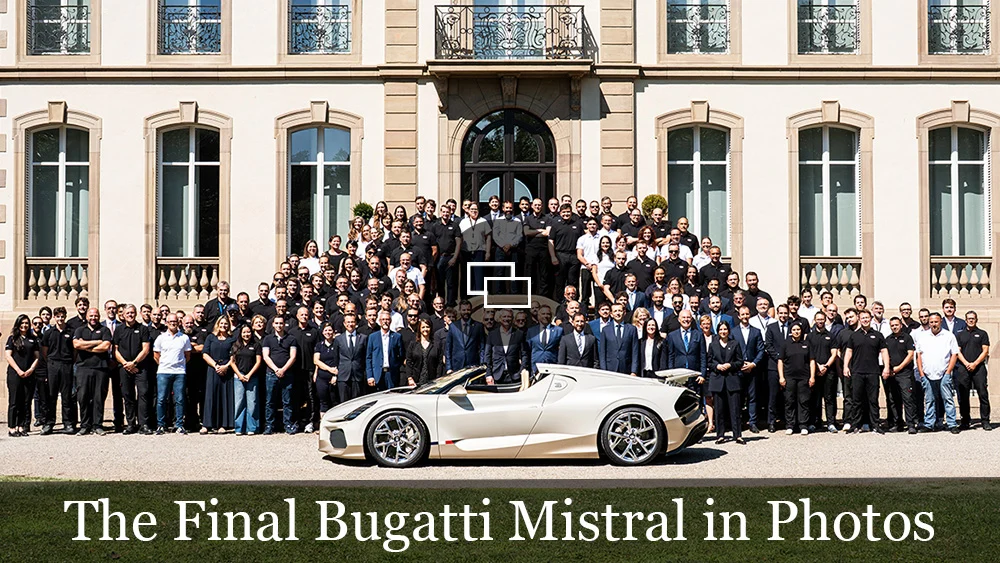
The automotive world has reached a definitive turning point. In the historic Molsheim atelier, a chapter that began over a quarter-century ago has officially closed. Bugatti has unveiled the 99th and final example of the Mistral roadster, a milestone that marks the absolute conclusion of the brand’s series-production W-16 engine era. This is not merely the end of a production run; it is the final curtain call for one of the most significant engineering achievements in the history of the internal combustion engine.
The Dawn of a New Era
The final vehicle, aptly and poignantly dubbed "The Last of Its Kind," represents the pinnacle of Bugatti’s modern legacy. Finished in a bespoke two-tone exterior that marries the purity of "Pearl" with the vibrant "Sparkle," the hypercar is as much a piece of art as it is a feat of engineering. Inside, the cabin is swathed in Magnolia and Grey Carbon Matt leather, with the signature of company founder Ettore Bugatti meticulously stitched into each headrest—a final nod to the heritage that this engine so faithfully served.
For collectors and enthusiasts, this vehicle serves as the closing bookend to a narrative that transformed the hypercar landscape. While the automotive industry pivots toward electrification and complex hybrid architectures, the W-16 remains a symbol of an era where mechanical excess was not just allowed, but celebrated.

A Chronology of the W-16 Reign
To understand the gravity of this moment, one must look back to 1998, the year the Volkswagen Group assumed control of Bugatti. At the time, the brand was a dormant legend, struggling to reconcile its storied past with the demands of the modern era. The solution was the development of the W-16 engine: a technical marvel featuring four banks of four cylinders in a unique "W" configuration.
- 1998–2005: The Prototype and The Veyron: The W-16 was the heartbeat of the Veyron 16.4, the first car to truly break the 1,000-horsepower barrier in a production package. It redefined what was possible, turning the abstract notion of a "hypercar" into a tangible, drivable reality.
- 2016: The Chiron Evolution: With the arrival of the Chiron, the W-16 was refined and pushed further. With its quad-turbocharged setup, it became the industry standard for longitudinal performance, capable of speeds that once existed only in the realm of theoretical physics.
- 2024: The World Record: The Mistral, in its specific "World Record" configuration, validated the engine’s prowess by officially becoming the fastest open-top production car in history, hitting 282 mph.
- 2026: The Final Curtain: With the completion of the 99th Mistral, the series-production line at Molsheim ceases to incorporate the W-16, shifting focus entirely to the forthcoming Tourbillon hybrid.
Supporting Data: The Mechanical Masterpiece
The W-16 is a 8.0-liter, quad-turbocharged beast that defies conventional engineering logic. Its specifications remain staggering even by today’s hyper-competitive standards:
- Power Output: 1,578 horsepower (1,600 PS).
- Torque: 1,180 ft-lbs, delivered with a relentless, linear force that defined the "Bugatti experience."
- Acceleration: 0–62 mph (100 km/h) in a blistering 2.4 seconds.
- Top Speed: A verified 282 mph (454 km/h).
The genius of the engine lies in its ability to manage immense heat and pressure while maintaining the refinement expected of a luxury grand tourer. It was an engine that could drive to the opera in complete comfort or shatter speed records on a test track with the flick of a switch.

Industry Implications and the Shift to Hybridization
The retirement of the W-16 coincides with a massive structural shift for the brand. Earlier this year, Porsche divested its 45 percent stake in Bugatti Rimac, signaling the end of the Volkswagen Group’s direct operational control. Under the leadership of Mate Rimac, the company is pivoting toward a future where electrification is paramount.
The successor to the Chiron, the Tourbillon, abandons the W-16 in favor of a radical hybrid powertrain. This new system features a massive, three-foot-long, naturally aspirated V-16 engine paired with a trio of electric motors. This transition is indicative of a broader trend: the era of "pure" internal combustion supremacy is waning, replaced by the hybrid era where instant electric torque supplements the soul of a high-displacement engine.
The "Programme Solitaire" Loophole
While the W-16 is officially retired from series production, it is not extinct. For the ultra-wealthy clientele who have maintained deep, long-standing relationships with the brand, Bugatti has introduced "Programme Solitaire."

This bespoke division allows for the creation of "one-off" or "few-off" vehicles that can still be commissioned with the W-16 architecture. Cars like the Brouillard and the FKP Hommage serve as evidence that the W-16 will continue to exist in the private collections of the world’s elite. These are not mass-produced machines, but rather tailor-made relics of a dying age, ensuring that while the assembly line has stopped, the heartbeat of the W-16 will echo in private garages for decades to come.
Looking Forward: The Legacy of Molsheim
The final Mistral is more than just a car; it is a monument. As the automotive industry moves toward the silent efficiency of electric motors, the visceral, mechanical roar of the W-16 will likely be remembered as the final flourish of the internal combustion age.
Bugatti’s transition is managed with the grace one expects from the marque. By bridging the gap between the mechanical insanity of the W-16 and the technological complexity of the hybrid Tourbillon, Bugatti is ensuring its own survival in a carbon-conscious world. Yet, for the engineers and enthusiasts who lived through the W-16 era, the closure of the Mistral line feels like the end of a golden age.

The Molsheim atelier will continue to innovate, and the Tourbillon will undoubtedly set new benchmarks for performance. However, the W-16 stands apart. It was an engine that did not just move the car—it moved the entire industry forward, forcing competitors to rethink the limits of what a road-legal vehicle could achieve.
As the 99th Mistral leaves the factory floor, it carries with it the spirit of a thousand-plus engineers, the dreams of its buyers, and the legacy of a brand that refused to compromise. While the W-16 engine has been retired, its place in history is cemented. It was, without a shadow of a doubt, the undisputed king of the hypercar world.
For those wishing to view the visual history of this engineering feat, Bugatti has released a comprehensive digital gallery documenting the assembly, testing, and final reveal of "The Last of Its Kind," a testament to the meticulous craftsmanship that defined the W-16 era.
 Evan Lee Salim
 Asep Darmawan
