

By Rhea Nayyar
Main Facts
Despite relentless rain, biting winds, and flash-puddling sidewalks, the 21st annual Art in Odd Places (AiOP) public art festival pressed forward this past weekend in New York City. Transforming Manhattan’s bustling 14th Street into a sprawling open-air laboratory, the festival centered its theme entirely around the concept of "Utopia."
For two days—Saturday and Sunday—artists from across the globe took over public thoroughfares, transit hubs, and commercial strips between the Hudson and East Rivers. Armed with performance art, site-specific installations, and interactive community projects, participants sought to disrupt the monotony of urban life and challenge New Yorkers to imagine worlds beyond contemporary political, technological, and environmental constraints.
However, the festival’s thematic ambition collided violently with reality. A fierce, weeping nor’easter slammed the city, bringing climate-induced technical difficulties, soaked infrastructure, and thoroughly disgruntled passersby. Rather than dampening the art, the severe weather fundamentally reshaped it. The festival became an accidental study in resilience, proving that dreaming of a better world is rarely an easy endeavor—especially when your socks are soaked through and commuters are wrestling with wind-whipped umbrellas beneath leaky scaffolding.
Chronology of a Waterlogged Weekend
Saturday: The Storm Front Arrives
As the first heavy bands of the nor’easter swept across the five boroughs on Saturday morning, AiOP’s organizers and artists faced an immediate trial by water. Stretching across 14th Street, installations made of paper, cardboard, and delicate fabrics required emergency waterproofing.
Performers stationed near Union Square and the subways had to quickly adapt their staging. What was originally planned as sprawling street theater compressed into narrow corridors under narrow awnings, storefront overhangs, and scaffolding. Yet, foot traffic remained surprisingly steady. Commuters rushing for shelter found themselves unwittingly stepping into artistic spaces, forced to confront avant-garde interpretations of freedom and community while dodging puddles.
Sunday Afternoon: Tension and Resilience Under Scaffolding
By Sunday afternoon, the weather had settled into a miserable cycle of pelting sideways rain and a heavy, mist-like drizzle. The atmosphere along 6th to 8th Avenue was electric, charged equally by artistic fervor and urban irritability.
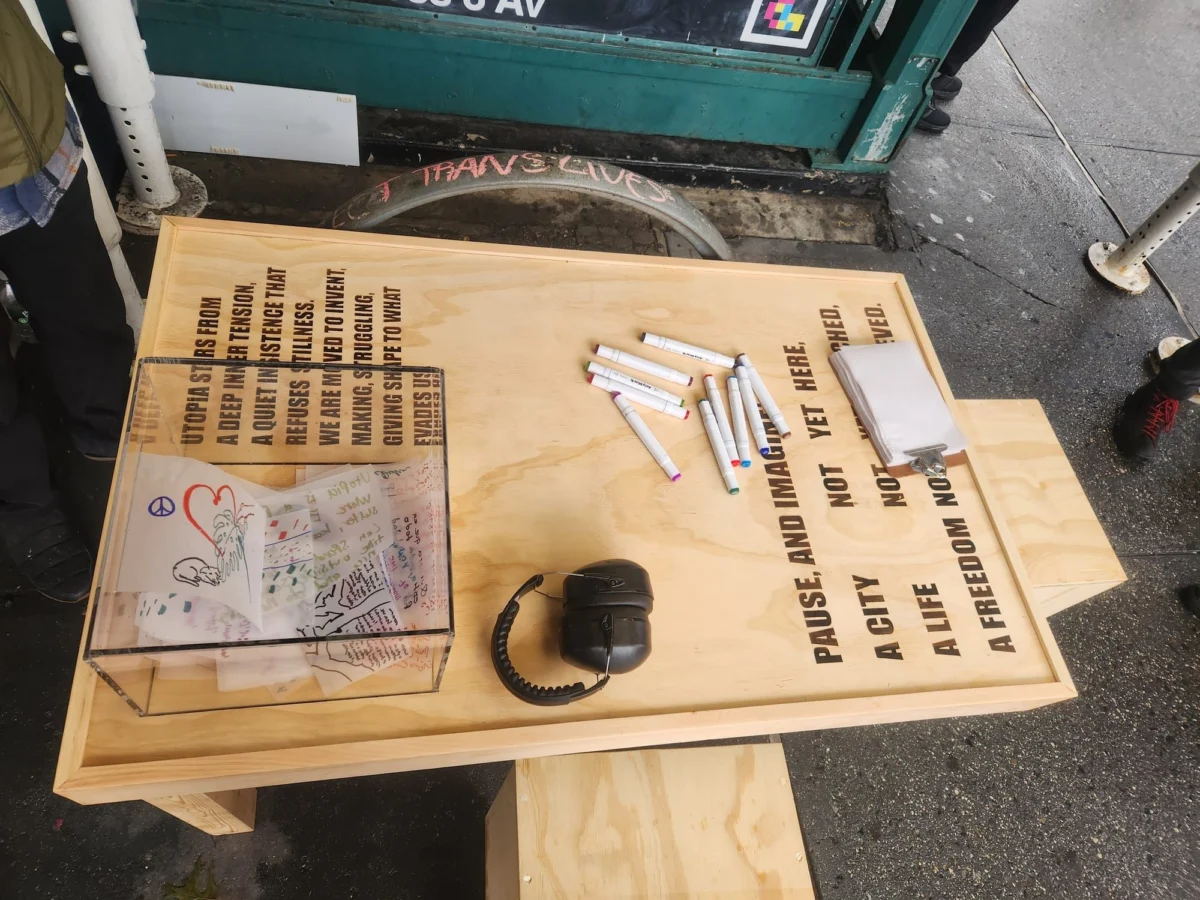
Near the 8th Avenue subway stop, Massachusetts-based artist Nima Nikakhlagh staged his interactive performance, The Archive of Possibility (2026). The piece invited shivering passersby to pause, sit down, and sketch a personal vision of a yet-unrealized utopian city or unachieved freedom. These contributions were slipped into a sealed box, destined to remain locked away forever.
The backdrop to Nikakhlagh’s participatory archive captured the chaotic reality of public art in a storm: a heated, expletive-laden argument broke out directly behind the installation over an accidental "brolly bonk" (umbrella collision).
Further down the corridor, other artists were actively battling urban hostility and infrastructural failure. Panama-based performance artist Susana Gonzalez-Revilla was forced to pack up her props from beneath a laundromat’s awning as the sharp, earthy scent of burning palo santo drifted into the wet air. Storefront tenants, already on edge from the weather and dwindling weekend foot traffic, complained about the smoke, drums, and fire integrated into her performance, prompting an early relocation.
Simultaneously, Astoria-based artist Ariel Kleinberg navigated high-stress conditions while installing cutout paintings of ancient goddesses along a dreary chain-link fence and tarp-covered vacant storefront, desperately trying to keep the damp wind from tearing the artwork away.
Supporting Data and Key Installations
Despite the logistical nightmares, the 21st edition of AiOP featured dozens of boundary-pushing projects that interrogated modern societal anxieties.
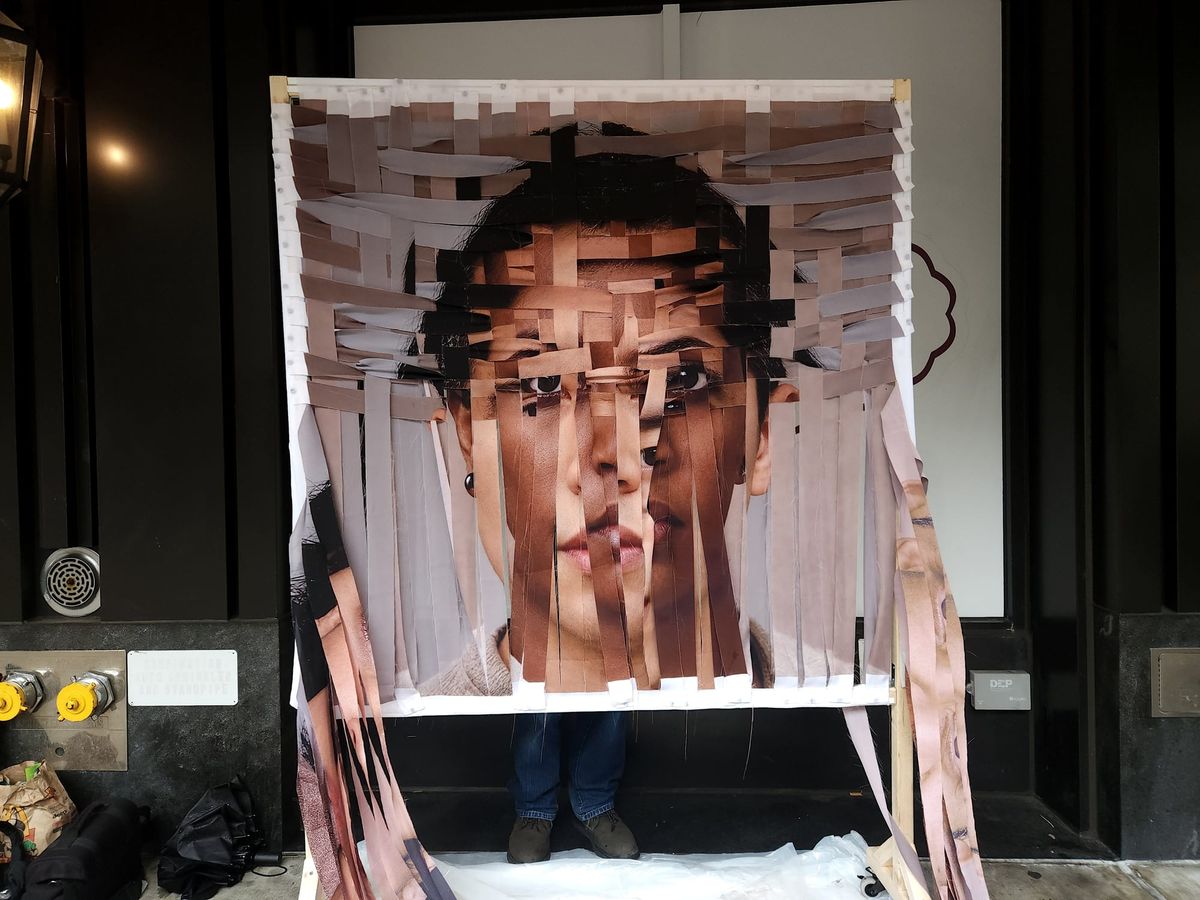
- Entung Liu’s Weaving You (2026): One of the festival’s emotional anchors, this performance piece invited the public to actively weave together strips of four distinct AI-generated portraits. Placed directly in the path of the elements, the participatory weaving served as a poignant metaphor for human connection versus technological standardization. The project directly questioned the cold, bureaucratic machinery of modern immigration systems and how artificial intelligence categorizes—or erases—individual human identity.
- The Geography of 14th Street: Spanning nearly the entire breadth of Manhattan, 14th Street functions as a unique socio-economic and architectural fault line, dividing the trendy neighborhoods of Chelsea and the Meatpacking District from the West Village, Union Square, and the East Village. Utilizing this corridor allowed artists to engage directly with socioeconomic disparity, transit congestion, and the rapid commercial gentrification of the city.
- Audience Participation Metrics: Despite the torrential downpours, hundreds of New Yorkers engaged directly with AiOP’s interactive booths, proving that public art serves as a vital psychological outlet during periods of civic and environmental stress.
Official Responses and Perspectives
The friction between artists, city infrastructure, and local merchants highlighted the ongoing challenges of executing independent public art in a hyper-regulated, climate-vulnerable metropolis.
Organizers of Art in Odd Places have long championed the philosophy that public spaces do not belong exclusively to commerce, transit, or municipal bureaucracy—they belong to the public imagination. By placing utopian art directly into the path of an uncooperative public, AiOP forces a collision between day-to-day survival and transcendent dreaming.
While local business tenants expressed frustration over blocked doorways, localized noise, and safety concerns regarding fire and smoke elements during Gonzalez-Revilla’s performance, participating artists viewed the friction as a necessary component of site-specific work. Art in public spaces is never created in a sterile vacuum; it is negotiated in real-time with the people who inhabit, police, and maintain those spaces.
Speaking on the conditions of the weekend, several artists noted that the bleakness of the nor’easter actually heightened the conceptual weight of their work. A utopia imagined on a sunny, perfect spring afternoon can easily slip into naive optimism. Imagining a utopia while standing in freezing, wind-driven rain under a leaky Manhattan scaffold, however, feels like a radical act of defiance against a crumbling status quo.
Implications for Public Art and Urban Futures
The 2026 iteration of Art in Odd Places leaves curators, city planners, and performance artists with critical questions regarding the future of urban public programming in an era of accelerating climate change.
1. The Climate Crisis and Ephemeral Art
As extreme weather events—such as nor’easters, flash floods, and unseasonal heatwaves—become increasingly frequent in the Northeast, outdoor arts festivals must adapt their infrastructure. Relying solely on tarps, awnings, and optimism is no longer viable. Curators will need to invest in weather-resilient materials and flexible indoor-outdoor hybrid models that do not dilute the street-level intimacy of public interventions.
2. Navigating Urban Tension
The verbal altercations over umbrellas and the friction between performers and local storefront tenants underscore a broader sociological truth: contemporary urban populations are perpetually stressed. Public art festivals function as pressure valves, sometimes absorbing collective societal anger. For artists, navigating these tensions requires high emotional intelligence and agile conflict resolution skills, transforming public disruption into dialogue rather than confrontation.
3. The Relevance of Utopia
In a political and environmental climate frequently defined by dystopian headlines—ranging from housing crises and bureaucratic immigration hurdles to ecological collapse—events like Art in Odd Places prove that the human compulsion to dream of alternatives cannot be washed away by a storm.
As long as cities remain chaotic, crowded, and occasionally miserable, initiatives like AiOP will continue to take to the streets, offering residents a fleeting, wet, and utterly human glimpse of a better world.
 Basiran
 Muslim
 Evan Lee Salim
