

Main Facts
In an age dominated by unrelenting digital feeds, hyper-visibility, and normalized catastrophes, contemporary art is frequently tasked with an impossible question: What can formal restraint possibly accomplish in the face of violent excess?
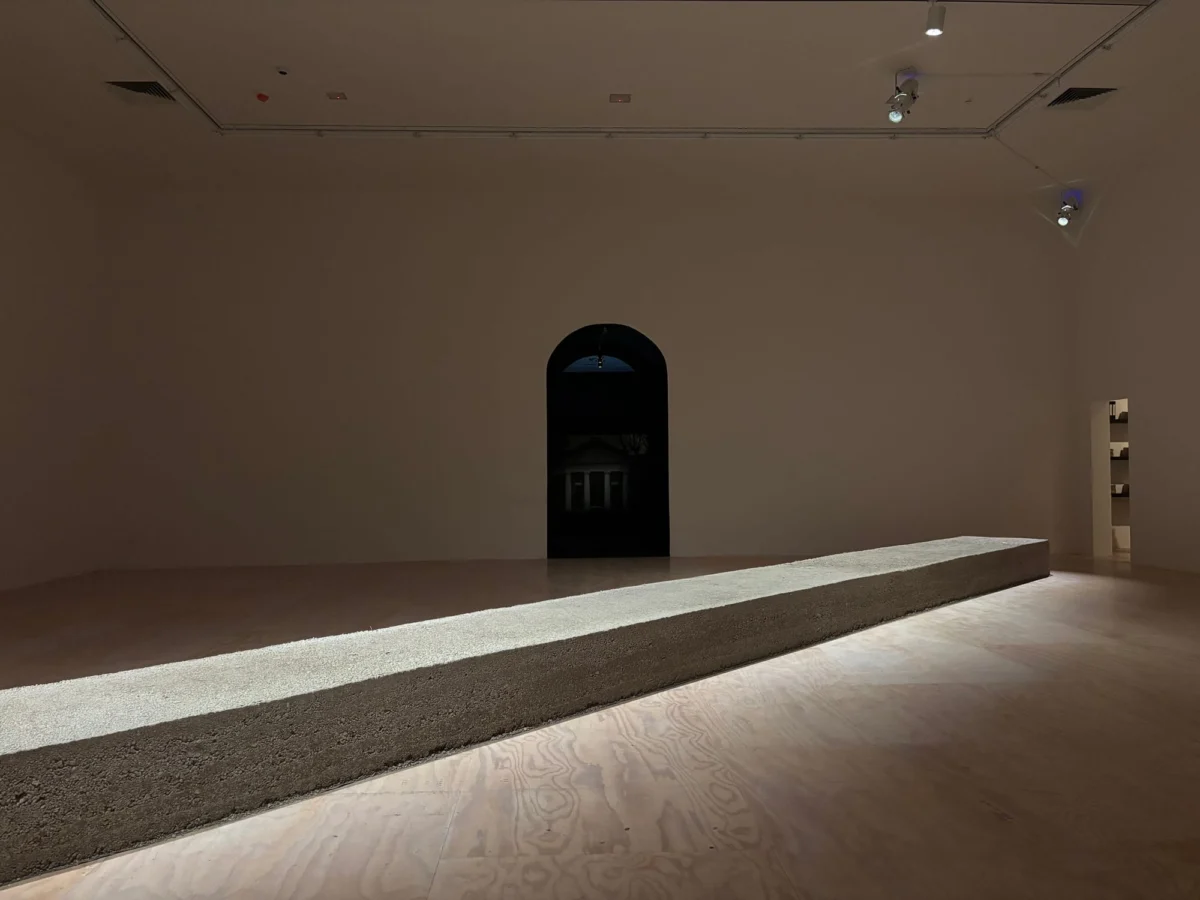
This is the central inquiry driving En el lugar de los hechos (At the Scene), a monumental, career-spanning retrospective of works by Mexican artist Teresa Margolles. Spanning more than three decades of artistic production, the exhibition is co-hosted by MoMA PS1 and the Museum of Modern Art in New York. It marks Margolles’s first comprehensive, large-scale museum exhibition in the United States, bringing together installations, videos, sculptures, and performances that trace the architectures of violence across international borders.
Born in Culiacán and based in Mexico City, Margolles has built a radical, uncompromising practice confronting the fatal intersections of systemic violence, state apathy, organized crime, and global capital. Much of her career has focused on the flashpoints of brutality along the United States-Mexico border—most notably in Ciudad Juárez and El Paso, Texas. However, as the MoMA PS1 presentation makes clear, her artistic lens extends far beyond regional borders. By utilizing minimalist gestures, conceptual rigor, and literal remnants of human tragedy—such as water from morgues, soil from murder scenes, and structural debris from demolished buildings—Margolles forces viewers to confront the invisible infrastructure of death that underpins modern society.
Chronology of a Practice: Three Decades of Witness
To understand the weight of En el lugar de los hechos, one must trace the evolution of Margolles’s career, which began not in traditional fine arts academies, but in the forensic pathology labs of Mexico.
The Forensic Beginnings (1990s)
Before emerging as a prominent figure in international contemporary art, Margolles trained as a forensic physician and worked in the morgues of Mexico City during the 1990s. Alongside a collective of artists known as Semefo (Servicio Médico Forense), she began incorporating the realities of the morgue—unclaimed bodies, autopsy tables, water used to wash corpses—into gallery spaces. Her early works utilized the material reality of death to strip away the sanitizing mechanisms of state bureaucracy.
The Shift to Monumental Absence (2000s–2010s)
As the so-called "War on Drugs" escalated in Mexico throughout the 2000s, Margolles’s work shifted toward the external environments impacted by violence: the streets, homes, and public squares where lives were abruptly ended.
- 2001: She debuted Vaporization (Vaporización), a seminal installation featuring a sealed room filled with vaporized water that had been used to wash corpses in forensic morgues.
- 2003: She expanded this conceptual vocabulary with Aire (Air), introducing humidifiers releasing water collected from sites of violent crime in cities like New York into the gallery atmosphere.
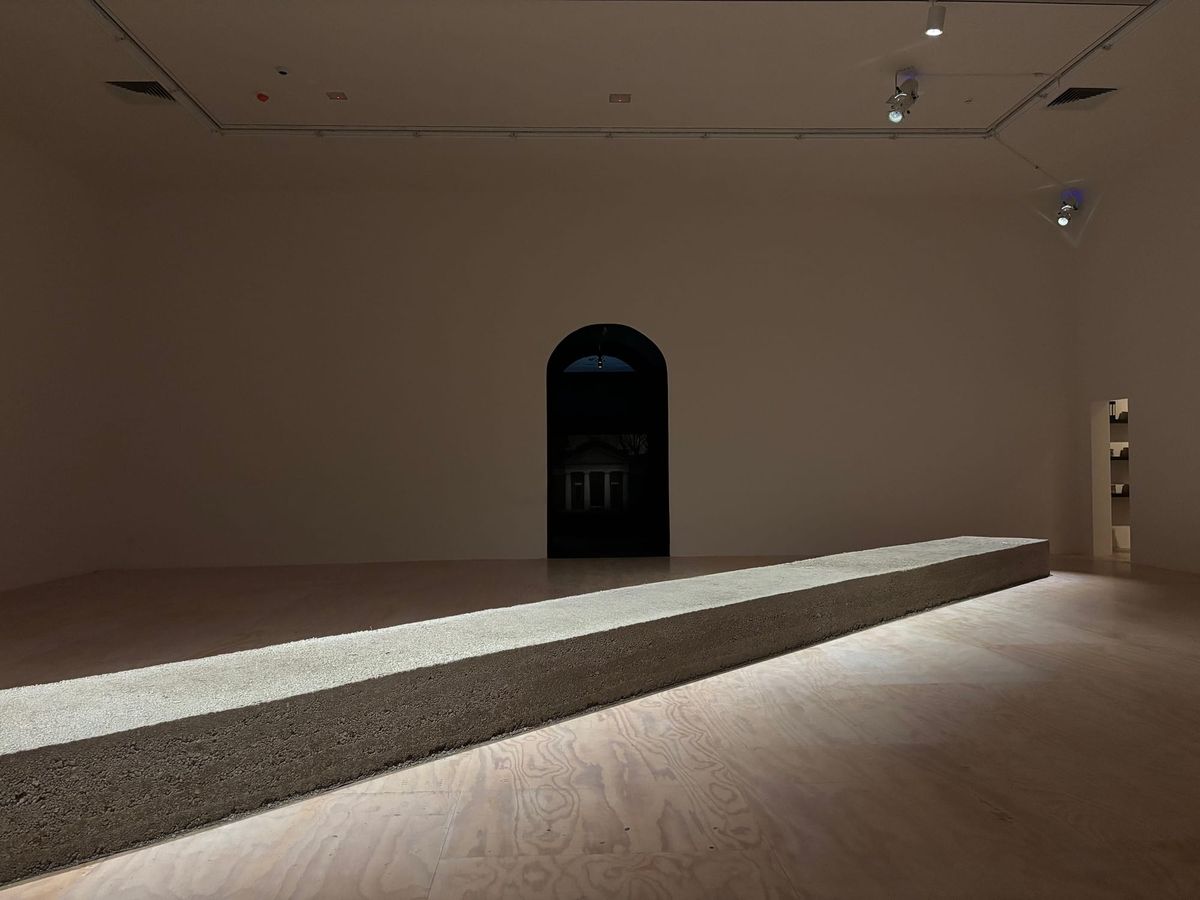
- 2012: Margolles executed La promesa (The Promise), transporting 22 tons of rubble from a demolished home in Ciudad Juárez—a city ravaged by cartel violence—into a pristine European exhibition space, treating architectural ruin as a monument to systemic failure.
The Contemporary Retrospective (Present)
The current exhibition at MoMA PS1 gathers these historical milestones alongside recent interventions. It documents how Margolles’s methodology has evolved from direct bodily confrontation to broader socio-spatial investigations of grief, policing, and labor across North America.
Supporting Data & Exhibition Breakdown
Occupying the third-floor galleries of MoMA PS1, En el lugar de los hechos features over 30 works that test the limits of viewer endurance through sheer minimalist precision.
El agua de la ciudad, Dallas (The Water of the City, Dallas) (2016)
The retrospective opens in a gallery defined by absence, repetition, and crushing futility. Projected onto a massive wall is El agua de la ciudad, Dallas, a grueling 296-minute video compilation. The footage documents people methodically scrubbing concrete pavement across various sites in Dallas where individuals were shot and killed.
- Each scene opens with a formalized title card detailing the victim’s name, age, date of death, and address.
- The staggering length of the video mimics the infinity of urban violence. One title card reads with devastating banality: "Victim shot while accidentally trying to enter the wrong apartment."
- The act of scrubbing serves as what Margolles calls señalizaciones (signalizations)—minimalist demarcations of trauma in an otherwise indifferent urban grid.
La nieve (The Snow) (2015)
Displayed on an adjacent, smaller screen, La nieve captures a lone man in Staten Island shoveling snow directly in front of the makeshift sidewalk altar dedicated to Eric Garner, who was choked to death by New York City police in 2014. Much like the Dallas scrubbing video, the act of shoveling carves out a temporary, sterile rectangular zone of memory amidst a chaotic, unruly urban landscape.
Aire (Air) (2003) & The Evolution of Immersive Grief
Returning to her early-2000s experiments with atmospheric installations, Aire utilizes unassuming mechanical humidifiers hidden behind gallery vents. The moisture circulating through the air ducts is harvested directly from sites of violent crime in New York City.
- During the exhibition’s press preview, co-curator Inés Katzenstein noted the shift in tone between Vaporization (2001)—where the steam retained an eerie, sublime beauty—and Aire.
- As Katzenstein remarked, "We don’t need the beauty of the steam anymore—we still breathe it every day, all the time." The violence is no longer an exoticized event housed in a separate room; it is rendered atmospheric, internalized by every visitor inhaling the gallery air.
Official Responses and Curatorial Intent
The curatorial team behind En el lugar de los hechos, led by Inés Katzenstein and representatives from MoMA and MoMA PS1, designed the exhibition to challenge traditional art-world viewing habits. Rather than offering passive contemplation, the museum spaces have been deliberately curated to elicit visceral discomfort.

In official statements, the curators emphasized that Margolles’s work refuses to aestheticize suffering. Instead, it weaponizes minimalism as an ethical imperative. Where minimalist masters like Donald Judd or Carl Andre used industrial materials to explore pure form, geometry, and space, Margolles hijacks the formal vocabulary of minimalism to map human casualties.
Art critics and institutional representatives have noted that bringing Margolles’s work to New York forces an uncomfortable reckoning for American audiences. While U.S. media frequently frames cartel violence and state brutality as localized, foreign phenomena—particularly concerning the southern border—Margolles’s integration of New York and Dallas crime scenes explicitly connects American complicity, consumer drug markets, domestic policing, and transnational migration policies into a single, unified ecosystem of violence.
Implications: The Art of Witness in an Age of Excess
What does formal restraint accomplish in an age of violent excess?
Margolles’s retrospective suggests that hyper-visuality has inured us to tragedy. Graphic imagery, endless news cycles, and real-time war footage have created an environment of empathetic fatigue. By stripping away narrative melodrama, graphic gore, and sensationalism, Margolles creates a vacuum. In that vacuum, the viewer is forced to confront the sheer scale of systemic neglect.
Her use of señalizaciones—the scrubbing of a sidewalk, the shoveling of snow, the circulation of tainted air—reminds us that society operates through perpetual amnesia. Streets are washed clean hours after a shooting to restore the illusion of safety and keep the engines of commerce running. Real estate values are prioritized over human lives; borders are reinforced to protect capital while rendering disposable the bodies of migrants, people of color, and the economically disenfranchised.
Ultimately, En el lugar de los hechos at MoMA PS1 is not an easy exhibition to digest. It demands emotional stamina and intellectual humility. By reducing violence to its ghostly traces—a patch of clean pavement, a breath of heavy air, a heap of structural rubble—Teresa Margolles strips away our defenses. She leaves us standing in the gallery, forced to realize that the brutal architectures we witness on the walls are the very ones we inhabit every day.
 Basiran
 Evan Lee Salim
