

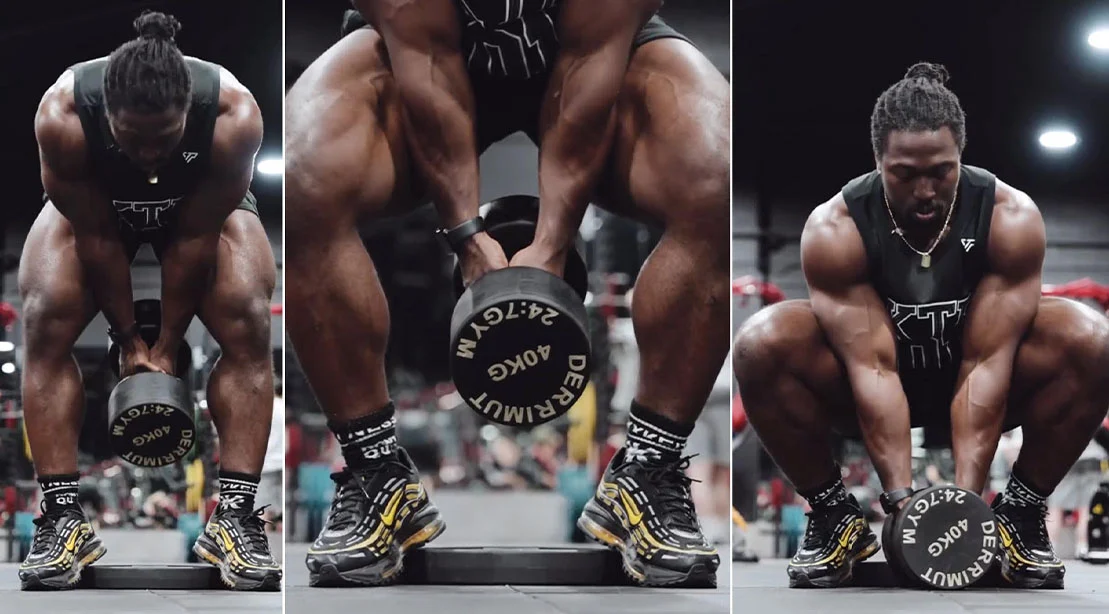
In the world of bodybuilding, the barbell back squat has long held the title of the "king of exercises." It is a staple movement for building structural integrity, raw power, and significant lower-body mass. However, the fitness industry is currently experiencing a paradigm shift toward movements that prioritize biomechanical tension and targeted hypertrophy over raw load. Leading this charge is Australian bodybuilder and social media powerhouse Kwame Duah, who recently took to Instagram to spotlight a specialized movement: the somersault squat.
Often referred to as the "Joe Daniels Squat," this exercise is proving to be a game-changer for lifters looking to isolate the quadriceps without the need for an expensive home gym or a traditional squat rack. By stripping away the barbell, the somersault squat forces a unique, deep-range mechanical tension that many athletes find far more effective for growth than standard variations.
The Evolution of the Squat: Understanding the Somersault Movement
To understand why the somersault squat is gaining such rapid traction, one must first understand its lineage. The movement is essentially a sophisticated evolution of the goblet squat. While the goblet squat is widely considered the gold standard for teaching beginners how to maintain an upright torso, the somersault squat introduces a nuanced trajectory that shifts the focus squarely onto knee flexion.
Defining the Mechanics
Unlike a traditional squat, where the goal is often to drive the hips back to engage the posterior chain, the somersault squat—when performed correctly—encourages the knees to travel forward over the toes. This is made possible through heel elevation, which compensates for ankle mobility restrictions and allows for a deeper, more upright squat pattern.
The weight—typically a single dumbbell or kettlebell—is held between the legs in a neutral grip. As the lifter descends, the weight travels along a vertical plane, acting as a counterbalance that allows the torso to remain perfectly perpendicular to the floor. This minimizes lower back involvement and maximizes the stretch on the quadriceps.
Chronology: From Niche Tool to Viral Sensation
The somersault squat did not originate in the mainstream. It gained its moniker, the "Joe Daniels Squat," from the trainer who first popularized the specific weight-path trajectory as a solution for athletes training with limited equipment during the global rise of home-based fitness.
The Social Media Catalyst
The movement remained somewhat obscure, relegated to the corners of functional fitness forums and niche bodybuilding blogs, until it reached the desk of Kwame Duah. Duah, a prominent influencer with a massive following across Instagram, YouTube, and TikTok, recognized the movement’s potential for pure aesthetic development.
In his recent viral reel, Duah broke down the movement into accessible steps for his followers. The response was immediate. Within days of the post, fitness enthusiasts across the globe were attempting the move, tagging Duah and sparking a broader conversation about the efficacy of "alternative" squat variations. The video served as a masterclass in modern fitness education: taking a complex, biomechanically demanding movement and translating it into a digestible, actionable format for the masses.
Supporting Data and Biomechanical Implications
Why move away from the barbell? For the average gym-goer, the answer lies in "stimulus-to-fatigue ratio." While a 300-pound barbell squat is excellent for total-body strength, it often leads to systemic fatigue that can hinder recovery. Furthermore, many lifters find that their lower back or hips fail before their quads actually reach a point of failure.
The Science of Knee Flexion
The somersault squat addresses this by emphasizing deep knee flexion. According to principles of exercise science, the quadriceps (specifically the vastus lateralis and vastus medialis) are best stimulated when the knee joint is taken through a full range of motion under load. By elevating the heels and keeping the weight centered, the somersault squat keeps the tension constant throughout the entire eccentric and concentric phases of the movement.
The Role of Ankle Mobility
A critical component of this exercise is the use of weight plates or a wedge to elevate the heels. For many, tight calves or poor ankle dorsiflexion prevent a deep squat. By elevating the heels, the lifter is artificially granted the mobility required to reach "ass-to-grass" depth. This allows for a more vertical shin angle, which is essential for placing the maximum possible load on the quads rather than the glutes or hamstrings.
Kwame Duah’s Protocol: A Step-by-Step Guide
During his recent demonstration, Kwame Duah outlined the exact technique required to derive the most growth from this exercise. He emphasized that the somersault squat is not merely a "move," but a deliberate mechanical process.
The Setup
- Elevate the Heels: Place two weight plates on the floor. Standing on them with your heels elevated provides the necessary stability and range of motion.
- The Grip: Hold a single dumbbell or kettlebell between your legs with a neutral grip (palms facing each other).
- The Descent: As you lower, allow your knees to track forward. Focus on keeping the weight centered between your legs. The "somersault" effect comes from the weight staying close to the body, almost as if it is swinging slightly through the space between your knees.
- The Ascent: Drive through the mid-foot and heels to return to the starting position. Maintain a braced core throughout the entire range of motion to prevent forward leaning.
Expert Perspectives: Integrating the Move into Your Split
When asked by followers about the frequency of training, Duah’s response provided a balanced outlook on modern training methodology. "It really depends on how well you recover," Duah noted. "But I would recommend training quads at least twice per week."
Prioritizing Quad-Dominance
For many lifters, "Leg Day" is often a mix of everything. Duah suggests a more strategic approach. If a lifter typically has a second leg day that is posterior-chain focused (focusing on hamstrings and glutes), they can modify it to be more quad-dominant by leading the session with the somersault squat or by increasing the volume of quad-specific accessories.
Implications for the Future of Training
The rise of the somersault squat signals a broader shift in the fitness industry. We are moving away from the "more weight, more ego" mentality and toward a more scientific, aesthetic-driven approach.
Accessibility and Democratization
One of the most significant implications of this movement is its accessibility. By removing the need for a rack, a barbell, and heavy plates, the somersault squat allows those with limited equipment to achieve results that were previously thought to be exclusive to commercial gym-goers. This democratizes the pursuit of hypertrophy, proving that one can build massive, detailed quadriceps with little more than a pair of plates and a single dumbbell.
A Word of Caution
Despite its efficacy, the somersault squat is not for everyone. The exercise requires a high level of joint integrity. Those with a history of knee injuries, patellar tendonitis, or chronic joint pain should approach the movement with extreme caution—or avoid it entirely. As with any deep-flexion movement, the stress on the knee joint is significant. Duah advises mastering the fundamental goblet squat—ensuring that your core is braced and your torso remains upright—before attempting to add the complexity of the somersault trajectory.
Conclusion: The Path Forward
The somersault squat is more than just a viral trend; it is a testament to the fact that there is always room for innovation in exercise science. By focusing on knee flexion, deep range of motion, and vertical spinal alignment, athletes can unlock new levels of quad development that the traditional barbell squat might miss.
As Kwame Duah continues to push the boundaries of what is possible through clever training adjustments, his followers are learning a valuable lesson: growth isn’t always about how much you can lift, but how well you can move. Whether you are a seasoned bodybuilder looking to break through a plateau or a home-gym enthusiast seeking a more intense leg stimulus, the somersault squat deserves a place in your rotation. Approach it with respect, focus on the technique, and prepare to feel the burn in muscles you never knew you could isolate so effectively.
 Lina Hope
 rifanmuazin
 Laily UPN
