

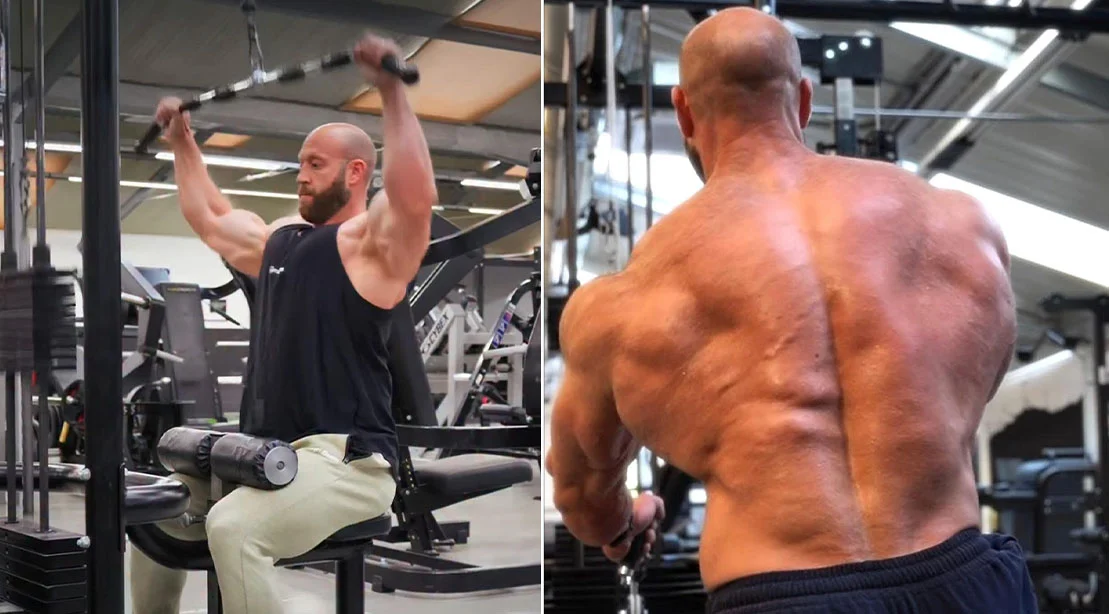
In the high-stakes world of professional bodybuilding, the prevailing misconception is that mass is built through brute force and Herculean efforts. Many gym-goers operate under the fallacious belief that to attain a physique akin to a professional bodybuilder, one must simply throw as much weight as possible around the gym floor. However, IFBB Pro Petar Klancir, a Croatian colossus renowned for his aesthetic yet powerful physique, is challenging this “ferocity over form” narrative.
As both a competitive athlete and a seasoned coach, Klancir emphasizes that the path to hypertrophy—particularly regarding back development—is paved with technical mastery rather than reckless intensity. In a recent digital masterclass shared via his social media channels, Klancir deconstructed the lat pulldown, an exercise often performed incorrectly, to illustrate how minor biomechanical adjustments can lead to major physiological gains.
The Anatomy of the Lat Pulldown
The lat pulldown is a staple of the resistance training canon. Performed either on a dedicated selectorized machine or via a cable station, the movement primarily targets the latissimus dorsi—the expansive, fan-shaped muscle group that spans the mid and lower back. These muscles are essential for spinal stability, posture, and the coveted “V-taper” aesthetic that defines competitive bodybuilding.
Despite its ubiquity, the lat pulldown is frequently misused. Because the motion of pulling a weighted bar from an overhead position toward the upper chest feels intuitive, many trainees assume they are performing the movement correctly. However, the difference between an efficient, growth-inducing set and a stagnant, injury-prone one lies in the micro-adjustments of form. As Klancir notes, if you are moving weight without feeling the targeted muscle fiber engagement, you are merely going through the motions.
Chronology of the Critique: Klancir’s Three-Step Correction
Petar Klancir’s recent instructional series was prompted by a desire to bridge the gap between amateur effort and professional results. Over the course of several weeks, the IFBB Pro observed common technical flaws plaguing the average gym-goer. He identified three specific “mechanical leaks” that, when plugged, fundamentally alter the stimulus provided to the latissimus dorsi.
Mistake #1: The Swing and Momentum Trap
The most glaring error in any cable-based pulling movement is the introduction of momentum. When a trainee selects a weight that is too heavy, the body naturally compensates by utilizing the lower back and core to "swing" or "rock" the torso. This turns a targeted isolation movement into a full-body exertion, effectively offloading the tension from the lats.
"Stop swinging your body to move the weight," Klancir advises. "Keep your torso stable and pull the bar to your upper chest." By locking the torso into a rigid, upright position, the athlete eliminates the involvement of secondary muscle groups that would otherwise steal the load. The result is an immediate increase in the time under tension (TUT) for the lats, which is the primary driver of hypertrophy.
Mistake #2: The Scapular Misconception
Perhaps the most counterintuitive piece of advice provided by Klancir involves the starting position of the shoulder blades. Many trainers advocate for "retracting and depressing" the scapulae before beginning a pull. While this is sound advice for rows, Klancir argues it is detrimental for the lat pulldown.
"Don’t start with your shoulder blades squeezed back," Klancir explains. "Reach up, protract your scapulae, and keep that stretch as you initiate the pull." By allowing the shoulder blades to protract at the apex of the movement, the lats are forced into a deep, functional stretch. This eccentric lengthening is vital; by starting from a position of total extension rather than a pre-contracted state, the trainee maximizes the range of motion and recruits a higher volume of muscle fibers throughout the concentric phase.
Mistake #3: The Elbow Flare
The final hurdle in Klancir’s corrective framework is the positioning of the elbows. A common tendency is to allow the elbows to flare outward, away from the torso, during the descent of the bar. This shift in mechanics forces the shoulders and traps to absorb the workload, effectively bypassing the lats.
"Don’t flare your elbows out," coaches Klancir. "Lock them in and drive them down towards your hips." By envisioning the elbows as pistons moving in a strictly vertical plane, the trainee ensures that the tension remains focused on the back. When the elbows are tucked and driven toward the hips, the latissimus dorsi is placed in the most advantageous position to contract, leading to a more profound "squeeze" at the bottom of the movement.
Supporting Data: The Mechanics of Hypertrophy
From a biomechanical perspective, Klancir’s advice aligns with established principles of muscle growth. Hypertrophy is largely dictated by three factors: mechanical tension, metabolic stress, and muscle damage.
When a trainee swings (Mistake #1), they reduce mechanical tension by shifting the load to the spinal erectors. When a trainee starts with retracted scapulae (Mistake #2), they artificially limit the range of motion, shortening the muscle fibers and preventing the deep stretch necessary for maximal fiber recruitment. Finally, when elbows flare (Mistake #3), the lever arm of the movement shifts away from the lats and onto the glenohumeral joint, increasing the risk of shoulder impingement while decreasing back activation.
Clinical research into EMG (electromyography) activity of the back muscles suggests that keeping the elbows in the "scapular plane"—slightly forward of the body—while maintaining a full range of motion yields the highest activation of the latissimus dorsi. Klancir’s "drive toward the hips" cue is essentially a practical application of these laboratory findings.
Official Perspectives and Coaching Philosophy
Petar Klancir’s influence in the fitness community extends beyond his impressive stage presence. As a professional athlete, his insights carry the weight of empirical experience. He is part of a growing movement of elite bodybuilders who are pivoting away from the “ego lifting” culture of the 1990s and 2000s toward a more scientific, longevity-focused approach.
"Fix these three mistakes, and your lat pulldowns will feel completely different," Klancir asserts. This sentiment is echoed by many modern strength coaches who prioritize movement quality over load. The implication is clear: if you are not feeling the target muscle, the weight is irrelevant. For the average fitness enthusiast, this shift in focus can mean the difference between years of plateaus and consistent, visible progress.
Implications for the Fitness Industry
The broader implication of Klancir’s critique is a democratization of professional knowledge. In previous decades, the "secrets" of elite bodybuilders were often hidden behind paywalls or restricted to inner circles. Today, platforms like Instagram allow pros like Klancir to provide direct, actionable feedback to millions.
This creates a higher standard for the average gym-goer. When the industry’s top athletes prioritize technical perfection over heavy, sloppy repetitions, it forces a change in the culture of commercial gyms. Trainers and gym members alike are becoming more discerning, valuing the "mind-muscle connection" as much as the numbers on the weight stack.
Furthermore, the emphasis on scapular protraction and elbow tracking highlights a growing awareness of injury prevention. By moving with intention, athletes like Klancir are not only building more aesthetically pleasing physiques but are also ensuring that their musculoskeletal systems remain healthy enough to sustain training for decades.
Conclusion: Mastering the Basics
The lat pulldown remains one of the most effective tools for building a powerful back, but its efficacy is entirely dependent on the operator’s technique. By adopting Petar Klancir’s three pillars—eliminating momentum, prioritizing a full stretch, and controlling elbow trajectory—trainees can transform a simple machine exercise into a potent catalyst for growth.
As Klancir continues to share his expertise, his message serves as a reminder that greatness in bodybuilding is rarely found in the extremes of the weight stack. Instead, it is found in the quiet, focused details of the movement. Whether you are a competitive athlete or a weekend warrior, the path to a broader back and a stronger physique begins with slowing down, refining your form, and respecting the mechanics of the human body. In the pursuit of excellence, precision is, and will always be, the ultimate power.
 Lina Hope
 rifanmuazin
 Laily UPN
