

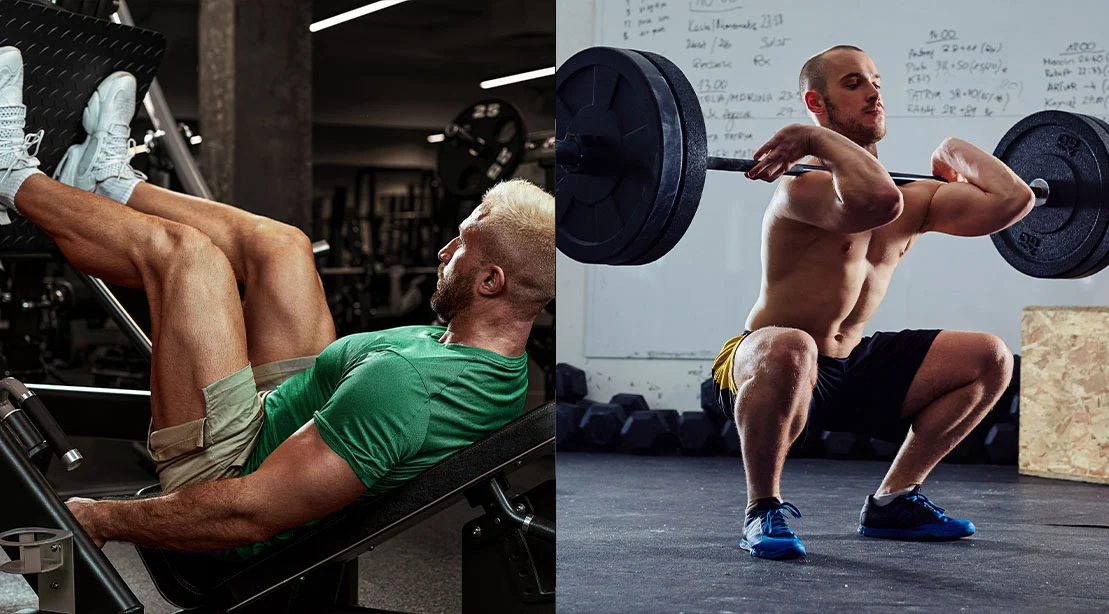
For decades, the barbell back squat has been heralded as the undisputed king of leg exercises. Walk into any traditional iron paradise, and you will inevitably hear the mantra echoed by trainers and veterans alike: "If you want big legs, you have to squat." It is a dogma so deeply entrenched in fitness culture that it has become synonymous with the very concept of leg training.
However, a growing body of evidence—and a shift in professional coaching philosophy—suggests that this "king" may be an ill-fitting crown for many. For a significant portion of the population, particularly beginners, the barbell squat is not merely a difficult exercise; it is an inefficient and potentially hazardous choice. The issue is not that the squat is inherently "bad," but that it demands a specific convergence of anatomical advantages, technical mastery, and structural resilience that many trainees simply do not possess.
The Anatomy of the Debate: Why One Size Does Not Fit All
The fitness industry often thrives on absolutes. We are told that squats are mandatory, deadlifts are the ultimate test of strength, and the bench press defines one’s character. Reality, however, is far less romantic.
The Biological Lottery
Not everyone is built to squat. This is not a matter of opinion or a lack of "grit"; it is a matter of biomechanics. Scientific studies examining hip joint structure, femur length, pelvic geometry, and muscle insertion points have repeatedly demonstrated that skeletal architecture varies dramatically between individuals.
Consider two lifters of identical height and weight. The first possesses short femurs, high ankle mobility, and favorable acetabular (hip socket) orientation. This individual can drop into a deep, upright squat with relative ease, maintaining a vertical torso and perfect balance. The second lifter, however, has long femurs, limited ankle dorsiflexion, and hip anatomy that necessitates a significant forward lean to achieve depth. For this person, the barbell squat becomes a battle against their own anatomy. Every repetition is a negotiation with their lower back, which is forced to compensate for the lack of mechanical efficiency. While one lifter is effectively training their quadriceps, the other is essentially drafting a future prescription for orthopedic intervention.
A Chronology of the "Squat-Only" Mindset
To understand why the barbell squat holds such a dominant position in the gym, one must look at the evolution of physical culture.
- The Early 20th Century: The squat began its rise in popularity alongside the emergence of early bodybuilding and powerlifting competitions. With limited machine options available, free-weight movements were the only tools for development.
- The Mid-Century "Golden Age": The 1960s and 70s cemented the barbell as the ultimate tool for strength. During this era, legends of the sport preached the squat as a "total body developer." Because these athletes were often genetically gifted with the proportions required for squatting, the exercise became synonymous with success.
- The Modern Technological Shift: In the last two decades, the introduction of sophisticated biomechanical machines—such as pendulum squats, belt squats, and advanced leverage systems—has changed the landscape. Yet, the old-school mentality remains, often ignoring the reality that we now have better, safer tools to isolate the legs without taxing the lumbar spine.
Supporting Data: Risks vs. Rewards
The primary argument for the barbell squat is its status as a "functional" movement. While it does teach coordination and recruits multiple muscle groups, the risk-to-reward ratio for a novice is often unfavorable.
The Kinetic Chain Vulnerability
Squatting requires a high degree of motor learning. The lifter must simultaneously balance the load, stabilize the spine, and track the knees correctly. When a beginner fails at any of these, the load shifts directly to the weakest link: the lower back. Unlike a quadricep, which can recover from a heavy training session in 48 hours, the lumbar spine has a "long memory." A single catastrophic rep or sustained poor form can result in disc herniation or chronic back pain that persists for years.
The Leg Press Advantage
In contrast, the leg press removes the variables of balance and spinal stabilization. By securing the torso, the lifter can focus entirely on the mechanical output of the legs.
- Fixed Path: The movement pattern is predetermined, reducing the chance of accidental instability.
- Targeted Overload: Because the spine is not under axial loading, the lifter can push their quadriceps and glutes to absolute failure with a significantly reduced risk of spinal injury.
- Motor Learning: Beginners can focus on the contraction of the muscle rather than the stabilization of the barbell, which leads to faster hypertrophy and improved mind-muscle connection.
Expert Perspectives and Professional Shifts
Prominent strength coaches and physical therapists have begun to challenge the "squat-at-all-costs" narrative. While they acknowledge that squats have value in athletic development, they argue that the "earned" approach is missing.
"Squats are an excellent tool, but they are a tool that must be earned," says one prominent conditioning specialist. "We shouldn’t be throwing a novice under a heavy barbell on day one simply because it’s the ‘traditional’ way to do things. The goal is to build muscle and longevity. If a machine can provide the stimulus for growth without the systemic fatigue or risk to the spine, it is the more intelligent choice for 90% of the training population."
Furthermore, many professional athletes now utilize the Smith Machine as a bridge. By providing a fixed bar path, the Smith Machine allows the lifter to develop confidence and refine their depth control before ever touching a free-weight barbell.
Implications: Building a Sustainable Future
If the goal is long-term physical development, the focus must shift from "What is the hardest way to train?" to "What is the most effective way for my body to train?"
The Path Forward for Beginners
- Prioritize Machine Work: Utilize the leg press, hack squat, and pendulum squat to build a foundational level of strength.
- Focus on Mechanics: Learn to control the eccentric (lowering) portion of the lift.
- The "Earned" Progression: Only transition to free-weight squats once your range of motion is sufficient and your core stability is rock-solid.
- Abandon Ego: Stop chasing "ass-to-grass" depth if your hip anatomy does not allow for it. Parallel or slightly above is perfectly acceptable if it preserves joint health.
Conclusion: Rethinking the King
The irony of the current fitness landscape is that modern engineering has largely solved the problem that the squat was intended to fix. We no longer live in an era where the barbell is the only option. We have access to machines that mimic the squat’s mechanical benefits while eliminating the axial loading that often leads to injury.
The question should never be "Should I squat?" The better question is: "What is the safest and most effective way for me to train my legs based on my unique structure?"
For many, the answer will be the leg press. It is not a sign of weakness to utilize equipment that supports your goals; it is a sign of wisdom. If you can build world-class legs while preserving the health of your spine and joints for decades to come, you aren’t "avoiding" the hard work—you are simply choosing to be smart about it. In the end, the most effective leg exercise is the one you can perform safely, consistently, and with maximum intensity for the rest of your life.
 Lina Hope
 Laily UPN
