

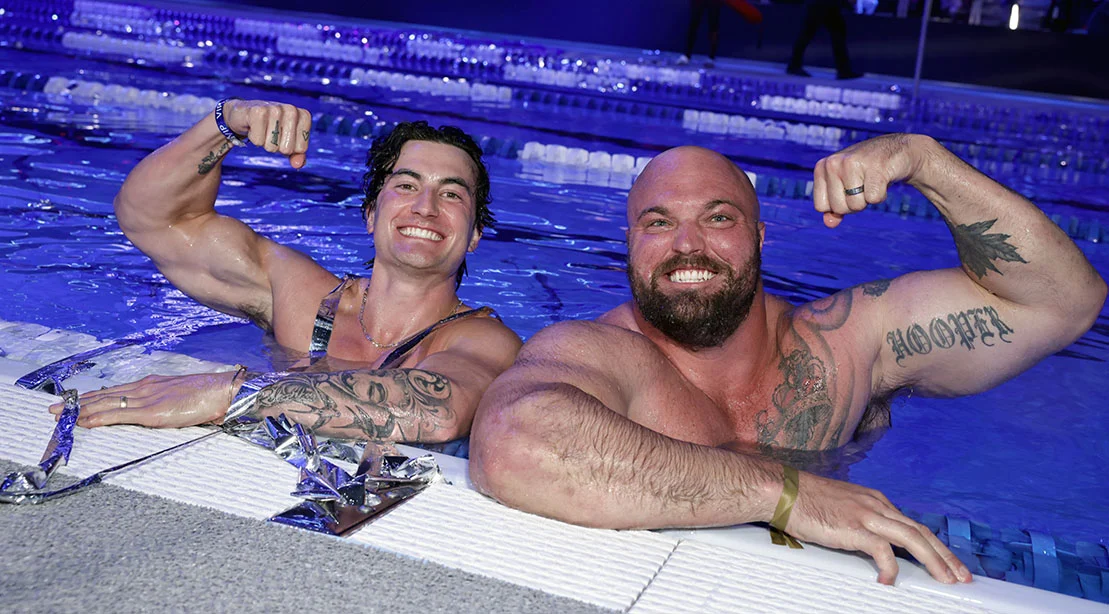
To the millions of fans who tune in annually to witness the pinnacle of human capability, Mitchell Hooper is an immovable object. Known to the world as "The Moose," the reigning World’s Strongest Man is a colossus capable of feats that defy biological convention. He moves mountains of steel with a technical precision that suggests he was born for the platform. However, the reality of Hooper’s journey is far more nuanced—a path defined not by innate athletic predestination, but by a hard-fought battle against insecurity, anxiety, and the relentless search for purpose.
The Unlikely Genesis of a Strongman
Long before he stood atop the podium as the world’s most dominant strength athlete, Hooper was a perennial athletic seeker. His youth was not defined by early specialization in weightlifting; rather, he cycled through golf, marathon running, football, and endurance sports. None of these endeavors hinted at the trajectory that would lead him to become the strongest human on the planet.
This background is precisely what makes Hooper one of the most compelling, if unconventional, voices in the strength community. While the sports world often demands that athletes define themselves exclusively by their medals and records, Hooper operates differently. He is a man who speaks with equal passion about the intricacies of a deadlift and the raw, unvarnished realities of fatherhood and mental health. This philosophy was on full display during his recent appearance at the Enhanced Games, where his performance—and his presence as a thoughtful ambassador—offered a glimpse into the mind of a modern elite athlete who refuses to be one-dimensional.
The Insecurity Behind the Legend
Despite his status at the apex of his sport, Hooper’s ascent was not paved with unwavering self-confidence. When asked which version of his younger self would be most stunned by his current success, he does not look to his high school football years or his early training days. He looks further back.
"I think myself at five to 10 years old would be the most shocked," Hooper admits. While many professional athletes are fueled by a lifelong, unshakable belief in their own greatness, Hooper recalls being an unusually self-aware child. He looked at the NFL and the NHL and saw dreams that felt fundamentally out of reach.
The turning point was an ironic one: it was during his adolescence, while grappling with profound insecurity and clinical symptoms of anxiety, that he developed the mental armor necessary for elite competition. When asked about his deepest moments of self-doubt, he is blunt: "Being fat." It is a jarring admission from a man who dominates the international circuit, but it is one he wears honestly. He recounts years of debilitating social anxiety and panic attacks, noting that he would wear hoodies in school—not for fashion, but to hide the excessive sweating caused by his internal psychological turmoil. Hooper believes this is a silent struggle for many men, one that remains largely buried under the pressure to project strength.
Refusing the "Cured" Narrative
As the world observes Father’s Day and continues to grapple with the stigma surrounding men’s mental health, Hooper has become a vocal advocate for radical honesty. He rejects the trope of the "recovered" athlete who offers easy solutions from the finish line.
"I’m not cured, and I still struggle a lot," he says. "I manage to put one foot in front of the other." This distinction is critical to his message. He argues that most influencers frame mental health through the lens of a completed journey, implying that with the right steps, the struggle simply evaporates. By refusing to paint himself as "fixed," Hooper offers something more valuable: solidarity. He admits that discussing his mental health does not necessarily provide him with personal catharsis; rather, he speaks up because he knows it helps others feel less isolated. This, he believes, is the responsibility that comes with his platform.
The "Dad Strong" Philosophy
The arrival of fatherhood catalyzed a profound shift in Hooper’s perspective. When speaking with fellow creator Jesse James West—who is preparing for the transition into parenthood—Hooper offered a reality check that is rarely discussed in the glossy world of social media fitness.
"As a new dad, you have to be ready that the first six months are not very fun for you," Hooper says. He speaks of the "uselessness" a new father can feel when the baby’s needs are entirely focused on the mother. It is a period of adjustment that forces a man to redefine his value system.
"You think about the world differently," he explains. "Now I have to provide. If things go bad, it’s not just me or my wife figuring it out. It’s now a dependent who you have to make sure is OK." This shift has redefined his training. Success is no longer measured solely by the weight on the bar or the prize money in his bank account; it is measured by his ability to show up, to provide, and to maintain the long-term health necessary to be an active, present father. His advice to new dads is characteristically practical: "Change the diapers. Change all the diapers you can, because you’re not needed for anything else."
The Enhanced Games: An Experiment in Data
Hooper’s participation in the Enhanced Games has been a lightning rod for controversy, but he views the project through a lens of scientific curiosity rather than rebellion. He identifies two primary objectives for the event: to create a controlled environment for the study of medically supervised performance enhancement and to challenge the traditional myths surrounding the "peak" of athletic performance.
Data from the games suggested that human potential might extend much further than current sports science acknowledges. Notably, the average age of a personal best for participants was approximately 30—a stark contrast to the common belief that an athlete’s decline begins in their late 20s. Furthermore, the event proceeded without the catastrophic injuries that critics had predicted, a point Hooper highlights as evidence that the conversation should move away from fear-based rhetoric and toward objective data.
The 505kg Attempt: A Victory of Process
To the casual observer, Mitchell Hooper’s failed 505kg deadlift attempt at the Enhanced Games might have seemed like a rare defeat. In reality, it was a triumph of management.
Following a grueling stretch of victories at the Rogue Invitational, the Arnold Strongman Classic, and the World’s Strongest Man, Hooper was operating on fumes. He suffered from significant back pain and nervous system exhaustion—a reality of the sport that fans often overlook. He admits that in the weeks leading up to the Enhanced Games, he could barely deadlift effectively. To even break 515kg off the floor was, in his estimation, a victory. "The fact that I got it off the ground, I’m really proud of that attempt," he says.
Strategic Longevity: Why Less Can Be More
Perhaps the most telling insight into Hooper’s maturity is his decision regarding the Airwaav performance mouthpiece during that specific 505kg attempt. While he acknowledges the mouthpiece’s benefits—increased rate of force production, reduced cortisol, and enhanced power—he chose not to wear it for his heaviest lift.
Why would a world-class athlete turn down a performance aid? Because he understood his own physiological state. An increase in power, while normally beneficial, posed an injury risk to his already overtaxed nervous system. He intentionally sought a "slower, smoother pull" to avoid the explosive strain that could have resulted in a season-ending injury. This is the hallmark of a veteran who prioritizes his career and family over a single record-breaking moment.
The Broader Health Conversation
Hooper’s intellectual approach to his own health extends to the debate over performance-enhancing substances. He challenges the public to look at the hierarchy of risk in his life. He cites his family history of cardiac events—where his father and grandparents experienced health crises in their 50s—as his primary concern.
"The number one thing people should be concerned about is my genetics," he notes. "Second to that is that I’m obese. I’m 330 pounds. Then under that is my total exercise volume. Under that is my cardiovascular fitness. And below that is PEDs."
By contextualizing his health in this way, Hooper highlights the obsession the public has with specific, "taboo" aspects of athletic performance, while ignoring the more mundane, yet far more critical, determinants of health. If the Enhanced Games can contribute to a more transparent, evidence-based understanding of these factors, Hooper believes it will have served a mission far greater than the trophies he collects.
Ultimately, Mitchell Hooper is redefining what it means to be the World’s Strongest Man. He is showing that true strength is not merely about what one can lift; it is about the capacity to carry the weight of one’s own flaws, the responsibility of fatherhood, and the courage to pursue a legacy built on honesty rather than the illusion of perfection.
 Lina Hope
 rifanmuazin
