

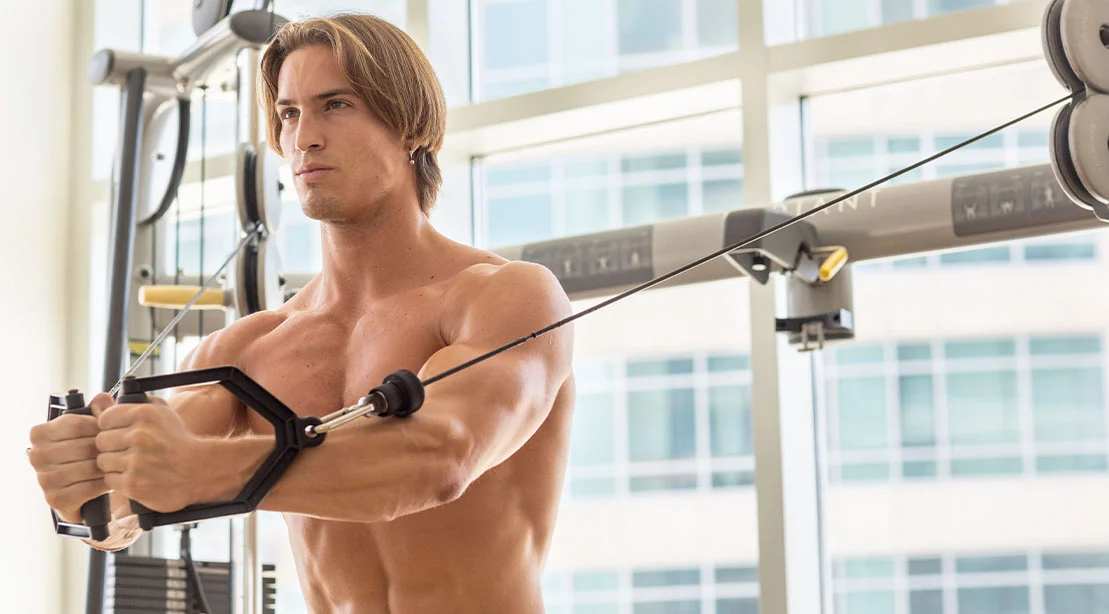
In the evolving landscape of functional fitness, the "core" has long been misunderstood. For years, the fitness industry focused almost exclusively on anti-movement exercises—static planks, crunches, and hollow holds—designed to stabilize the spine by resisting external forces. While these movements are essential for foundational health, they represent only one half of the equation. If your goal is to swing a golf club, throw a baseball, or simply navigate the physical demands of daily life with ease, you must train your body not just to resist force, but to generate, transfer, and decelerate it.
Enter the Cable Push-Pull Rotation. This dynamic, standing rotational exercise bridges the gap between traditional strength training and real-world athletic performance. By integrating the ground-up power of the lower body with the stability of the core and the mechanical output of the upper body, this movement transforms the torso from a static pillar into a high-octane engine for rotational force.
The Mechanics of Kinetic Linkage: How It Works
The Cable Push-Pull Rotation is fundamentally an exercise in kinetic chain integration. Unlike isolation movements, it requires the entire body to function as a singular, cohesive unit. The movement begins at the feet, which drive into the floor to generate ground reaction force. This energy travels upward through the hips, which initiate the rotation. The core acts as the "bridge," transferring that energy from the lower body to the upper body, where the push-pull motion of the arms finishes the task.
In sports, this is known as the "kinetic link." Whether a quarterback is winding up for a pass or a tennis player is executing a backhand, the power is never generated by the arms alone. It is harvested from the ground and amplified through the core. The Cable Push-Pull Rotation replicates this biomechanical reality, teaching the athlete to create rotational torque while simultaneously managing the deceleration required to prevent injury.
Chronology of a Repetition: A Step-by-Step Guide
To reap the benefits of this movement, technique is non-negotiable. Because it involves complex integration, rushing through the motion will lead to "leaky" energy—where force is lost rather than transferred. Follow this protocol to ensure perfect execution:
1. The Setup
Position a cable machine so that the handle is at chest height. Stand perpendicular to the weight stack, far enough away that the cable is taut when your arms are extended. Adopt a shoulder-width stance with a slight bend in your knees. Your core should be braced as if preparing for a punch.
2. The Initiation
The movement begins with the hips. As you push with the arm closest to the machine and pull with the arm furthest away, initiate the turn by pivoting your lead foot and rotating your hips toward the direction of the pull. Think of your belt buckle leading the rotation.
3. The Transfer
As your torso follows the hip rotation, your core must maintain a rigid, neutral spine. The rotation should occur primarily in the thoracic spine (the upper back), while the lumbar spine remains stable.
4. The Deceleration
The "pull" is only half the battle. The return phase is where true athleticism is built. Use your obliques and glutes to control the weight stack as it returns to the starting position. Do not let the cable snap you back; resist the tension throughout the entire eccentric phase.
Coaching Cues: How to Feel the Movement
Without a personal trainer, it can be difficult to gauge whether you are maximizing the exercise or simply going through the motions. Use these sensory and visual checkpoints to audit your form.
Sensory Feedback
- The "Hips-First" Feeling: You should feel the weight shift from your heels through your hips before your arms move. If your arms feel like they are doing all the work, you are disconnected from your lower body.
- Oblique Engagement: You should feel a deep, controlled stretch and contraction in your obliques. If you feel pressure in your lower back, stop immediately; you are likely over-rotating through the lumbar spine.
- Tension Consistency: The cable should never go slack. You are maintaining constant tension, creating a seamless loop of force.
Visual Checkpoints
- The Belt Buckle Test: Your belt buckle and your sternum should move in unison. If your chest is rotating but your hips are static, you are creating shear force in the spine rather than power.
- Shoulder Alignment: Your shoulders should stay down and back, away from your ears. Rounded shoulders limit the range of motion and decrease the efficiency of the lats.
The Anatomy of Rotation: What Muscles are Working?
The Cable Push-Pull Rotation is a full-body symphony, but specific muscle groups act as the primary players in this complex movement:
- The Obliques (The Governors): These are the primary engines of rotation. They generate the force to start the turn and provide the eccentric braking mechanism to stop it safely.
- The Glutes (The Engine): As the largest muscles in the body, the glutes are responsible for the initial drive. They stabilize the pelvis, providing a solid platform from which the core can rotate.
- The Transverse Abdominis (The Internal Girdle): This deep abdominal muscle acts as a weight belt, stiffening the torso and protecting the lumbar spine from excessive rotational stress.
- The Latissimus Dorsi (The Power Conduit): Often overlooked in core training, the lats are crucial for the "pulling" aspect of the movement, bridging the gap between the power generated by the hips and the output of the arms.
Common Pitfalls and Strategic Fixes
Even experienced lifters often fall into the trap of treating the Cable Push-Pull Rotation as an upper-body exercise. Here is how to troubleshoot the most common errors:
1. The "Heavyweight" Fallacy
Using too much weight is the fastest way to kill the movement’s integrity. When the weight is too heavy, the body compensates by shortening the range of motion or shifting the load to the lower back.
- The Fix: Lower the weight by 20–30%. Focus on speed, control, and a full range of motion. The goal is velocity and coordination, not ego-lifting.
2. The Lumbar Trap
The lower back is designed for stability, not heavy rotation. If you rotate through your lumbar spine, you invite disc stress and injury.
- The Fix: Focus on thoracic mobility. Imagine your chest and hips moving as a single, rigid block. If you cannot rotate without your lower back moving, limit your range of motion until your thoracic mobility improves.
3. Rushing the Eccentric
Allowing the cable stack to "clank" at the end of the movement is a sign of wasted potential.
- The Fix: Control the return phase for a count of two seconds. This eccentric loading builds the tendon strength and muscle control necessary to prevent injuries in sports.
Implications for Athletic Performance
Why dedicate time to this movement? The implications for your fitness and longevity are profound. By training the body to manage rotational forces, you reduce the "leaks" in your movement patterns.
Athletes who master the Cable Push-Pull Rotation often report significant improvements in their "explosiveness." Because the exercise trains the body to decelerate—a phase often ignored in gym settings—athletes become more resilient to the non-contact injuries that often plague field sports. For the general fitness enthusiast, the exercise translates to better posture, improved coordination, and a more robust, injury-resistant spine.
Implementation: Integrating into Your Routine
Because this is a high-skill, high-coordination movement, it is best placed at the beginning of a workout or as a dedicated core accessory.
- Dynamic Warm-Up: Perform 2 sets of 10 reps per side with a light load to prime the nervous system and mobilize the thoracic spine.
- Power Training: Integrate this movement between explosive sets of medicine ball slams or kettlebell swings to reinforce rotational sequencing under fatigue.
- Core Accessory: Perform 3 sets of 10–12 reps at the end of your session to emphasize the control and deceleration phase.
In conclusion, the Cable Push-Pull Rotation is more than just an exercise; it is an education in human movement. By shifting your focus from "resisting" the world to "interacting" with it, you unlock a level of physical capability that static training simply cannot provide. Stop holding your core still and start teaching it how to move with power, intent, and precision.
 Lina Hope
 rifanmuazin
 Laily UPN
