

When we think of core training, our minds inevitably drift to the “Big Three” of static stability: the front plank, the dead bug, and the Pallof press. While these movements are staples for a reason—they build a foundation of anti-extension and anti-rotation—they all share a common limitation: they exist almost exclusively in the sagittal plane. They are straight-line movements for a world that is anything but linear.
In reality, human movement is rarely restricted to forward and backward motion. Whether you are swinging a golf club, throwing a fastball, or simply navigating the daily rigors of loading a heavy suitcase into an overhead bin, your body is required to produce, transfer, and control complex rotational forces. These movements demand that your hips, core, and shoulders function as a kinetic unit. When we train only in straight lines, we create a functional gap in our athletic development.
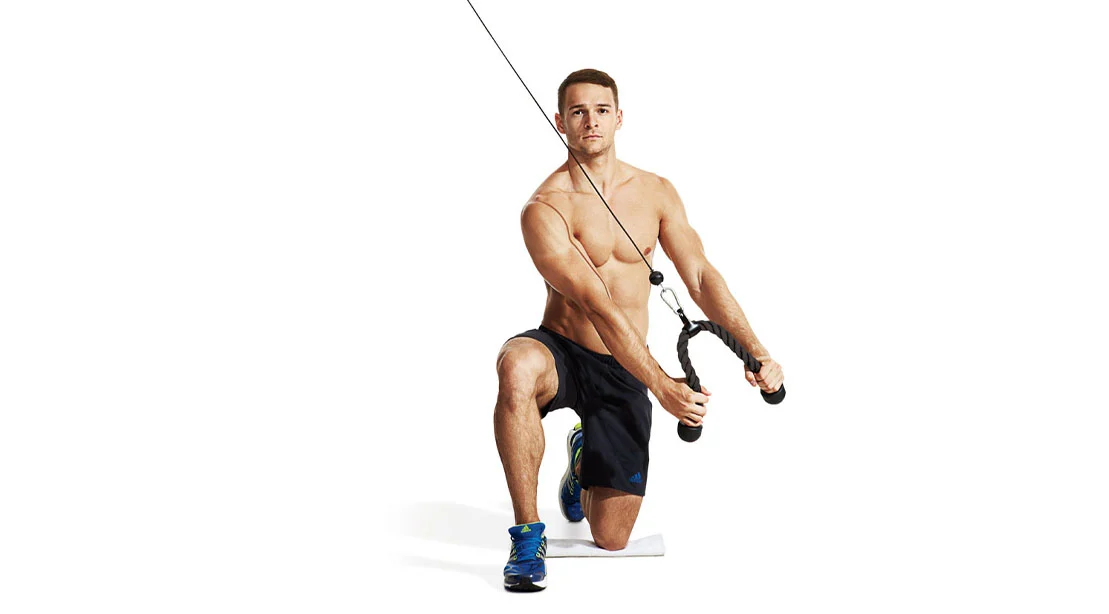
The Half-Kneeling Cable Chop is the bridge across that gap. By utilizing a high-to-low diagonal pattern from a locked-in, half-kneeling position, this exercise forces your core to generate high-level force while maintaining absolute stability in the lower back and hips. For the athlete looking to optimize performance and the fitness enthusiast seeking a core that is as functional as it is aesthetic, the Half-Kneeling Cable Chop is the gold standard of rotational training.
The Mechanics of the Movement: A Technical Breakdown
The Half-Kneeling Cable Chop is a high-to-low diagonal pull that trains the core to act as a bridge between the lower body and the upper body. The “half-kneeling” aspect is critical; by placing one knee on the ground, you effectively eliminate momentum. You cannot rely on “body English” or hip swinging to cheat the weight. Instead, the movement must be initiated through the thoracic spine and hips, forcing the obliques and transverse abdominis to engage under significant tension.
Chronology of Execution
To perform the Half-Kneeling Cable Chop with the precision required for maximum stimulus, follow this structured approach:
- The Setup: Set a cable pulley to its highest position. Kneel perpendicular to the machine, placing the knee closest to the cable stack on the ground. The lead foot should be flat, forming a 90-degree angle at both the front and back knees.
- The Engagement: Grasp the handle with both hands, arms extended. Before you initiate the pull, create full-body tension. Squeeze the glute of your kneeling leg—this is your anchor. Draw your ribs down toward your hips to engage the core.
- The Chop: Pull the cable diagonally across your body toward the outside of your front knee. The movement should be smooth and controlled. Your chest should rotate, but your pelvis must remain locked in place.
- The Return: The eccentric portion is just as vital as the concentric. Do not let the cable snap your torso back. Slowly resist the weight, returning to the start position with total control.
Supporting Data: The Anatomy of a Chop
The effectiveness of the Half-Kneeling Cable Chop lies in its complex recruitment of the kinetic chain. Unlike a crunch, which isolates a single muscle group, this exercise integrates the entire midsection.
- The Obliques (Internal and External): These are your primary movers. They are responsible for the diagonal rotation of the torso and the eccentric deceleration required during the return phase.
- The Transverse Abdominis (TA): Acting as a natural weight belt, the TA increases intra-abdominal pressure, creating the necessary stiffness to protect the lumbar spine during high-torque rotations.
- The Rectus Abdominis: While often associated with the "six-pack," its true function here is structural integrity. It prevents excessive rib flare and hyperextension, keeping the torso stacked.
- The Gluteal Complex: The glute of the down knee is the "silent partner" of the movement. It provides the base of support that allows the torso to rotate without the hips wobbling or shifting.
- The Lats and Upper Back: These muscles facilitate the transfer of force. They act as the transmission between the power generated by your core and the grip held by your hands.
Implications: Why This Movement Redefines Core Stability
The traditional view of the core as a "resister of movement" is evolving. While anti-rotation (like the Pallof press) is essential for spinal health, "pro-rotation" exercises like the Half-Kneeling Cable Chop teach the body how to be powerful in transition.
Force Transfer and Energy Efficiency
Power in sports is generated from the ground up. In a golf swing or a baseball throw, the energy starts in the legs, travels through the hips, is amplified by the core, and is finally expressed through the arms. If your core is weak or unable to coordinate these segments, energy "leaks." The Half-Kneeling Cable Chop trains the body to synchronize these segments, ensuring that no energy is lost during the transfer.
The Mobility-Stability Dichotomy
One of the most profound implications of this exercise is its ability to train mobility and stability simultaneously. It forces the thoracic spine to rotate through a healthy range of motion—which is essential for overhead health and rotational power—while demanding that the pelvis remains rock-solid. This separation of function is the hallmark of an elite athlete.
Avoiding the "Form Trap": Common Mistakes and Corrections
Even seasoned lifters often fall victim to ego-driven mistakes when performing cable chops. Because the movement involves rotation, it is easy to default to poor mechanics when the weight gets heavy.
1. Lumbar Spine Compensation
The Issue: Many lifters attempt to generate power by twisting at the lower back rather than the thoracic spine. This is a recipe for disc issues and lower back pain.
The Fix: Imagine your rib cage is a solid cylinder. Focus on rotating from the chest up. If you feel the movement in your lower back, lower the weight immediately.
2. Losing the Foundation
The Issue: The hips rock or the front knee caves inward during the pull. This suggests a lack of glute engagement or insufficient core stiffness.
The Fix: Maintain a "tripod" foot on the front leg and aggressively squeeze the glute of the back leg. If the hips are moving, you are not working your core; you are working your momentum.
3. The "Arm-Dominant" Trap
The Issue: Using the biceps and triceps to pull the cable. This turns a core exercise into an arm exercise.
The Fix: Treat your arms as hooks. The movement should be initiated by the torso. If your arms are doing the heavy lifting, your core is not being challenged.
4. Rushing the Eccentric
The Issue: Letting the cable stack pull you back to the start.
The Fix: The return is where the oblique fibers are lengthened under load. Control the descent for a count of two seconds. The "chop" is only half the battle; the "control" is where the results are made.
Programming for Performance
To integrate the Half-Kneeling Cable Chop into your routine, consider the objective of your training cycle.
- As a Warm-up: Use a light load for 2 sets of 10-12 reps per side. This acts as a "neurological primer," waking up the obliques and glutes while lubricating the thoracic spine.
- As Accessory Work: Place this after your primary compound lifts (like squats or deadlifts). Perform 3 sets of 8-10 reps with a moderate-to-heavy load. This reinforces core stability after the spine has been under axial load.
- For Athletic Performance: If your goal is to build power for sports, emphasize the speed of the concentric (the chop) while maintaining a strict, controlled tempo on the eccentric.
Conclusion: The New Standard for Core Development
A strong core is not merely about looking good on the beach; it is about the ability to move with intent, power, and safety. The Half-Kneeling Cable Chop challenges the outdated notion that core training is a sedentary, floor-bound activity. By moving in the diagonal plane, you are preparing your body for the realities of the physical world.
Whether you are an athlete looking to shave strokes off your golf game or someone who simply wants to bulletproof their lower back, the Half-Kneeling Cable Chop provides the necessary stimulus to transform your midsection. Stop training for the straight line, and start training for the rotation that defines human potential. The test is set—all that remains is for you to step into the half-kneeling position and perform.
 Lina Hope
 rifanmuazin
