

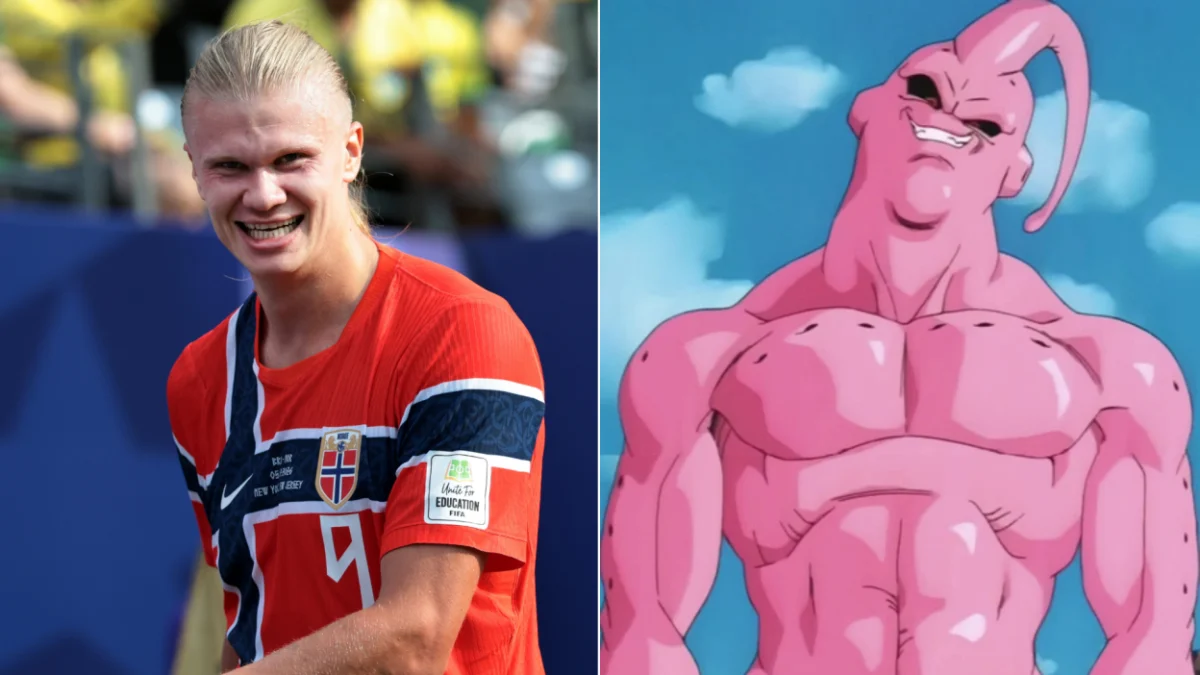
The digital landscape is a place where professional sports and pop culture frequently collide, often resulting in surreal, hilarious, and enduring memes. Among the most persistent of these is the uncanny visual parallel between Manchester City’s Norwegian scoring machine, Erling Haaland, and Majin Buu, the iconic, pink, reality-bending villain from the Dragon Ball Z universe. While the comparison has circulated through the depths of internet forums and social media for years, it has finally reached its ultimate conclusion: Erling Haaland has officially made it canon.
As the 2026 FIFA World Cup reaches its fever pitch, with Norway preparing for a high-stakes quarter-final showdown against England, the striker has found himself at the center of a cultural moment that transcends the pitch. By publicly acknowledging the likeness, Haaland has turned a long-running joke into a solidified piece of internet lore.
A History of the Comparison: How the Meme Began
The visual association between the striker and the Dragon Ball Z antagonist first gained traction back in 2021. As Haaland rose to global prominence, fans began to note specific physical similarities—not just in his closely cropped blond hair, but in the way his facial expressions seemed to mirror the manic, sometimes vacant, and often intimidating stare of the anime villain.
What began as a niche observation on Twitter (now X) and Reddit quickly blossomed into a multi-platform phenomenon. Every time Haaland scored a hat-trick or pulled off a particularly acrobatic goal, a side-by-side comparison would inevitably appear on a fan account. The joke, while centered on the resemblance, was never malicious. It was a testament to Haaland’s almost supernatural ability to dominate a match, a quality that aligned perfectly with the nearly unstoppable power of the Majin Buu character.
The 2026 World Cup: A Perfect Storm for Viral Culture
The timing of this "official" acknowledgment is hardly coincidental. The 2026 FIFA World Cup has transformed into a massive digital event, where the lines between athlete performance and viral social media moments are thinner than ever. Haaland, serving as a talismanic figure for Norway, has been the subject of intense media scrutiny and fan adoration.
As the tournament progressed, the intensity of the "Majin Buu" discourse surged. During training sessions and post-match interviews, observers noted that Haaland’s mannerisms—his intensity, his specific celebratory gestures, and his sheer physical presence—seemed to lean into the meme rather than shy away from it. The internet, acting as a global hive mind, was waiting for a signal. They found it on July 6, 2026, when a post on the lifestyle and culture account @hidden.ny featured Haaland striking a pose that bore an undeniable resemblance to the character’s signature stance.
The Turning Point: "I Mean I Don’t Disagree"
On July 6, the digital world received the confirmation it had been waiting for. In the comments section of the @hidden.ny post, Erling Haaland himself left a simple, five-word response: "I mean I don’t disagree."

That single sentence acted as a catalyst for a massive surge in engagement. Within hours, the comment was screenshotted and shared across every major social media platform, from TikTok to X and Instagram. For fans, this was more than just a funny interaction; it was the ultimate act of "meme-literacy" from one of the most guarded athletes in the sport. By acknowledging the comparison, Haaland effectively bridged the gap between his professional persona as a world-class athlete and his role as a digital icon.
Deconstructing the Comparison: Why Buu?
To understand why this specific meme has stuck, one must look at the character of Majin Buu. Created by the wizard Bibidi and later unleashed by his son, Babidi, in the legendary Dragon Ball Z series, Buu is a complex figure. He is defined by his seemingly limitless power, his ability to regenerate from almost any injury, and a childlike, sometimes unpredictable nature.
In the eyes of his fanbase, Haaland embodies these traits on the pitch. His goal-scoring record is, by all accounts, "limitless." His physical resilience and recovery time are often discussed with awe by medical professionals and sports analysts alike. Furthermore, there is a certain "otherworldly" quality to his movement—a blend of raw, brute force and surprising grace—that aligns with the aesthetic of an anime powerhouse.
The meme is not a critique of his appearance, but rather a playful recognition of his status as a "final boss" in the world of professional soccer. Fans have gone to great lengths to fuel this narrative, creating high-quality edits that place Haaland in the Dragon Ball Z aesthetic. Some have even produced custom-made action figures, reimagining the Norwegian striker in the iconic, candy-colored skin of the villain, wearing the national team kit.
The Impact on Modern Sports Fandom
The fact that an elite athlete like Haaland would engage with a meme of this nature reflects a significant shift in how professional sports are consumed. In previous decades, the distance between the professional athlete and the fan was immense, maintained by press agents and traditional media gatekeepers. Today, that barrier is largely porous.
Athletes are now part of the same digital ecosystem as their fans. They see the same memes, browse the same platforms, and understand the cultural currency of their own image. When a player like Haaland "signs off" on a meme, it humanizes them, creating a sense of shared community that traditional marketing campaigns struggle to replicate. It transforms the athlete from a distant, stoic professional into a relatable personality who is "in on the joke."
Implications for Athlete Branding
For brands and stakeholders in the sports industry, the "Majin Buu" saga offers a masterclass in organic brand building. Haaland did not need a PR team to draft a statement; he simply commented on an Instagram post. The resulting organic reach was, and continues to be, exponentially higher than any curated content piece could hope to achieve.

This incident also underscores the importance of "internet-native" engagement. By choosing to lean into the joke, Haaland has secured a level of loyalty from Gen Z and Alpha fans that is incredibly valuable. He has demonstrated that he is aware of his digital footprint and is willing to engage with the internet culture that surrounds him.
Looking Ahead: The Legacy of the Meme
As Norway prepares for their quarter-final match, the "Majin Buu" narrative will undoubtedly follow them. Whether it manifests in creative chants, new fan art, or continued social media banter, the association is now firmly cemented in the history of the 2026 World Cup.
What began as a lighthearted visual comparison in 2021 has evolved into a full-blown cultural touchstone. It represents the intersection of global sport and global pop culture, proving that even the most disciplined, high-performing athletes are subject to the whims and creativity of the digital age.
For Erling Haaland, the meme is likely just a footnote in a storied career. But for the millions of fans who have followed the story, it is a reminder that the world of sports is far more fun when the icons themselves are willing to play along. As the tournament continues and the pressure mounts, one thing is certain: whether he is scoring goals or interacting with his fanbase, the "Majin Buu" of the soccer world is exactly where he belongs—at the center of the conversation.
Conclusion
The evolution of the Erling Haaland-Majin Buu comparison is a perfect case study for the modern digital era. It highlights how memes can evolve from simple jokes into established parts of an athlete’s public identity. By embracing the likeness, Haaland has not only endeared himself to a new generation of fans but has also demonstrated a sophisticated understanding of how to navigate the complexities of digital culture. As the 2026 FIFA World Cup proceeds, the "Majin Buu" meme will remain a symbol of the unique, often chaotic, and endlessly entertaining relationship between the beautiful game and the internet.
 Nana Wu
 Neng Nana
 Reynand Wu
