

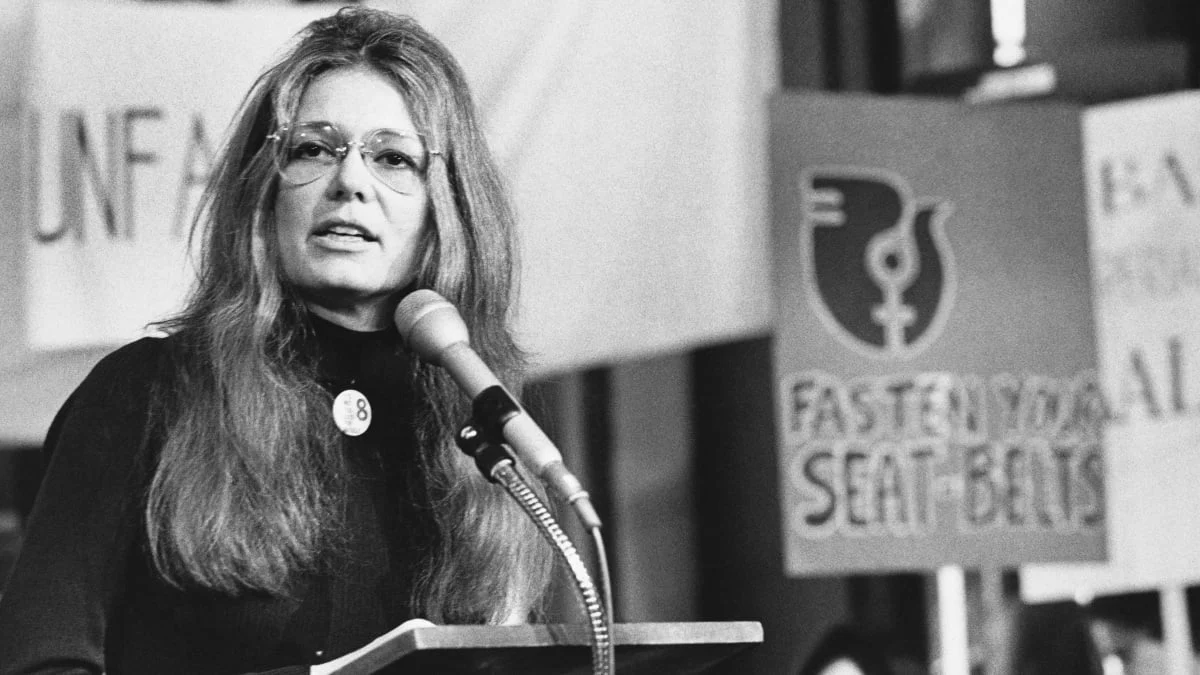
NEW YORK — Gloria Steinem, the indomitable journalist, author, and foundational architect of the modern American feminist movement, passed away peacefully on Wednesday at her home in Manhattan. She was 92 years old.
Surrounded by a close circle of loved ones during her final moments, Steinem’s death was announced early Thursday via a statement shared on her official Instagram account. The news immediately reverberated across the globe, sparking an unprecedented outpouring of grief, gratitude, and remembrance from political leaders, cultural icons, writers, and everyday activists whose lives and careers had been shaped by her nearly century-long existence.
No specific cause of death was provided by her family or representatives, though the official statement emphasized that her remarkable life had been "well-lived" and that she remained actively engaged in the fight for global equality until her final days.
"Gloria’s near-century on earth were years well-lived, and she continued working for equality until the very end," the family and foundation’s statement read. "Yesterday, Gloria Steinem passed away peacefully at her home in New York City, surrounded by some of the many who loved her."
A Chronology of a Revolutionary Life: From Undercover Reporting to Global Icon
Steinem’s journey to becoming the undisputed face of second-wave feminism in the United States was marked by intellectual rigor, personal courage, and a profound, lifelong curiosity about the human condition.
Born in Toledo, Ohio, in 1934, Steinem experienced an itinerant childhood, traveling across the country with her mentally ill mother and traveling-salesman father before attending Smith College. After graduating, she spent time in India on a Chester Bowles Asian Fellowship, an experience that deepened her global perspective and cemented her commitment to social justice. Returning to the United States in the late 1950s, she moved to New York City to launch a career in journalism.
The 1960s: Gaining National Attention
Steinem first captured the nation’s attention in 1963 with a masterclass in investigative journalism. Going undercover as a Playboy Bunny at the notorious New York Playboy Club, she exposed the grueling working conditions, systemic exploitation, and pervasive misogyny women faced behind the glossy veneer of the club’s iconic imagery. Her resulting two-part exposé, published in Show magazine, launched her into the national spotlight and signaled the arrival of a sharp, fearless critic of patriarchal institutions.
The 1970s and Beyond: Co-Founding Ms. Magazine and Institutionalizing the Movement
As the turbulent 1960s bled into the 1970s, Steinem transitioned from observer to principal organizer of the burgeoning Women’s Liberation Movement. She marched, organized, and articulated the core tenets of gender parity, reproductive freedom, and institutional equity to a mainstream audience that was often hostile to women’s liberation.
In 1972, Steinem cemented her legacy as a media pioneer by co-founding Ms. magazine, the first periodical to consistently address contemporary issues from a feminist perspective, owned and operated entirely by women. As an editor, writer, and cultural critic, Steinem used the magazine to give voice to millions of women who had previously felt isolated in their domestic struggles and professional frustrations.
Throughout the decades that followed, Steinem’s activism expanded globally. She helped found the Women’s Action Alliance, the National Women’s Political Caucus, and the Choice USA foundation. She traveled extensively across continents, documenting the plight of women in developing nations, fighting against female genital mutilation, and forging international networks of solidarity.
Honors and Later Years
In recognition of her monumental contributions to civil rights and human equality, President Barack Obama awarded Steinem the Presidential Medal of Freedom—the nation’s highest civilian honor—in 2013.
Remarkably, Steinem never retired. Into her late 80s and early 90s, she continued to write, lecture, and organize. Up until her passing, she maintained a rigorous schedule of intellectual engagement, hosting intimate gatherings known as "Talking Circles" in her New York City living room. These salons brought together diverse thinkers, activists, and writers to discuss the future of democracy, reproductive rights, and intersectional justice.
The Power of Listening: Supporting Data and Philosophy
While history will remember Steinem for her razor-sharp wit, fiery speeches, and prolific writing, those closest to her often emphasized a quieter, more radical gift: her capacity to listen.
"Gloria’s greatest gift was her ability to listen to others, to make others feel seen and heard," the official family statement noted. "Her words, actions, and example gave people permission to be their truest selves. Gloria lived true to her independent spirit, always with curiosity and a great sense of humor."
This philosophy was institutionalized through Gloria’s Foundation, an organization dedicated to fostering social justice through fellowships, residencies, and the continuation of her beloved Talking Circles. According to the foundation, Steinem frequently used the metaphor of lighting signal fires on hilltops to describe community activism—a reminder that individual actions, when joined together, can illuminate the path forward through the darkest political landscapes.
Her final months were spent doing what she loved most: connecting with community. Amanda Litman, president of the political organization Run For Something, recalled attending two Talking Circles at Steinem’s home—one in August 2024, amid discussions about electing the nation’s first female president, and another earlier this year.
"Those experiences I’ll never forget," Litman wrote, highlighting Steinem’s enduring mentorship of younger generations of political leaders.
Official Responses and Global Tributes
News of Steinem’s passing triggered an immediate and massive wave of grief and tribute across digital platforms, uniting cultural icons, authors, politicians, and public figures in mourning the loss of a titan.
Voices from the Arts and Literature
- Roxane Gay: "Gloria was one of a kind. Genuine, generous, curious, thoughtful. She lived a staggering life and her passing is a staggering loss tempered only by the ferocity of her legacy."
- Amy Sedaris: "She was our leader. We have to be more like her. Carry her fight."
- Shonda Rhimes: "She was fierce and kind and full of grace. What a loss for the world."
- Carole King: "As we elders, our daughters, and our granddaughters continue the fight for power, equality, and respect, we hold you in our hearts with love and gratitude."
- Sandra Bernhard: "It was an honor to have a conversation with the great Gloria Steinem. Classy, funny, she didn’t take any punches… Let’s honor her life & work & rededicate it to reclaiming our reproductive rights!"
- Tia Levings: "If you, like me, grew up hearing that Gloria Steinem was evil, please use this time of her visible impact to educate yourself on her extraordinary life and fight for all women."
Voices from Politics and Journalism
- Nancy Pelosi (Former Speaker of the House): "Gloria Steinem was a fearless trailblazer who transformed the fight for equality in America and inspired generations of women to know their power."
- Stacey Abrams (Former Georgia State Representative): "Meeting heroes always risks disappointment, but knowing Gloria was an honor, where her humor and kindness were matched by a relentless belief that we could be better."
- Christiane Amanpour (CNN Chief International Anchor): "Gloria Steinem will go down in history as one of the most important activists of all time, leading a movement for the equality of half the world: its women."
Steinem’s passing also follows closely behind the loss of other cultural giants, such as music icon Dolly Parton, with whom Steinem shared a deep, mutual admiration and legacy of breaking barriers in male-dominated industries.
Implications: The Future of the Feminist Movement Without Its Matriarch
The death of Gloria Steinem marks the end of an era for the American progressive movement. As the last surviving major architect of second-wave feminism’s front lines, her loss forces a moment of profound reckoning for contemporary activists.
1. The Preservation of Institutional Memory
With Steinem’s passing, the movement loses a direct, living link to the legislative battles of the 1960s and 1970s—including the fight for the Equal Rights Amendment (ERA), the legalization of abortion via Roe v. Wade, and the foundational restructuring of workplace equity laws. The imperative now falls to organizations like Gloria’s Foundation, Ms. magazine, and a diverse new generation of intersectional activists to safeguard and transmit that history to a generation facing renewed rollbacks on civil liberties.
2. Renewed Focus on Reproductive Justice
Steinem spent the twilight of her life witnessing the overturning of Roe v. Wade and the subsequent state-level restrictions on bodily autonomy. Tributes from figures like Sandra Bernhard explicitly linked mourning Steinem with a call to action regarding reproductive rights. Her death is expected to galvanize voter mobilization and grassroots organizing ahead of upcoming election cycles, serving as a rallying cry for pro-choice advocates.
3. Intersectional Evolution
While second-wave feminism has historically faced valid criticisms regarding its initial blind spots concerning race, class, and queer identity, Steinem spent the latter decades of her life consciously evolving, listening to, and championing an inclusive, intersectional framework. The leaders she mentored—ranging from progressive politicians to grassroots organizers—carry forward a movement that is vastly more diverse and decentralized than the one she helped launch in the 1960s.
A Final Legacy
In accordance with her wishes, Steinem’s family has requested that, in lieu of flowers, mourners make charitable contributions to Gloria’s Foundation to support ongoing social justice fellowships and the preservation of her iconic Talking Circles.
As the signal fires she lit continue to burn across hillsides worldwide, Gloria Steinem leaves behind a world fundamentally transformed by her courage, intellect, and unyielding belief in human equality. She taught generations of women not only to demand a seat at the table, but to recognize their own inherent power to build a better one.
 Nana Wu
 Neng Nana
 Reynand Wu
