

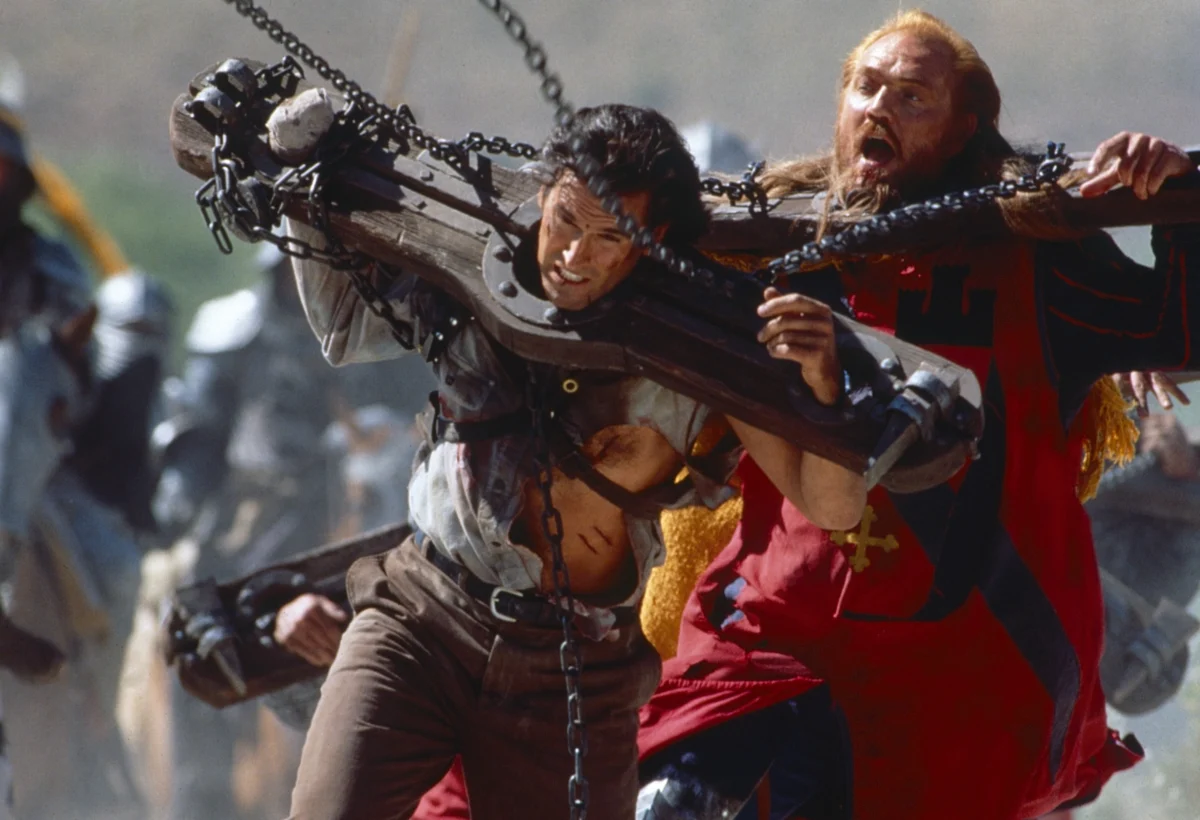
The Evil Dead franchise has long been celebrated as the "wild child" of horror cinema. Unlike its contemporaries—the rigid slasher logic of Halloween or the dreamscape rules of A Nightmare on Elm Street—Sam Raimi’s creation has always prioritized stylistic experimentation over narrative consistency. At the heart of this identity lies the 1993 cult classic Army of Darkness. While once viewed as a bizarre, slapstick-heavy outlier, the film is experiencing a critical renaissance. This renewed interest is driven by the upcoming release of Sébastien Vaniček’s Evil Dead Burn, a project that reportedly leans into the "Wise Men" lore established in Raimi’s medieval epic.
As the franchise continues to evolve through the hands of new visionary directors, Army of Darkness stands as the definitive blueprint for how a series can pivot from claustrophobic terror to grand-scale fantasy without losing its soul.

Main Facts: The Medieval Pivot and the ‘Wise Men’ Lore
Army of Darkness serves as the third installment in Sam Raimi’s original trilogy, following 1981’s The Evil Dead and 1987’s Evil Dead II. However, it represents a seismic shift in tone and scope. Produced by Universal Pictures with a budget of roughly $11 million—nearly triple that of its predecessor—the film moved the protagonist, Ash Williams (Bruce Campbell), from a remote cabin in the woods to the 14th century.
The Significance of the ‘Wise Men’
In the context of the current Evil Dead revival, the most pertinent element of the 1993 film is the introduction of the "Wise Men." These characters—monastic scholars and sorcerers who possess knowledge of the Necronomicon Ex-Mortis (the Book of the Dead)—provide the historical and mystical scaffolding for the entire series. In Army of Darkness, the Wise Men are the ones who recognize Ash as the "Prophesied One" and task him with retrieving the book to save humanity.

Reports surrounding Sébastien Vaniček’s Evil Dead Burn suggest a return to this deeper mythology. By name-dropping the Wise Men, the new film acknowledges that the Deadite threat is not merely a localized haunting but a trans-temporal plague. This connection bridges the gap between the gritty, urban horror of 2023’s Evil Dead Rise and the high-fantasy absurdity of Raimi’s earlier work.
Chronology: From Indie Horror to Studio Blockbuster
The journey to Army of Darkness was fraught with creative and legal hurdles, reflecting the chaotic energy of the films themselves.

1981–1987: The Cabin Years
The franchise began as a low-budget exercise in "splatter" horror. The Evil Dead was a grueling, serious-minded film that gained notoriety as a "video nasty." By the time Raimi secured funding for Evil Dead II, he began incorporating the Three Stooges-inspired slapstick that would become his trademark. Evil Dead II famously ended with a cliffhanger, showing Ash being sucked through a temporal vortex and landing in the Middle Ages.
1993: The Universal Experiment
Originally titled Medieval Dead, the project was renamed Army of Darkness by Universal Pictures to appeal to a broader audience who might not have seen the first two films. Co-written by Sam and his brother Ivan Raimi, the film abandoned the "R" rating of its predecessors for a more accessible PG-13 (though unrated versions exist). This transition marked Raimi’s first major foray into the studio system, testing his ability to maintain a singular vision while managing a larger crew and complex visual effects.

2013–Present: The Modern Era
After a long hiatus, the franchise was rebooted by Fede Álvarez in 2013, focusing on a hyper-violent, "straight" horror approach. This was followed by the Starz series Ash vs Evil Dead and Lee Cronin’s Evil Dead Rise. Each iteration has grappled with the legacy of Army of Darkness, alternating between the film’s campy humor and the original’s nihilistic dread.
Supporting Data: Technical Innovation and the ‘Campbell’ Factor
The enduring appeal of Army of Darkness is rooted in two primary factors: the physical genius of Bruce Campbell and the film’s commitment to "tactile" special effects.

The ‘Bugs Bunny’ of Horror
Bruce Campbell’s performance as Ash Williams in Army of Darkness is often cited as one of the greatest physical comedy displays in cinema history. Critics have frequently compared his performance to a live-action cartoon.
- Elasticity: Campbell’s ability to contort his face—eyes bulging, mouth stretching—allows him to sell the film’s most ridiculous moments, such as being attacked by "Mini-Ashes" or having a skeleton’s hand shoved up his nose.
- The Anti-Hero: Unlike the traditional "final girl" or stoic hero, Ash is arrogant, incompetent, and frequently the architect of his own misfortune. This vulnerability makes the character relatable despite his "Chosen One" status.
A Tribute to Ray Harryhausen
Technically, Army of Darkness is a love letter to the history of cinema. Raimi utilized the Introvision front-projection process, which allowed actors to interact with miniature sets and pre-shot footage with a level of depth that traditional blue-screens could not achieve.

- Stop-Motion Skeletons: The "Deadite Captain" and his skeleton army were a direct homage to the work of legendary animator Ray Harryhausen, specifically the sword-fighting skeletons in Jason and the Argonauts (1963).
- Budgetary Efficiency: Despite the $11 million budget, the film looks significantly more expensive due to Raimi’s inventive use of perspective and practical props. In an era dominated by airless, digital CGI, the "gritty and raw" texture of Army of Darkness remains a breath of fresh air for genre purists.
Official Responses: Critical Reception and Director Philosophy
Upon its release in February 1993, Army of Darkness received a polarized response. While many fans embraced the tonal shift, some critics were baffled by the transition from horror to "fantasy-comedy."
Initial Reviews vs. Legacy
The New York Times at the time noted that the film was "so busy being clever that it forgets to be scary." However, over the subsequent three decades, the film has achieved a 75% "Fresh" rating on Rotten Tomatoes, with modern critics praising its "unbridled imagination."

Sam Raimi has often spoken about his philosophy of "the sandbox." He views the Evil Dead universe not as a rigid narrative to be followed, but as a stylistic playground. "We never really cared about the continuity," Raimi has stated in various retrospectives. "We cared about whether the audience was having a good time and if we were pushing the camera in new ways."
The New Guardians
Sébastien Vaniček and Lee Cronin, the directors of the most recent installments, have both expressed that they were given "creative carte blanche" by Raimi and Campbell (who now serve as executive producers). This hand-off approach ensures that while the films may look different, they inherit the "audacity" of Army of Darkness.

Implications: The Future of the ‘Evil Dead-Verse’
The legacy of Army of Darkness suggests that the Evil Dead franchise is uniquely positioned to survive the "franchise fatigue" currently plagueing Hollywood. By establishing that the series can exist in any time period and take on any tone, Raimi has created a "limitless" IP.
Redefining the Blockbuster
Raimi’s ability to balance populist appeal with "weird" genre choices in Army of Darkness paved the way for his later success with the Spider-Man trilogy. It proved that a director could maintain a "cult" sensibility while working within the studio system.

The ‘Burn’ Connection
As Evil Dead Burn approaches, the return to the "Wise Men" lore implies a new era of world-building.
- Lore Expansion: We may finally see the origins of the three different volumes of the Necronomicon (hinted at in Army of Darkness).
- Genre Blending: Vaniček’s background in high-tension, textured horror (seen in Infested) suggests he will attempt to marry the "cerebral" nature of his style with the "unserious" history of Raimi’s medieval world.
- The "King" Returns: While Bruce Campbell has retired from playing Ash in live-action, the character’s shadow looms large. The "Wise Men" connection keeps the door open for Ash’s legend to influence new protagonists, ensuring the "Hail to the King" mantra remains relevant.
In conclusion, Army of Darkness is no longer just the "weird" sequel. It is the foundational text that gave the Evil Dead franchise the permission to be anything it wants to be. Whether the series heads into the future or further into the past, it does so on the chiseled, blood-splattered shoulders of the 1993 classic.
 Lina Hope
 Asep Darmawan
 Jia Lissa
