

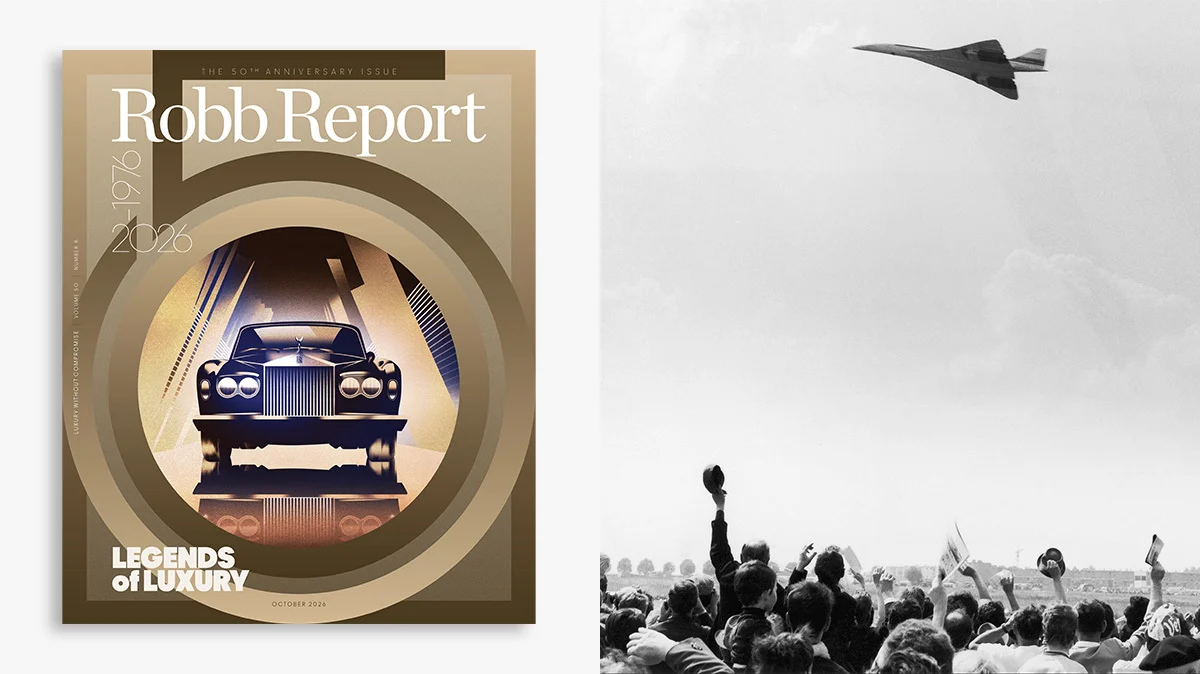
As anniversaries go, the alignment is almost poetic. On January 21, 1976—the exact year Robb Report was founded—the Concorde began ferrying commercial passengers across the Atlantic at twice the speed of sound. While the supersonic jet was shrinking global geography, a specialized, ambitious new publication was quietly stepping onto the scene to chronicle the emerging frontiers of daring, high-end ingenuity.
Fast-forward five decades. To mark its golden jubilee, Robb Report has turned the lens inward and backward for its monumental October 2026 issue. At the heart of this milestone edition is a sprawling retrospective entitled "Legends of Luxury." The feature sifts through 74 defining objects, people, places, and cultural milestones that have not only defined the wealthy lifestyle over the last fifty years, but also mapped the contours of the modern world.
Yet, looking back at these transformative innovations reveals a deeper, more compelling narrative: the luxury of yesterday has an uncanny habit of becoming the necessity of tomorrow.
Main Facts: The Evolution of Elite Indulgence
The premise of "Legends of Luxury" is simple yet expansive: examine the items and experiences that changed how humanity communicates, dresses, travels, dines, and chases thrills. Far from being mere baubles of the ultra-wealthy, many of these selections were the vanguard of technological, cultural, and structural shifts that eventually cascaded down to the broader public.
From the dawn of cellular communication to the deconstruction of tailoring, the list highlights how avant-garde concepts transitioned from exclusive status symbols to ubiquitous modern standards. The retrospective also serves as a humbling reminder of the unpredictable nature of forecasting. For every innovation that quietly revolutionized daily existence, there were grand predictions that spectacularly missed the mark—and speculative fads that burned brightly before turning to ash.
Chronology: Milestones That Shaped Modern Luxury
To understand how modern opulence has evolved, one must look at the timeline of disruption. The past fifty years can be neatly charted through the emergence of distinct paradigm shifts:

- 1976: Robb Report is founded, sharing its birth year with the commercial debut of the Concorde, which cut transatlantic travel times down to roughly three and a half hours. Concurrently, designers like Giorgio Armani began dismantling the rigid structures of the traditional European suit.
- The Late 1970s to Early 1980s: High fashion undergoes a quiet revolution as Armani strips away structured shoulders and stiff trouser creases, creating a louche yet sophisticated silhouette that Hollywood quickly embraced.
- 1984: The commercial mobile phone market is officially upended with the release of the Motorola DynaTAC 8000X. Weighing nearly two pounds and costing close to $4,000 (roughly $12,000 in today’s currency), "The Brick" becomes the ultimate power accessory for Wall Street titans and pop-culture icons alike.
- The Late 1990s to Early 2000s: Culinary arts enter a scientific renaissance. At El Bulli in Spain, chef Ferran Adrià pioneers molecular gastronomy, utilizing scientific principles to shatter and rebuild diner expectations of taste, texture, and presentation.
- 2003: The super-yacht paradigm is redefined with the delivery of Octopus. Commissioned by the late Microsoft co-founder Paul Allen and built by Lürssen, the 414-foot vessel merges supreme luxury with blue-water expedition capabilities, transforming private yachts from floating sun-decks into genuine exploratory vessels.
- Present Day: The magazine celebrates its 50th anniversary by re-featuring the Rolls-Royce Silver Shadow—the star of Robb Report’s inaugural 1976 cover—bringing five decades of luxury publishing full circle.
Supporting Data: The Economics and Metrics of Disruption
Examining the numbers behind these historical luxury milestones reveals just how drastically accessibility and valuation have shifted over the decades.
- The Price of Connection: When Motorola launched the DynaTAC 8000X in 1984, its $3,995 price tag restricted ownership to a hyper-exclusive tier of executives and celebrities. Adjusted for inflation, that early brick of a phone cost the equivalent of roughly $12,000 USD today—far exceeding the price of the most maxed-out, titanium-bodied flagship smartphones available on the market right now.
- The Scale of Exploration: Paul Allen’s Octopus shattered traditional sizing and operational limits for private vessels at 414 feet, proving that billionaires were no longer satisfied merely cruising the Mediterranean. This single vessel catalyzed a multi-billion-dollar global market for explorer yachts, which now populate the order books of nearly every major custom shipyard.
- The Concorde Economics: Operating at Mach 2, the Concorde could cross the Atlantic in approximately 3.5 hours. Though commercially retired in 2003 due to high operational costs, shifting airline economics, and the tragic 2000 crash, it remains a benchmark for ultra-high-speed transit that modern supersonic startups (like Boom Supersonic) are still trying to resurrect.
- The Editorial Full Circle: The original 1976 debut of Robb Report featured the Rolls-Royce Silver Shadow on its cover—a vehicle that epitomized mid-70s engineering, coachbuilt prestige, and traditional craftsmanship. Fifty years later, that same automotive legacy is being re-evaluated through the lens of modern electrification and sustainable ultra-luxury.
Official Perspectives and Reflections from the Editors
Reflecting on half a century of curating the high life brings a distinct sense of humility, according to the editors behind the anniversary issue. Compiling "Legends of Luxury" was initially envisioned as a nostalgic exercise—a chance to reminisce about the golden age of elite consumption. However, the process quickly evolved into a study of cultural foresight.
"When we started putting together ‘Legends of Luxury,’ we knew we wanted to celebrate the occasion with a sprawling retrospective," the editorial team noted. "But sifting through history revealed something more interesting. Many of the 74 objects, people, places, and experiences we chose hinted at the world that was coming—one that would change how we communicate, dress, travel, dine, or chase a thrill."
At the same time, the publication is refreshingly candid about the perils of crystal-ball gazing. The editorial retrospective does not shy away from past miscalculations, offering a humorous nod to the industry’s historical blind spots.
"It would be tempting to say we knew this would be the outcome all along," editors confessed. "But none of it looked quite so obvious at the time. As it turns out, predicting the future is much easier in hindsight. We know firsthand: We once declared the internal-combustion engine dead. It is, as you may have noticed, very much alive."
Similarly, the editors acknowledged that speculative manias are nothing new, pointing out how quickly certain "inevitable" cultural touchstones—such as the digital craze surrounding Bored Ape Yacht Club NFTs—can vanish as rapidly as they arrived. "The future humbles us all," they wrote.

Implications: Where Luxury Goes From Here
What do fifty years of chronicling the pinnacle of human achievement teach us about the trajectory of wealth, taste, and innovation?
The primary takeaway is the fluid, cyclical nature of luxury itself. In the modern era, the trajectory of high-end goods almost always follows a predictable arc: what begins as an exorbitant, wildly impractical novelty for the ultra-wealthy eventually trickles down, scales in production, and morphs into an indispensable utility for the masses.
- The Democratization of Technology: The Motorola DynaTAC proved that portability is the ultimate currency. What was once a heavy, two-pound status symbol for Gordon Gekko archetypes is now a lightweight glass rectangle carried by billions of people across every socioeconomic stratum.
- The Evolution of Style and Comfort: Giorgio Armani’s deconstructed suits taught the fashion world that true elegance does not require physical discomfort. By stripping away stiff canvas interlinings, he anticipated a modern professional world that increasingly prioritizes relaxed, versatile tailoring over rigid formality.
- Experiential Over Material Wealth: The launch of vessels like Octopus signaled a fundamental shift in ultra-high-net-worth psychology. Accumulating static assets—like parked yachts or seaside villas—took a back seat to active exploration. Today’s luxury consumer increasingly values remote, transformative experiences, propelling the market for adventure travel and ice-class expedition yachts.
- The Culinary Avant-Garde: Ferran Adrià’s molecular gastronomy demonstrated that even traditional industries like fine dining must continually self-disrupt. While early imitators turned foam and liquid nitrogen into culinary clichés, the overarching ethos—treating the kitchen as a laboratory of sensory surprise—permanently elevated global culinary standards.
As Robb Report looks ahead to its next half-century, the fundamental ethos of the publication remains unchanged. In twenty years, one of the extravagant novelties featured in the current anniversary issue may be as commonplace as the smartphone is today. Another may vanish entirely, leaving behind only a conceptual blueprint that outlives its physical iteration.
The editors offer no definitive predictions on which modern extravagances will endure and which will fade into historical footnotes. But after fifty years of watching the horizon, they remain anchored by one immutable truth:
Every so often, the future shows up first disguised as a luxury. And the pursuit of what comes next remains as intoxicating as ever. Here’s to the next fifty.
 Muslim
 Nana
Nana
 Raul Delapena Setiawan
