

Main Facts
Venice has long been a city of cinematic illusions, hidden canals, and historic palazzos that whisper tales of bygone centuries. Yet, even against this backdrop of timeless theatricality, the debut of the Orient Express Venezia marks a watershed moment for luxury hospitality in the Floating City.
If cultural iconoclast Peggy Guggenheim and rock-and-roll royalty Elton John were to collaborate on a hotel, the result would likely mirror this maximalist masterpiece. Located in the historic and vibrant district of Cannaregio, the Orient Express Venezia is a 47-room sensory overload—a lavish love letter to Venetian craftsmanship that trades minimalist restraint for an unapologetic celebration of color, texture, and history.
Following a painstaking, eight-year restoration and reimagining, the historic cotton-candy-pink Palazzo Doná Giovannelli—originally built in the 1400s—has been transformed into one of Europe’s most talked-about new hotels. The property’s architectural bones are nothing short of monumental. Boasting a rare double frontage onto two separate canals, the palazzo is packed with historical holdovers from its centuries as a noble residence, including priceless freschi, intricate mosaics, and soaring ceilings.
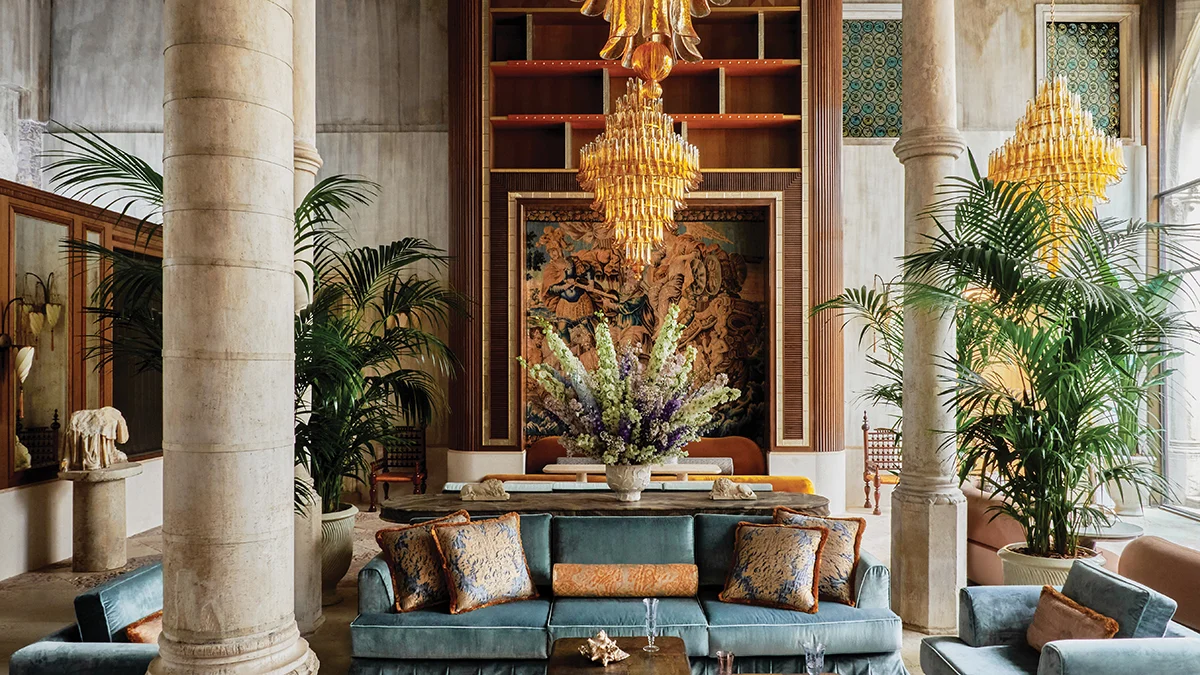
Helmed by visionary designer Aline Asmar d’Amman—whose celebrated portfolio includes Paris’s legendary Hôtel de Crillon—the hotel is layered with custom elements. Guests are surrounded by custom-commissioned Bevilacqua textiles, hundreds of hand-blown Murano-made chandeliers, and historical remnants that blend seamlessly with modern, high-octane luxury.
Beyond its striking aesthetic, the property offers world-class culinary destinations, including an upscale restaurant spearheaded by Michelin-starred chef Heinz Beck, the all-day dining venue La Casati (named in honor of the eccentric aristocrat Luisa Casati, who once owned the building that now houses the Peggy Guggenheim Collection), and the Art Deco-tinged Wagon Bar, which subtly nods to the legendary railway history of the Orient Express brand.
Chronology: The Eight-Year Evolution of Palazzo Doná Giovannelli
The transformation of the Palazzo Doná Giovannelli from a decaying noble home into a crown jewel of modern hospitality was an exercise in extreme patience, architectural precision, and artistic vision.

- The 15th Century: Palazzo Doná Giovannelli is constructed along the canals of Cannaregio, serving as a stately home for Venetian nobility. Over the centuries, it passes through various aristocratic hands, accumulating layers of artistic wealth, including classical frescoes and mosaic floors.
- The Mid-20th Century: The palazzo becomes intertwined with Venetian cultural lore, briefly owned by eccentric figures like the Marchesa Luisa Casati, a legendary patron of the arts whose lavish lifestyle defined an era of European high society.
- The Mid-2010s (circa 2016–2018): Plans are solidified to breathe new life into the historic structure. Accor and Orient Express acquire the property, envisioning a flagship hotel that marries the romance of the legendary train line with the permanence of a Venetian palazzo. Architect and interior designer Aline Asmar d’Amman is brought on board to lead the massive restoration.
- 2018–2025 (The Eight-Year Restoration): A multidisciplinary team of historians, master artisans, and conservationists spend nearly a decade peeling back centuries of wear. Structural reinforcements are delicately balanced with the preservation of fragile freschi, double-frontage canal access points, and historical stone masonry. Artisans recreate authentic fabrics using centuries-old looms, while Murano glassblowers craft bespoke lighting fixtures.
- Late 2025 / Early 2026 (The Debut): The Orient Express Venezia officially opens its doors to the public, introducing 47 ultra-luxurious guest rooms and suites, including six signature suites on the piano nobile, marking a new era for tourism in the Cannaregio district.
Supporting Data & Architectural Breakdown
To understand the scale of the Orient Express Venezia is to examine its intricate design metrics, historical preservation efforts, and strategic positioning within Venice.
Property Overview & Architectural Highlights
- Total Key Count: 47 guest rooms and suites.
- The Signature Suites: Located on the expansive and historically significant piano nobile, the six signature suites range in size up to an astonishing 1,560 square feet.
- The Colori Persi Suite: Named in tribute to the faded, atmospheric, and nearly lost color palettes that define traditional Venetian art and architecture.
- The Cherubini Suite: Anchored by an original Sebastiano Santi frieze depicting playful cherubs, complemented by a monumental, mid-century 1950s chandelier designed by master architect Carlo Scarpa.
- Common Areas: Described by design critics as wandering through an elaborate opera set. Features include multi-room frescoed ceilings, a glittering gilded ballroom, mosaic-tiled floors, and a showstopping octagonal staircase designed for dramatic grand entrances.
- Artisanal Collaborations: Hundreds of custom Murano glass chandeliers illuminate the property, alongside bespoke woven textiles from the historic Venetian fabric house Bevilacqua.
Culinary & Beverage Offerings
- Fine Dining: Headed by renowned Michelin-starred culinary maestro Heinz Beck, offering high-concept gastronomy that bridges Italian tradition with contemporary flair.
- La Casati: An all-day dining destination paying homage to Luisa Casati, the avant-garde muse and aristocrat.
- The Wagon Bar: An intimate, Art Deco-inspired cocktail lounge designed as a direct nod to the golden age of luxury train travel.
Location Advantage
- Cannaregio Setting: Situated far enough from the crushing tourist masses of St. Mark’s Square to offer privacy, yet within easy walking distance of Venice’s primary cultural landmarks.
- Accessibility: Located a short, effortless water taxi ride from Venice’s main railway station, positioning it directly adjacent to the arrival points of the upcoming Orient Express La Dolce Vita train fleet, creating a seamless rail-to-hotel luxury transit ecosystem.
Official Responses and Curatorial Insights
The launch of the property has drawn intense commentary from the design and hospitality sectors, highlighting the tension between rigorous historical preservation and theatrical modernity.
Lead designer Aline Asmar d’Amman reflected on the emotional weight of working within a centuries-old Venetian structure. In statements surrounding the property’s unveiling, d’Amman emphasized that the interiors were conceived as a "lavish love letter to the city," designed not to overpower the building’s historic bones, but to engage in an ongoing dialogue with them.
"Wandering the common areas is like meandering through an elaborate opera set," notes the design team. "From frescoed ceilings and gilded ballrooms to mosaic-tiled floors and a showstopping octagonal staircase that’s irresistibly sashay-ready, every corner is crafted to evoke an emotional response."
Hospitality analysts have also praised the strategic decision to plant the Orient Express flag in Cannaregio rather than crowding the heavily saturated waterfronts surrounding the Hotel Danieli or forcing guests into total seclusion on the island of Giudecca, home to the Belmond Hotel Cipriani.
By choosing a discreet canal-front location in Cannaregio, Orient Express has curated a sanctuary that feels entirely integrated into the authentic fabric of Venetian neighborhood life, while remaining utterly invisible to the casual tourist walking past its double-fronted canal gates.

Implications: A New Benchmark for Venetian Luxury Tourism
The opening of the Orient Express Venezia carries significant implications for the future of luxury travel, real estate development, and tourism management in Venice.
1. Shifting the Tourist Footprint
For decades, luxury tourism in Venice has been hyper-concentrated around St. Mark’s Square, the Riva degli Schiavoni, and select island outposts. By establishing a world-class, ultra-luxury flagship in Cannaregio—historically a more residential, authentic, and less congested district—Orient Express is actively encouraging high-net-worth travelers to explore a different side of the city. This move could catalyze high-end commercial and cultural investment in northern Venice, diffusing foot traffic away from fragile historical bottlenecks.
2. The Synergy of Rail and Hospitality
The timing of the hotel’s debut directly coincides with the launch of the Orient Express La Dolce Vita train, which will soon bring elite travelers straight into Venice’s railway station via a newly minted luxury fleet. The integration of high-end rail travel with a destination palazzo hotel creates a closed-loop luxury ecosystem. Guests can step off a vintage-inspired luxury train and onto a private water taxi, gliding directly to the canal doors of Palazzo Doná Giovannelli without ever navigating the chaotic public vaporetto lines.
3. Raising the Bar for Historic Restoration
The eight-year timeline of the Palazzo Doná Giovannelli project underscores a growing industry trend: ultra-luxury travelers no longer want sterile, modern cookie-cutter hotels wrapped in historic facades. They demand profound historical authenticity paired with unbridled creative expression. The success of d’Amman’s maximalist vision proves that contemporary luxury consumers are increasingly drawn to narrative-driven design—spaces that tell a distinct, culturally resonant story, blending the artistic legacy of Renaissance Venice with the theatrical glamour of 20th-century design icons.
 Muslim
 Nana
Nana
 Evan Lee Salim
