

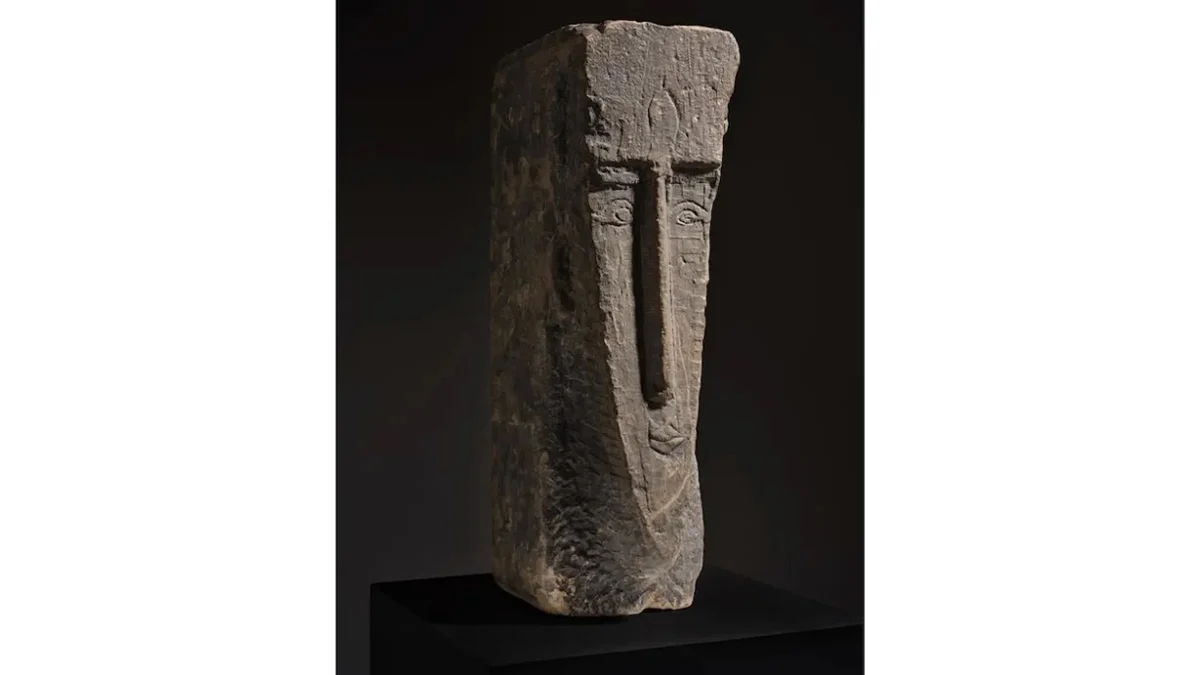
NEW YORK — Capitalizing on a powerful wave of international market momentum for the Italian modernist, auction house Phillips has announced it will bring a rare, museum-quality limestone sculpture by Amedeo Modigliani to its marquee New York evening sales this November.
Titled Tête and executed between 1911 and 1912, the monumental three-dimensional work carries a pre-sale estimate of $28 million to $35 million. If the sculpture achieves a price within or above this lofty range, it will instantly cement its status as one of the most expensive sculptural works by the artist ever to cross the auction block.
While Amedeo Modigliani is universally celebrated as a titan of 20th-century painting—best remembered for his sensuous, elongated portraits of female nudes featuring iconic, almond-shaped eyes—his sculptural output is exceedingly rare. During his tragically short and turbulent lifetime, Modigliani produced an estimated 28 sculptures in total. Today, only 26 of those physical works are known to survive, with the vast majority safely housed within the permanent collections of elite international cultural institutions, ranging from New York’s Metropolitan Museum of Art to the prestigious Tate network in the United Kingdom.
The arrival of Tête at Phillips represents a major coup for the auction house, which is positioning the piece as the crown jewel of its autumn auction calendar. It also serves as a critical bellwether for the high-end art market, testing whether institutional-grade masterpieces can continue to command astronomical figures amid evolving global economic landscapes.
Chronology of a Masterpiece: From Parisian Bohemianism to Private Seclusion
To fully understand the significance of Phillips’s upcoming offering, one must look back at the brief and intense period during which Modigliani focused his creative genius on stone and chisel.
The Sculptural Years (1909–1914)
Born in Livorno, Italy, in 1884, Amedeo Modigliani moved to Paris in 1906, immersing himself in the bohemian art scene of Montmartre and Montparnasse. Although he initially arrived in the French capital with aspirations as a painter, his encounter with African tribal art, ancient Greek Cycladic figures, and Khmer sculpture—fostered in part by his close friendship with the Romanian sculptor Constantin Brâncuși—fundamentally shifted his artistic trajectory.
Between roughly 1909 and 1914, Modigliani devoted a significant portion of his creative energy to sculpture. Working primarily in stone—often commandeering soft limestone blocks intended for construction sites or pilfering materials from building yards—he envisioned an ambitious architectural installation of primitive, totem-like heads meant to be displayed together as a "pillar of tenderness."
Tête (1911–1912) is a quintessential product of this fertile period. Carved directly from a substantial block of limestone, the sculpture showcases Modigliani’s signature aesthetic: a remarkably slender, elongated face defined by a long, straight nose, pursed lips featuring a tiny, enigmatic smile, and deeply recessed eye sockets that once held the ghosts of ancient gazes.
Half a Century in Private Hands
The subsequent history of Tête reads like a provenance dream for fine art collectors. The sculpture has spent the past half-century quietly residing within the same important private collection. The work last changed hands publicly in 1972, meaning its upcoming appearance in New York marks its first true "fresh to the market" debut in over fifty years.
Auction houses covet works with long private residencies because they eliminate market fatigue—a phenomenon where collectors grow tired of seeing the same piece repeatedly recycled through salesrooms over short periods. The decades-long dormancy of Tête ensures it will attract intense competitive bidding from elite collectors and institutional acquisitions committees alike.
Supporting Data: Modigliani at Auction and the Sculptural Benchmark
While a $28 million to $35 million price tag is undeniably staggering, it occupies a fascinating middle tier within the broader ecosystem of Modigliani’s market history.
The Rare Sculptural Market
Sculptures by Modigliani rarely appear at public auction because so few were ever made and even fewer remain in private hands. When they do surface, they command extraordinary sums.
- 2010 (Christie’s, New York): Another rare limestone head by the artist shattered expectations when it sold for $52.8 million. At the time, this transaction set an all-time record for any work by Modigliani, proving that the market valued his rare sculptural output just as fiercely as his celebrated canvases.
- 2019 (Christie’s, New York): A subsequent limestone Tête was brought to the block, realizing a solid $34.3 million.
Phillips’s current estimate of $28 million to $35 million for its iteration places it squarely in line with historical precedents for the artist’s carved stone heads, though the high-end estimate leaves ample room for a dramatic bidding war that could push the final realization past the 2019 benchmark.
The Painting Records: A Different Stratosphere
While Modigliani’s sculptures command tens of millions of dollars, his paintings operate in an entirely different financial stratosphere. The undisputed crown jewel of the artist’s market remains his 1918 masterpiece Nu couché (Reclining Nude). Sold at Christie’s in 2015, the monumental canvas achieved a breathtaking $170.4 million, making it one of the most expensive artworks ever sold at public auction in human history.
Thus, while Phillips’s Tête is a monumental offering for the sculpture market, it sits comfortably below the nine-figure valuations associated with his major canvases.
Official Responses and Expert Commentary
Art market leaders and auction house specialists have been quick to praise the upcoming sale, framing Tête not merely as a high-value commodity, but as a critical piece of art-historical heritage.
Jeremiah Evarts, Phillips’s Deputy Chairman of the Americas and Senior International Specialist, spoke directly to the profound gravity of the consignment in an official statement released by the house.
"Fresh to the market after over half a century in the same important private collection, Tête embodies everything that makes Modigliani’s sculpture so revered, including its profound art historical importance," Evarts noted, unhesitatingly labeling the piece a true "masterpiece."
Although Phillips has maintained strict confidentiality regarding the identity of the consignor—respecting the privacy of the estate or private collector who acquired the work in 1972—art market insiders have noted that the decision to consign the sculpture to Phillips (rather than the traditional duopoly of Christie’s or Sotheby’s) represents a major coup for the challenger auction house. It signals Phillips’s growing capacity to successfully court and secure top-tier, museum-quality consignments for its marquee evening sales.
Market Implications: Riding the European Wave to New York
Phillips’s aggressive valuation of Tête is not an isolated gamble; rather, it is a calculated bet designed to surf a surging wave of renewed market enthusiasm for Modigliani over the past twenty-four months.
Recent European Milestones
Over the last two years, Modigliani’s market has experienced a powerful resurgence across European salesrooms, demonstrating robust collector demand that auctioneers are now eager to channel toward the North American market:
- Paris (2025): At a Christie’s sale in the French capital, a striking portrait by Modigliani obliterated expectations by selling for $31.3 million—tripling its pre-sale high estimate and establishing an all-time record for the artist within France.
- London (Early 2026): Earlier this year at Sotheby’s in London, a classic painting of a nude woman originating from the collection of billionaire Joe Lewis went under the hammer. The canvas achieved a spectacular $63.5 million, setting a brand-new benchmark for Modigliani within the European market as a whole.
Implications for the November New York Sales
The success of these European auctions signaled to major houses that collector appetite for Modigliani’s signature blend of modernist abstraction and sensual humanity remains insatiable. By bringing Tête to New York this November, Phillips is strategically positioning itself to capture the liquidity of global wealth looking for safe-haven assets in blue-chip fine art.
If Tête achieves or exceeds its $35 million upper estimate, it will validate the strength of the sculpture market and reinforce the narrative that rare, investment-grade antiquities and modern masterworks remain largely insulated from broader economic uncertainties. More importantly, it will demonstrate that Phillips is a formidable contender in the high-stakes world of marquee evening sales, capable of securing and successfully marketing some of the rarest cultural treasures of the 20th century. As the November sales approach, the international art world will be watching closely to see if this limestone visionary can once again captivate the room and command a king’s ransom.
 Nana
Nana
 Evan Lee Salim
 Raul Delapena Setiawan
