

By Olivia Tauber
Published September 9, 2026
Main Facts
Apple’s highly anticipated "Surprise and shine" keynote event delivered a monumental paradigm shift for the world’s most valuable technology company, officially introducing its long-rumored entry into the foldable smartphone market: the iPhone Duo. Priced starting at a steep $1,999, the device represents Apple’s boldest hardware gamble in years.
During the polished, highly choreographed corporate presentation at Apple Park, the iPhone Duo was depicted as an impossibly seamless piece of engineering. However, once the keynote concluded and tech journalists, prominent creators, and early testers got their hands on actual production units, the reality of the hardware began to take shape.

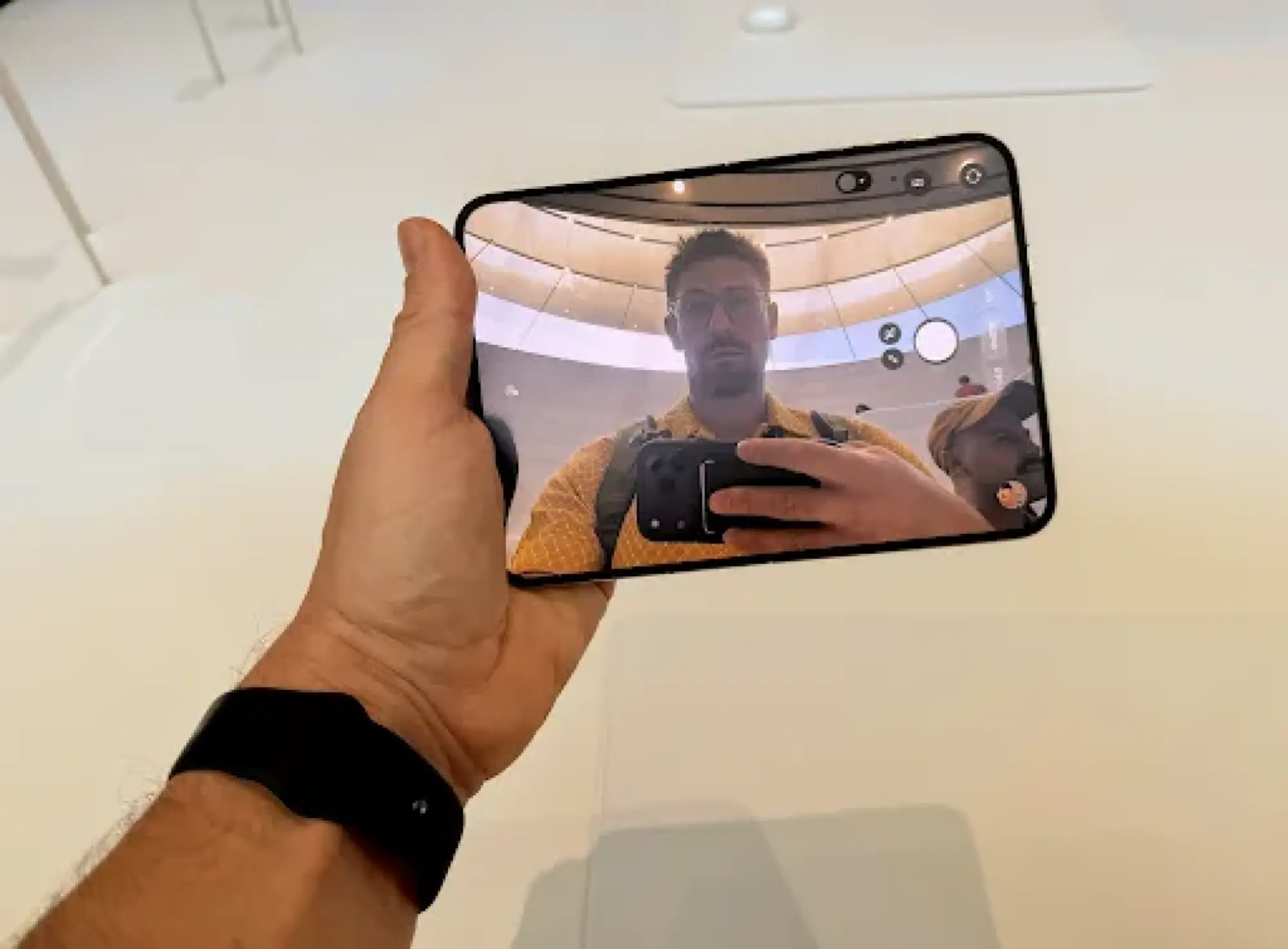
Early physical impressions reveal a device that is remarkably thin, features rapid software adaptation as the screen changes orientation, and handles multitasking with fluid grace. Yet, despite Apple’s engineering feats, the hands-on period also exposed the undeniable physical laws of foldable displays: the center crease, while remarkably subtle, is still visible under specific lighting conditions. Early testers including Mashable’s Senior Editor Stan Schroeder, tech creator Max Weinbach, iJustine (Justine Ezarik), streamer IShowSpeed, journalist Geoff Keighley, and Gizmodo Senior Editor Ray Wong have provided the public with its first unfiltered look at how the iPhone Duo performs in everyday scenarios.
Chronology
The journey toward the iPhone Duo’s hands-on debut has been years in the making, marked by relentless industry speculation, patent filings, and supply chain rumors.
- Years Prior to 2026: Competitors like Samsung, Google, and OnePlus iterate through multiple generations of book-style and flip-style foldables. Meanwhile, Apple remains notably absent from the category, quietly filing patents for hinge mechanisms, ultra-thin glass, and crease-minimization technology.
- Morning of September 9, 2026: Apple hosts its "Surprise and shine" keynote event at Apple Park in Cupertino, California. CEO Tim Cook and his executive team formally unveil the iPhone Duo, emphasizing its bespoke hinge architecture, dual-screen capabilities, and a hefty $1,999 starting price tag.
- Afternoon of September 9, 2026: The presentation concludes, and the Steve Jobs Theater hands-on area opens to invited media and content creators. Journalists and influencers swarm the demo tables to test the folding mechanics, camera systems, and application transitions.
- Late September 9, 2026: Social media platforms—particularly X (formerly Twitter), YouTube, and TikTok—flood with live-streams, short-form video clips, and hands-on reviews from creators like IShowSpeed, Max Weinbach, and iJustine, showcasing everything from gaming performance to hinge durability.
- October 23, 2026 (Upcoming): The official commercial release date when pre-ordered units will begin arriving in the hands of everyday consumers worldwide.
Supporting Data & Technical Specifications
While complete teardowns and laboratory benchmarks are still forthcoming, early documentation and hands-on observations have outlined the core specifications defining the iPhone Duo:

- Price: Starting at $1,999 USD, placing it firmly in the ultra-premium tier alongside maxed-out traditional flagships and specialized productivity devices.
- Internal Display: A sprawling 7.6-inch foldable OLED inner panel designed for immersive media consumption, split-screen multitasking, and expansive gaming experiences.
- External Display: A secondary outer screen that functions as a conventional, highly responsive smartphone interface when the device is closed.
- Hinge and Profile: Early testers noted an impressively slim profile when unfolded, rivaling non-folding smartphones in thickness. The proprietary multi-angle hinge allows the phone to stay propped open at various degrees, enabling unique tripod-free camera framing and tabletop viewing modes.
- Camera System: Features an advanced configuration paired with software that cleverly utilizes both the inner and outer displays for high-definition selfie previews and dual-perspective framing.
Official Responses and Creator Reactions
The initial reactions from the tech community at Apple Park ranged from unbridled awe to practical skepticism, highlighting a deep fascination with how Apple has chosen to approach the foldable form factor.
Max Weinbach took to social media to declare the iPhone Duo the "bar none best foldable," expressing genuine shock at the quality of the device’s under-display camera technology. "I wasn’t expecting that," Weinbach noted, praising Apple’s implementation for hiding hardware elements that often look pixelated or intrusive on competing devices.
Content creator iJustine (Justine Ezarik) focused her demonstrations on media consumption and user interface fluidity. Ezarik used the device to watch vertical video feeds on Netflix’s "Clips" feature as well as standard cinematic content like Wednesday, illustrating how the 7.6-inch interior real estate adapts to varying aspect ratios. Her hands-on clips emphasized how comfortable and compact the device feels when held with two hands in its fully opened state.

YouTube streamer IShowSpeed provided an energetic, unscripted look at the device during a live-stream from the event floor. His continuous, rapid-fire folding and unfolding of the Duo captured the raw curiosity of mainstream consumers, drawing massive engagement from chat participants who watched the hardware undergo immediate, heavy-duty stress testing.
Journalist Geoff Keighley focused heavily on software continuity, highlighting the sleek, stutter-free animations that trigger when transitioning content from the large inner tablet display down to the outer cover screen. Several tech commentators noted that what Apple showed in promotional videos translated surprisingly well to real-world performance.
However, not all feedback was universally glowing. Gizmodo Senior Editor Ray Wong provided a more grounded, analytical assessment. By filming the device from multiple angles under direct overhead lighting, Wong revealed a subtle vertical crease running down the center of the 7.6-inch panel.

"Can definitely see the screen crease at certain angles," Wong observed. While online commentators quickly pointed out that physics still dictates some degree of surface refraction on folding glass, the observation grounded consumer expectations: Apple has built a remarkable foldable, but it has not broken the laws of material science entirely. Other critics drew historical comparisons to Microsoft’s defunct Surface Duo or Nintendo handhelds, questioning how third-party app developers will handle the unique aspect ratio over the long term.
Implications for the Mobile Industry
The launch of the iPhone Duo and the subsequent early hands-on reactions carry profound implications for the global smartphone market:
- Validation of the Foldable Category: For years, companies like Samsung, Motorola, and Huawei pioneered and built the foldable market, but Apple’s entry serves as ultimate validation. By planting its flag in the $1,999 category, Apple instantly legitimizes foldables as a mainstream, long-term consumer electronics category rather than a temporary tech novelty.
- Pressure on Competitors: Rival Android manufacturers will now face intense pressure to refine their own hinge durability, crease minimization, and software-ecosystem continuity. Google and Samsung will likely accelerate their software optimization pipelines to compete with Apple’s seamless display-switching animations.
- The Rise of "Tablet-Phone" Hybrids in Daily Life: As creators like iJustine and Geoff Keighley demonstrated, the ability to effortlessly pivot from a pocketable daily driver to a mini-tablet for multitasking—such as running Pokémon Go alongside social feeds or viewing emails in a dual-pane layout—will redefine how power users interact with mobile software.
- Price and Accessibility Barriers: At $1,999, the iPhone Duo remains an exclusive luxury item. Its success will test whether early adopters are willing to pay a massive premium for Apple’s iteration of foldable technology, potentially setting the pricing baseline for future generations of flexible iPhones.
As consumers await the official retail release on October 23, 2026, the early consensus from Apple Park is clear: Apple’s first foldable is an ambitious, visually stunning, and surprisingly polished piece of engineering. While physical realities like the center crease remain, the iPhone Duo has successfully proven that Apple is ready to bend the rules of smartphone design.
 Nana Wu
 Neng Nana
 Reynand Wu
