

Main Facts: A Semiotic Intervention in the Heart of Manhattan
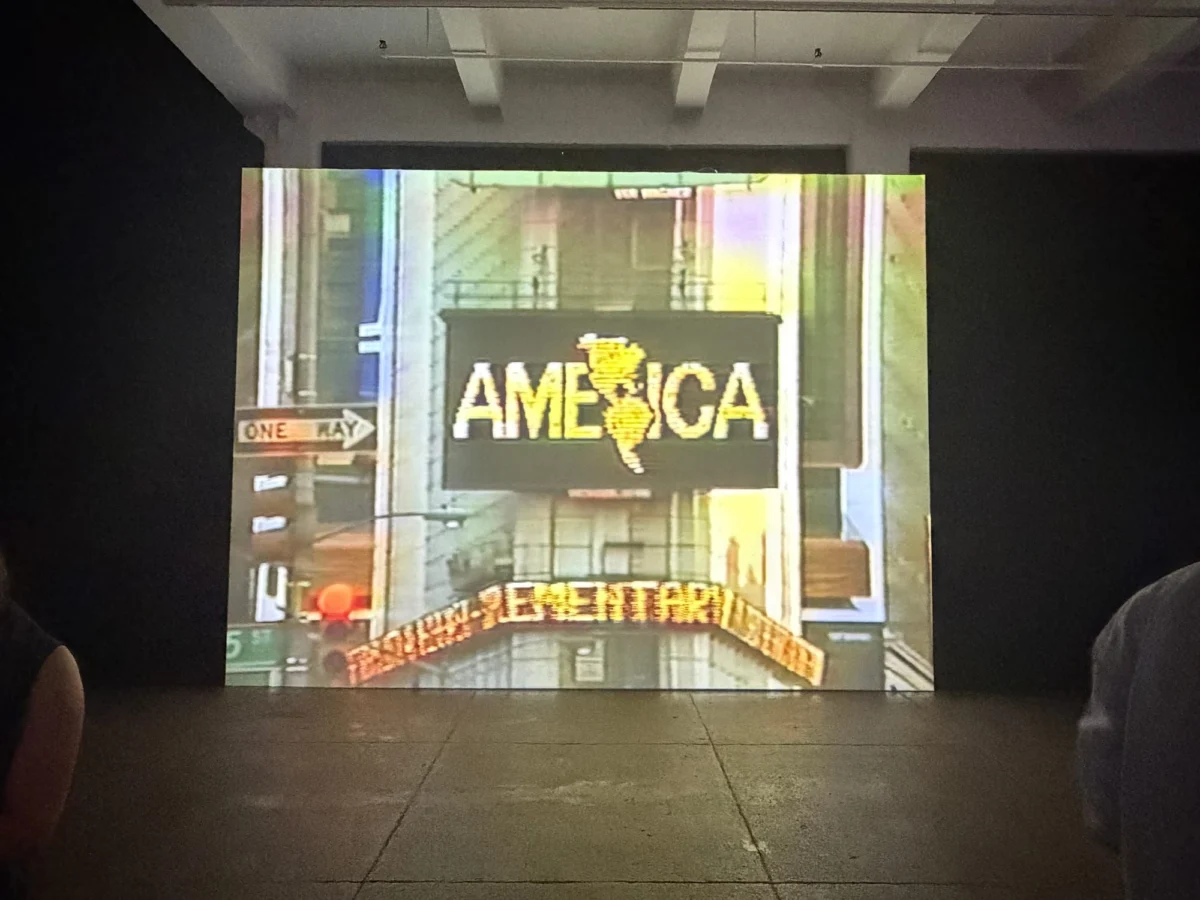
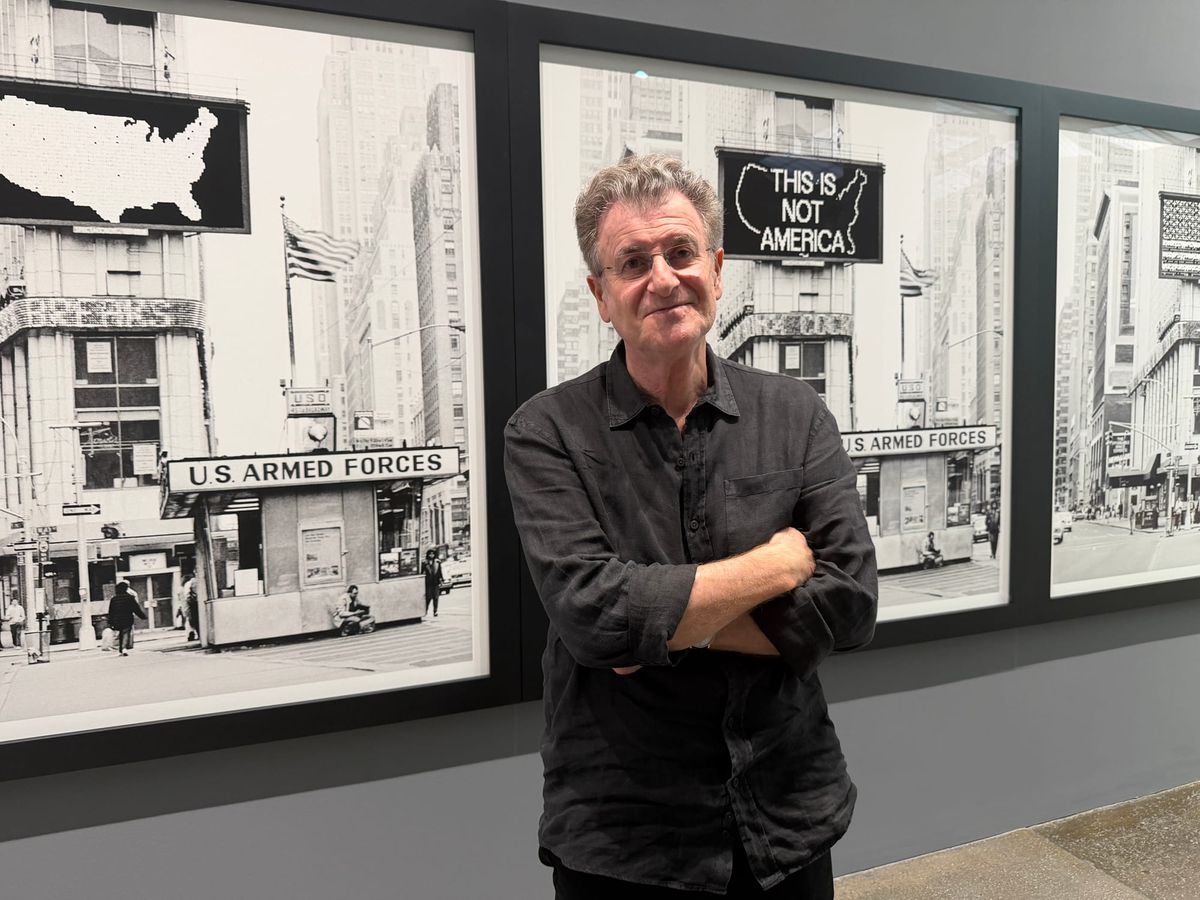
In April 1987, at the height of the Reagan administration’s aggressive foreign interventions and geopolitical posturing, a relatively unknown 31-year-old Chilean artist named Alfredo Jaar unleashed a quiet yet seismic disruption onto the commercial landscape of New York City. Nestled incongruously among blinking neon advertisements for tomato sauce and local eateries in Times Square, a 42-second LED animation beamed a provocative, unambiguous message into the night: “This Is Not America,” superimposed boldly over the silhouette of the United States.
The sequence continued, flashing an image of the U.S. flag alongside the declaration, “This Is Not America’s Flag.” Finally, the letter “R” in the word “America” fluidly expanded, transforming into a vibrant, unified map representing South, Central, and North America.
Almost four decades later, Jaar’s seminal work remains a masterclass in political conceptual art. Originally conceived as a localized linguistic correction against American exceptionalism and linguistic imperialism, A Logo for America has transcended its 1980s origins. It has evolved into a recurring barometer for political tensions across the Western Hemisphere.
As the United States marks its 250th anniversary—and amid a contemporary political climate marked by aggressive nationalist rhetoric and the localized renaming of geographic landmarks—Jaar’s installation has returned to New York for a landmark exhibition at Galerie Lelong. The show not only honors the 1987 installation but forces a modern reckoning with geography, colonialism, and the persistent habit of conflating a single nation with an entire hemisphere.
Chronology: The Evolution of a Conceptual Masterpiece
To understand the weight of A Logo for America, one must trace its path from an expatriate’s cultural shock to its recurring appearances during moments of profound geopolitical friction.
1982–1986: Exile and the Discovery of Linguistic Ignorance
Alfredo Jaar arrived in New York City in 1982, having fled the oppressive military dictatorship of Augusto Pinochet in Chile. Stepping into the cultural epicenter of the Western world, Jaar was immediately struck by a linguistic quirk woven into everyday American parlance: the habitual use of phrases like "God bless America" and "Welcome to America" to denote exclusively the United States.
When Jaar gently corrected acquaintances by asking, "You mean the United States?" the typical response was a blank stare or a stubborn, "No, America, America." For Jaar, trained as an architect rather than a traditional fine artist, this revealed a profound systemic ignorance regarding geography and shared continental identity.
April 1987: The Times Square Debut
Granted an unexpected opportunity to produce a public project in Times Square in 1986, Jaar seized the platform. In April 1987, his 42-second LED animation went live. Far from being embraced as high art, the intervention confused and occasionally infuriated commuters. When National Public Radio (NPR) interviewed passersby about the flashing message, one bewildered pedestrian famously declared of the art piece: "This is illegal."
2014: A Midnight Revival
Decades after its debut, the installation caught a second wind. In 2014, the piece briefly returned to the towering screens of Times Square for a single minute at midnight. The Guardian dedicated a two-page spread to the revival, framing it through a modern lens as an "anti-Trump sign"—a characterization Jaar notes completely bypassed his original, purely semiotic intentions.
2016: The Miami Beach Barge
During Donald Trump’s first presidential campaign in 2016, the artwork took to the water. Played on massive video screens mounted on a barge off the coast of Miami Beach, the installation served as a direct visual counter-protest against xenophobic rhetoric directed at Latin American immigrants.
Present Day: The 250th Anniversary and Galerie Lelong
Now, as the United States approaches its semiquincentennial (250th) anniversary, and amid fresh waves of populist nationalist posturing—including rhetorical and physical rebrandings like the "Gulf of America"—A Logo for America has returned to Manhattan. Hosted at Galerie Lelong, the retrospective pairs the original 1987 LED animation and initial sketches with historic precursors, most notably Joaquín Torres-García’s 1943 conceptual masterpiece, Inverted America, which inspired Jaar decades prior.
Supporting Data: Art, Advertising, and Audience Reception
Jaar’s choice of medium was never accidental. Trained in architecture, he bypassed traditional gallery spaces in favor of the public square—a methodology he honed during the height of censorship in Pinochet’s Chile, where he asked citizens public questions like “¿Es usted feliz?” (Are you happy?) to simulate democratic discourse under authoritarian rule.
By commandeering the infrastructure of advertising—a medium engineered for psychological conditioning and mass persuasion—Jaar turned corporate capitalism’s tools against itself.
- Duration: 42 seconds of animation time per loop in Times Square.
- Geographic Scope: Encompassing 35 sovereign nations across North, Central, and South America, home to over one billion people.
- Exhibition Lineage: Traveling from 1987 Times Square to international biennials, a 2014 midnight reprise, a 2016 Miami Beach water protest, and the current 2026 Galerie Lelong showcase in Manhattan.
Official Responses and Public Discourse
The public reception of A Logo for America has consistently reflected the broader sociopolitical anxieties of the United States.
When the work first flickered to life in 1987, the establishment largely viewed it as an eccentric, if harmless, annoyance. Yet, the visceral discomfort expressed by ordinary citizens—such as the NPR interviewee who deemed the geographical correction "illegal"—highlighted an insular American worldview that viewed the rest of the hemisphere as a peripheral afterthought.
Over the decades, institutional responses have shifted. Curators, international press outlets, and human rights advocates have increasingly co-opted Jaar’s imagery to push back against U.S. hegemony, border enforcement policies, and cultural imperialism.
Despite the artwork being interpreted through various political lenses over the past 40 years, Jaar maintains that his initial motivation was fundamentally linguistic rather than partisan. In a recent interview at the Galerie Lelong installation, Jaar reflected on his ongoing mission:
"I was not thinking about the larger political issues; I was just trying to change the language: This is not America. America is a continent. But then, the work picked up and had a life of its own and I completely lost control over it."
Implications: What Does It Mean to Be "American" Today?
As the United States celebrates its 250th year of independence, the questions raised by Alfredo Jaar in 1987 carry an urgent, renewed resonance. In an era where political figures routinely weaponize nationalist nomenclature—renaming natural bodies of water to project territorial dominance and tightening ideological borders—the assumption that "America" belongs exclusively to the United States remains deeply entrenched.
Jaar’s exhibition at Galerie Lelong is more than a nostalgic nod to 1980s New York; it is a critical intervention into modern chauvinism. By placing Torres-García’s Inverted America alongside Jaar’s glowing LEDs, the exhibition challenges viewers to flip their mental maps and expand their geopolitical imaginations.
When asked whether he believes art can change the world after decades of bearing witness to global injustices, Jaar remains clear-eyed yet steadfast:
"We cannot change the world, but we can show it can be different."
In a political landscape dominated by rigid borders and linguistic exclusion, A Logo for America continues to carve out a vital space for imagination, reminding us that the Americas comprise a vast mosaic of nations, cultures, and peoples who refuse to be erased by a single possessive pronoun.
 Muslim
 Evan Lee Salim
 Jia Lissa
