

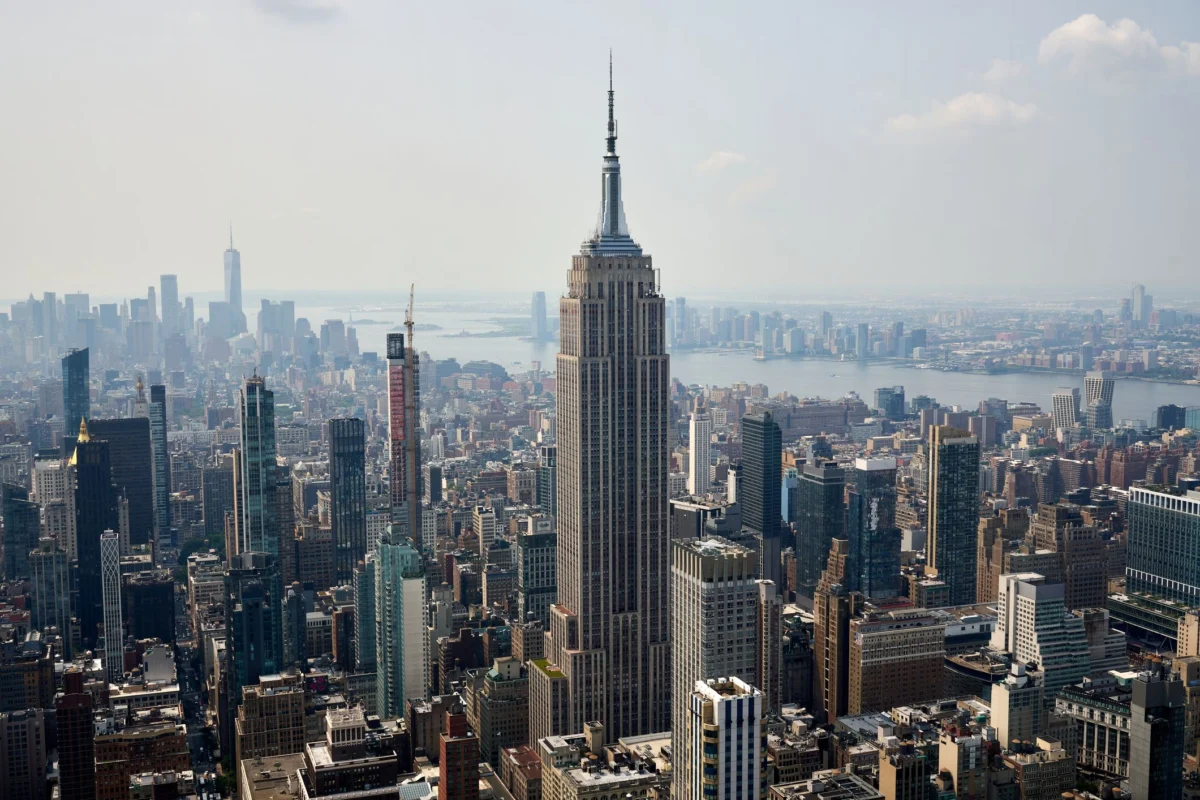
For many, the act of travel is incomplete without a vertical pilgrimage. There is a distinct, almost spiritual orientation that occurs when one stands above a city, tracing the veins of streets and the clusters of neighborhoods from a bird’s-eye perspective. Whether it is the historic rooftops of Barcelona’s Casa Milà or the spiraling heights of Copenhagen’s Round Tower, these elevated vantage points transform a foreign landscape into a legible map.
Despite having resided in the New York metropolitan area for over half a decade, I found myself—until this past autumn—among the ranks of locals who had never ascended to the summit of the Empire State Building. It is a peculiar phenomenon: the monuments we live closest to are often the last ones we choose to explore. Yet, on a crisp September morning, I finally made my way to 350 Fifth Avenue to confront the skyscraper that has served as the visual anchor of my life for years.
The Art Deco Titan: Main Facts and Legacy
The Empire State Building is far more than a tourist trap; it is a definitive monument of 20th-century ambition. Designed by the architectural firm Shreve, Lamb & Harmon, the 102-story Art Deco masterpiece was completed in 1931. Its construction remains a marvel of efficiency, having been erected in just 13 months—an average of 4.5 stories per week—during the height of the Great Depression.
Standing at a total height of 1,454 feet, the building held the title of the world’s tallest structure for nearly 40 years, only surrendering that distinction to the North Tower of the World Trade Center in 1970. Today, while it sits as the eighth-tallest building in New York City, it remains the most iconic silhouette in the skyline. It serves as a functional office hub for over 150 companies, including major players like LinkedIn, Workday, and Expedia, proving that the tower is as much a living workspace as it is a cultural artifact.
Beyond its architectural pedigree, the building is a cornerstone of American pop culture. It has appeared in over 250 films and television programs, most notably in the 1933 classic King Kong. Since 1976, when it first illuminated its spire in red, white, and blue to celebrate the U.S. Bicentennial, it has become a beacon of civic expression, lighting its upper tiers to commemorate holidays, seasonal events, and social causes.
A Chronology of Construction and Evolution
The history of the Empire State Building is a narrative of rapid industrial progress. Work commenced in early 1930, following the demolition of the Waldorf-Astoria Hotel. Despite the economic fragility of the era, the project employed thousands of workers, many of whom are immortalized in archival photography as "sky boys," balancing on steel beams with precarious ease.
- 1930: Construction begins, setting a blistering pace for the era.
- 1931: The building officially opens on May 1st, with President Herbert Hoover turning on the lights from Washington, D.C.
- 1970: The World Trade Center surpasses the Empire State Building in height.
- 1976: The first light show marks the beginning of the iconic spire-lighting tradition.
- 2019: The building undergoes a massive $165 million renovation, modernizing the visitor experience with revamped 2nd and 80th-floor exhibits and a reimagined 102nd-floor observatory.
This multi-year renovation was crucial to maintaining the building’s relevance in a city that now offers high-altitude competition from modern structures like One World Observatory and The Edge at Hudson Yards. The current iteration of the experience focuses on storytelling, guiding guests through the history of the building’s construction before whisking them toward the heavens.
Insider Data: Logistics and Visitor Strategy
The Empire State Building is located in the heart of Midtown Manhattan, with a dedicated visitor entrance at 20 West 34th Street. It is highly accessible via public transit, situated within walking distance of Penn Station, Port Authority, and an array of subway lines including the 1, 2, 3, A, C, E, and N, Q, R, W trains.
Ticket Tiers and Accessibility
The building operates 365 days a year, regardless of weather. Tickets are categorized by the height of access:

- 86th Floor Observatory: Starting at approximately $46, this remains the classic experience, offering an open-air deck protected by historic metal railings.
- 102nd Floor Observatory: For roughly $81, visitors gain access to the climate-controlled indoor deck. This is a superior choice for inclement weather, offering unobstructed, glass-enclosed views that often extend to six states: New York, New Jersey, Pennsylvania, Connecticut, Massachusetts, and Delaware.
Official Guidance and Expert Tips
According to Dan Rogoski, Senior Vice President and Observatory General Manager, the move toward timed ticketing has been the most significant improvement for guest flow. "We strongly recommend that guests purchase tickets in advance on our official website to secure their preferred date and time," Rogoski notes, "particularly during holidays and peak periods like sunset."
However, for those with flexible itineraries, same-day tickets are often available. During my visit on a Monday at 10 a.m., kiosks offered immediate availability for the next time slot, proving that "Flex" or "Express" skip-the-line add-ons are often unnecessary for weekday travelers.
The Experience: What to Expect
The visitor journey is designed to be immersive. After passing through security—which feels efficient and similar to airport screening—guests move to the second-floor museum. Here, the "NYC: Above and Beyond" exhibition stands out, featuring a massive, intricate mural by artist Stephen Wiltshire, who sketched the entire Manhattan cityscape from memory after a single 45-minute helicopter ride.
The ascent to the 86th floor is an experience in itself, with elevators that feel like time machines. Stepping onto the deck, the 360-degree vista is unparalleled. It is the only place in the city where you can look down at the Chrysler Building or gaze across to the Financial District.
If you are a planner, consider the "AM/PM" experience ticket, which allows for a daytime visit and a return trip at night. New York City at night is a fundamentally different beast; the grid of the city lights creates a golden tapestry that is arguably more enchanting than the daytime panorama. For early risers, the Sunrise Experience is a premium, albeit expensive, way to witness the city waking up before the general public is admitted.
Implications for the Modern Traveler
Is it worth the expense? In an era where "viewing platforms" are becoming a common feature of every new skyscraper in New York, the Empire State Building retains a distinct gravitational pull. It does not just offer a view; it offers a place in history.
The decision to visit should depend on your priorities. If you are an architecture enthusiast, the 2nd and 80th-floor exhibits are essential. If you are a photographer, the 86th-floor open-air deck is superior to the 102nd floor, as you will not have to contend with reflections on the glass.
Recommendations for Your Trip:
- Timing is Everything: Aim for the "sweet spot" between 1:00 p.m. and 4:00 p.m. on a weekday to avoid the heaviest tourist surges.
- Bundle for Savings: If your itinerary includes other landmarks, look into the New York CityPass or the New York Pass by GoCity. These can reduce the cumulative cost of entrance fees if you plan on hitting the Statue of Liberty or the Museum of Modern Art as well.
- Prepare for the Elements: Even in mild weather, the wind at the 86th-floor observatory is significantly stronger than at street level. Bring a light jacket, even in spring or fall.
- Embrace the Exit: Don’t rush through the gift shop. Take a moment to appreciate the original Art Deco lobby on your way out—it is a preserved landmark that features stunning gold leaf and aluminum designs, representing the height of 1930s luxury.
In conclusion, while the allure of the Empire State Building may seem cliché to those who walk its streets daily, the experience of standing at its summit is a rite of passage that justifies the ticket price. It provides a unique, clarifying perspective on the sheer scale and density of New York City, serving as a reminder that even in a city of millions, one can always find a moment of quiet, elevated reflection. Whether you are a first-time visitor or a long-time resident, the view from the top remains the definitive way to understand the heart of Manhattan.
 Asro
Asro
 Siti Muinah
