

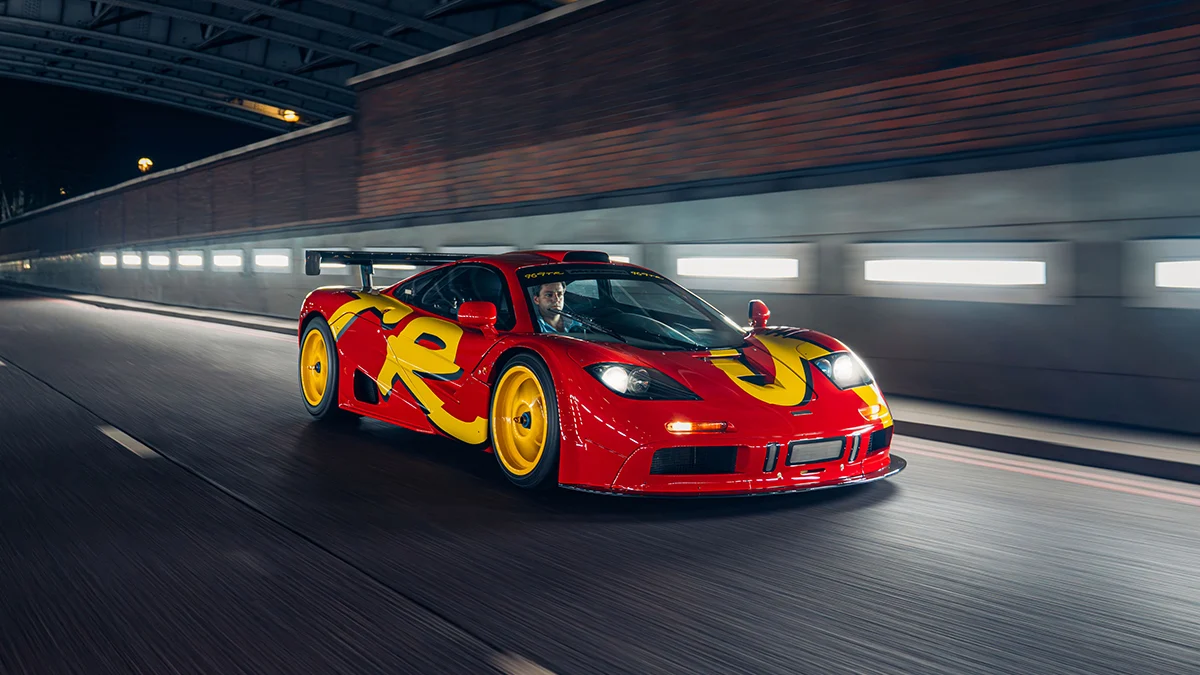
For decades, the rhythm section of Pink Floyd provided the heartbeat for some of the most influential music in history. Yet, for Nick Mason, the band’s iconic drummer, that rhythmic precision has long been mirrored by a different kind of mechanical pulse: the high-revving roar of a V-12 engine. Next month, at the prestigious RM Sotheby’s Monterey auction, the intersection of rock-and-roll royalty and automotive history will reach a fever pitch as Mason parts ways with his crown jewel—a 1996 McLaren F1 GTR that has been the centerpiece of his personal collection for nearly thirty years.
The Main Event: A Masterpiece of Engineering
The vehicle in question is not merely a supercar; it is a time capsule of 1990s motorsport dominance. Chassis no. 10R is a rare, Le Mans-spec machine that has been meticulously converted for road use by the craftsmen at McLaren. As it rolls onto the auction block in Monterey, industry experts and collectors alike are bracing for a record-breaking event. With a pre-auction estimate of "in excess of $35 million," this McLaren is poised to become the most expensive vehicle ever produced by the Woking-based marque, eclipsing the $25.3 million benchmark set by a 1994 McLaren F1 just last year.
The Chronology of a Legend
To understand the gravity of this sale, one must look back at the origins of the F1 GTR. When Gordon Murray designed the original McLaren F1, he created a road-going supercar that defied logic. However, the world of international racing was not content to let the F1 remain a pavement-bound legend. Following mounting pressure from motorsport teams eager to leverage the car’s unique central-driving-position architecture, McLaren began the development of the GTR in 1995.
The GTR variant was an immediate sensation. It burst onto the scene with a stunning overall victory at the 1995 24 Hours of Le Mans, proving that the road car’s architecture was superior to purpose-built prototypes. Over the next three years, McLaren produced only 28 examples of this hard-core racing machine.

Chassis no. 10R, Mason’s specific vehicle, holds a distinct place in this timeline. As the first of only nine examples produced in the 1996 model year, it remains one of only two short-tail body configurations in existence, the other being the historic 1995 Le Mans winner. Acquired by Mason directly from the automaker in 1999, the car has remained under his stewardship for twenty-six years, serving as a pillar of one of the world’s most respected private collections.
Supporting Data: Under the Hood of a Titan
The heart of the 10R is a masterpiece of German-British engineering: the BMW-sourced 6.0-liter V-12 engine. In its original racing configuration, this power plant was hampered by mandatory air restrictors designed to equalize competition under FIA regulations, resulting in an output of 591 horsepower.
However, the "road-legal" conversion process—conducted with surgical precision by McLaren—transformed the beast back into a usable, albeit ferocious, machine. By removing the air restrictors, the engineers unlocked the engine’s full potential, allowing it to breathe freely. Furthermore, the suspension was recalibrated to provide increased ground clearance for public roads, and the cockpit was updated with the addition of a passenger seat and mufflers to accommodate a more civilized driving experience. Despite these concessions, the car retains the raw, unadulterated spirit of a Le Mans champion.
What truly sets 10R apart, however, is its aesthetic identity. It is the only F1 GTR to feature a factory-applied livery, a bold, high-contrast scarlet and yellow design that draws its inspiration from the pop-art movement of the 1990s. This visual signature makes it one of the most recognizable and photographed supercars in the world.

Official Perspectives and Market Implications
The Monterey auction, scheduled to take place from August 12 to August 15 at the city’s convention center, is widely considered the "Super Bowl" of the collector car world. RM Sotheby’s has signaled that this lot represents a generational opportunity.
"When you talk about the holy grail of automotive collecting, you are talking about the McLaren F1 GTR," noted a senior representative from the auction house. "To have one with the provenance of Nick Mason, and the specific history of chassis 10R, creates a market dynamic that we rarely see. We are not just selling a car; we are selling a piece of music history, a piece of motorsport history, and arguably the finest example of the most important car ever built."
The market impact of this sale will likely be felt for years. With the previous record for a McLaren F1 standing at $25.3 million, a successful sale north of $35 million would represent a significant valuation jump for the brand’s most exclusive models. It confirms that in the world of high-end asset management, rare, competition-proven supercars are increasingly viewed as the equivalent of blue-chip fine art.
The Legacy of the Drummer’s Collection
For Nick Mason, selling the F1 GTR is not a decision born of necessity, but perhaps a recognition of the car’s status as a monument that deserves a new chapter. Throughout his tenure as its owner, Mason—a man who has spent his life surrounded by creative genius—has treated the car with the reverence one might afford a vintage drum kit or a classic guitar.

The car’s departure from his collection marks the end of an era. It serves as a reminder that the F1 was not just a supercar; it was a watershed moment in automotive design that closed the book on the 20th century while defining the possibilities of the 21st.
As the bidding begins in Monterey, the world will watch. Whether the final price reaches $35 million or beyond, the result will be more than just a transaction. It will be the final note in a long-standing performance by one of the world’s most dedicated automotive enthusiasts, leaving the lucky new owner with the keys to a machine that, much like Pink Floyd’s music, will never truly go out of style.
The Future of the F1 Market
What does this auction tell us about the future of investment-grade automobiles? The trend toward "provenance-heavy" assets is accelerating. Collectors are no longer simply looking for speed; they are looking for stories. The fact that a rock icon like Mason has cared for this car for nearly three decades adds an intangible layer of value that simply cannot be replicated by any modern hypercar.
As we look toward the Monterey sale, the industry is already buzzing with speculation. Will it be a private collector from the Middle East, a tech mogul from Silicon Valley, or a museum entity that secures the keys? Regardless of the buyer, the 1996 McLaren F1 GTR chassis 10R will continue its journey as a cultural icon, forever linked to the man who kept its engine running for a generation.

For those attending the auction, the opportunity to witness this sale in person is a rare privilege. For the rest of the world, it is a chance to watch as a piece of history finds its next home, continuing a legacy of performance that has resonated since the first time those tires hit the tarmac at Le Mans.
 Evan Lee Salim
 Asep Darmawan
 Laily UPN
